
Port Said
"The ships come through at night and their running lights look like a city moving slowly toward the sea."
The canal city at the northeastern tip of Egypt where ships pass between two seas and the wooden verandas of the colonial quarter lean over streets that smell of salt and history.

Port Said sits at the point where the Suez Canal meets the Mediterranean, and the effect of this geography on everything — the architecture, the food, the personality of the people, the specific smell of the waterfront — is total. I arrived by train from Mansoura and walked out of the station into a city that felt fundamentally different from the rest of the Delta. There is a breeze here that does not exist twenty kilometers inland. The buildings along the waterfront are largely nineteenth century, built when Port Said was a boom town of canal construction and international shipping — wide wooden verandas painted in fading greens and blues, projecting out over the streets in the manner of colonial ports from New Orleans to Hanoi. Some of them lean at angles that suggest structural conversations still being negotiated with gravity.
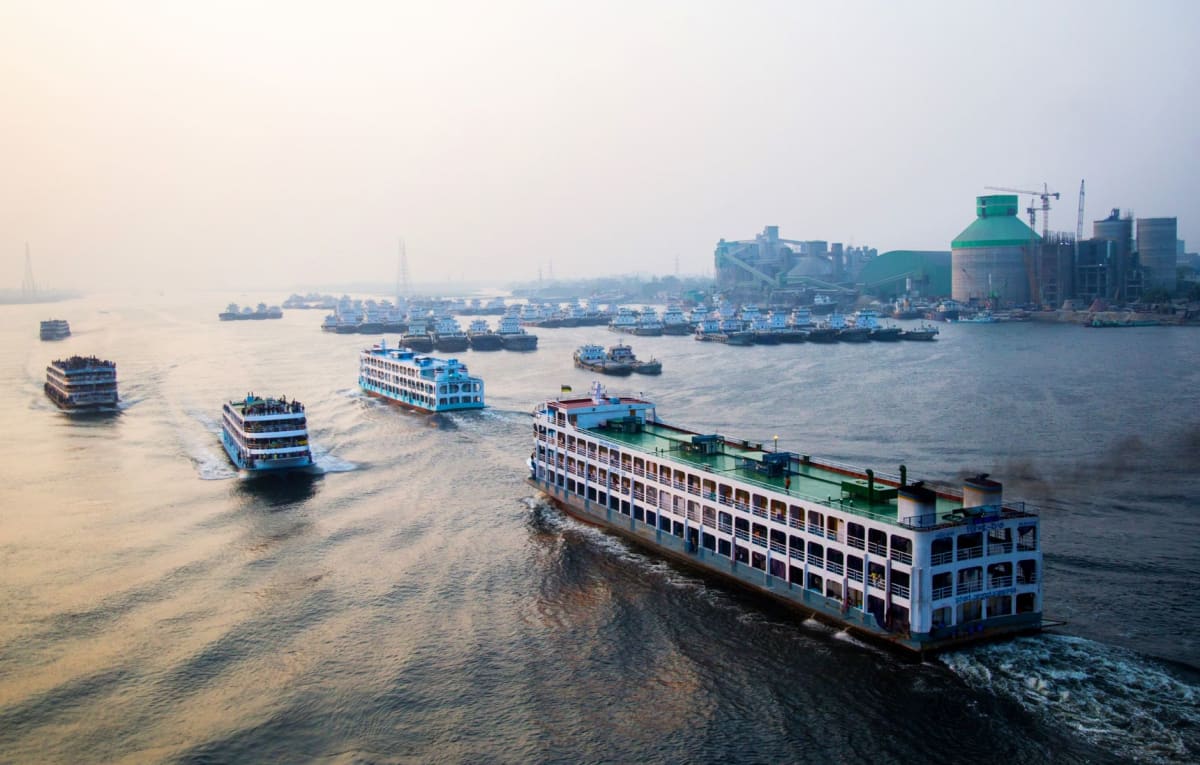
The canal is the thing that Port Said cannot escape and does not want to. Standing at the waterfront in the afternoon, I watched a fully loaded supertanker move through the channel at a walking pace — an object of impossible scale being very slowly threaded through an improbably narrow passage, the red Cypriot flag at its stern barely moving, the white wake spreading across the entire width of the canal. There is no good way to convey what this looks like from street level. The ship is simply too large for the eye to process as a ship. It reads as a building being relocated. I stood and watched it for twenty minutes and walked away and came back and watched some more. A man selling tea from a cart near me showed no interest whatsoever — he had been watching ships like this his entire life and had arrived at a reasonable relationship with their magnificence.
The old fishing quarter on the Mediterranean side of the city is narrow and salt-bleached and full of cats. The fishermen go out before dawn and are back by nine in the morning, and the catch — sea bream, bass, mackerel, various creatures I could not identify — is sold from crates on the dock by the men who caught it while their wives collect and mend the nets nearby. I bought a sea bream and took it to a small restaurant two streets back from the dock where they cooked it for me with cumin and coriander over charcoal, and it arrived with bread and a plate of sliced tomatoes and was the correct meal for that place and that morning.
In the evening, the canal-side promenade fills with families who come specifically to watch the ships pass. This is Port Said’s free entertainment, its civic ritual, its equivalent of the sunset walk. The ships go through day and night on a fixed schedule, and people consult this schedule the way others consult cinema listings. A family near me had brought a folding table and a thermos of tea and folded chairs and arranged themselves as if for a theatrical performance. The child among them narrated the passing tanker’s features to his grandfather with the authority of a small person who has decided he is an expert. The grandfather agreed with everything he said.
When to go: October through April. Port Said’s sea breezes make it more tolerable than inland Delta cities in shoulder season, but the summer heat is still fierce. December through February is the calmest and most beautiful period, when clear Mediterranean light falls hard and horizontal on the colonial facades.
Keep exploring
More from Nile Delta
 nile-delta
 Rosetta (Rashid)
The quiet Nile town where a stone changed everything and almost no one visits — Ottoman merchants' houses still stand with mashrabiyya screens over the river.
Explore nile-delta
 Sais (Sa el-Hagar)
A vanished capital in the western Delta, where a lake of lamps once burned for Neith and only silence remains.
Explore nile-delta
 Tanis
A sprawling, half-forgotten field of fallen colossi and royal tombs in the northeastern Delta — the city Hollywood made famous and almost nobody actually visits.
Explore nile-delta
 Tanta
The beating agricultural heart of the Delta, a cotton-and-clover city that erupts each October into Egypt's largest moulid — a million pilgrims and the smell of sugarcane.
Explore nile-delta
 Zagazig
The eastern Delta city built beside ancient Bubastis, where cats were sacred and the ruins of a great temple lie scattered among the traffic and cotton warehouses.
Explore nile-delta
 Abu Mena
A UNESCO early Christian pilgrimage site in the desert west of Alexandria where the ruins of a Byzantine basilica sink slowly back into the earth they rose from.
Explore