Through the Gate, Shutters Still Down
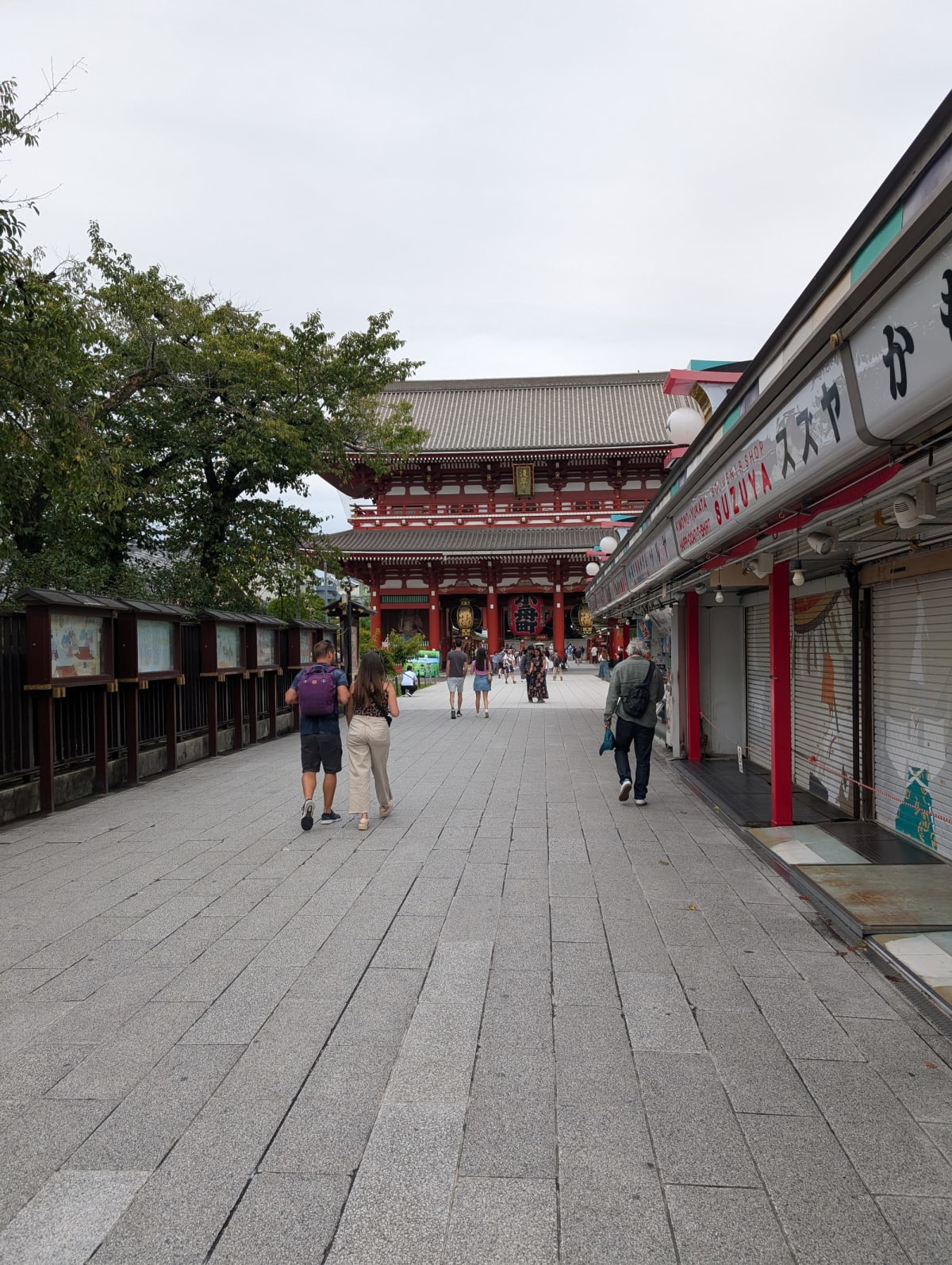
We got to Senso-ji on our first evening in Japan, jetlagged and running on the specific adrenaline of having just landed in a country neither of us had been to before. The Nakamise-dori stalls on either side of the approach were already closing for the night — half the shutters down, the wooden fencing lined with faded illustrated panels nobody was reading — and ahead of us the inner gate rose up anyway, red-lacquered and lit, indifferent to whether the souvenir shops around it were open or closed. Lia was a few steps ahead of me. Two older men in dress shirts walked past us in the other direction like this was a Tuesday commute, which, for them, it probably was. That contrast — a fifth-generation shopping street shutting down for the night next to a temple that has never really closed in fourteen hundred years — was the first thing that told me this place operates on more than one clock at once.
The Prayer Nobody Was Performing For
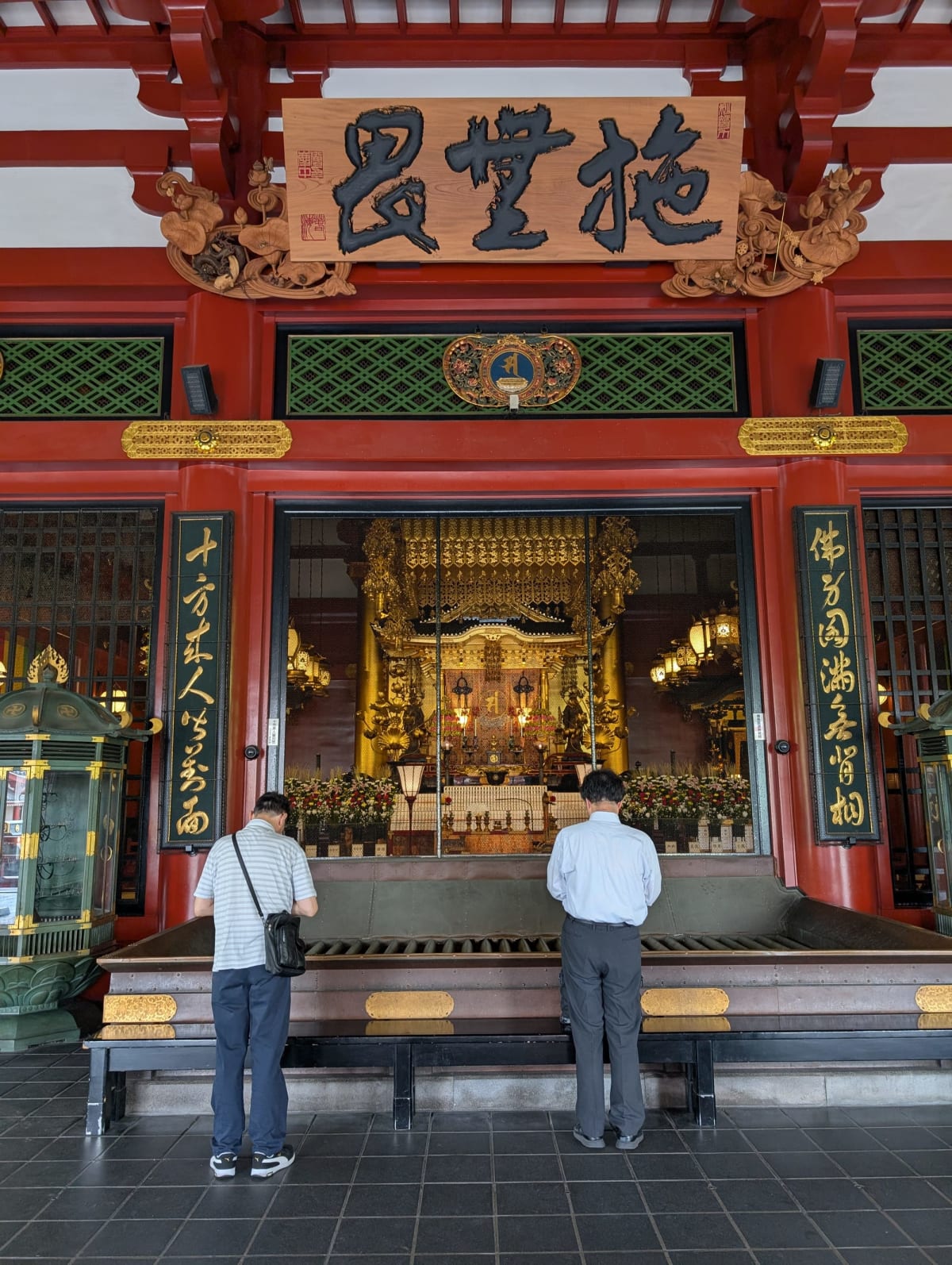
Inside, past the incense and the crowd funneling toward the main hall, I watched two men — strangers to each other, as far as I could tell, just two guys who happened to arrive at the altar rail at the same moment — stand in front of the golden inner shrine and bow, quiet and unhurried, for longer than the flow of foot traffic really allowed for. Nobody around them was performing anything. No phones out, no group photo, just two people doing the thing the building was built for, while a few meters behind them a river of tourists kept moving toward the exit. I’d expected the actual religious function of Senso-ji to have been pushed out entirely by the gift shops and the crowd control ropes. It hadn’t. It had just been compressed into whatever space people were willing to make for it, which turned out to be enough.
The View Lia Kept Coming Back To
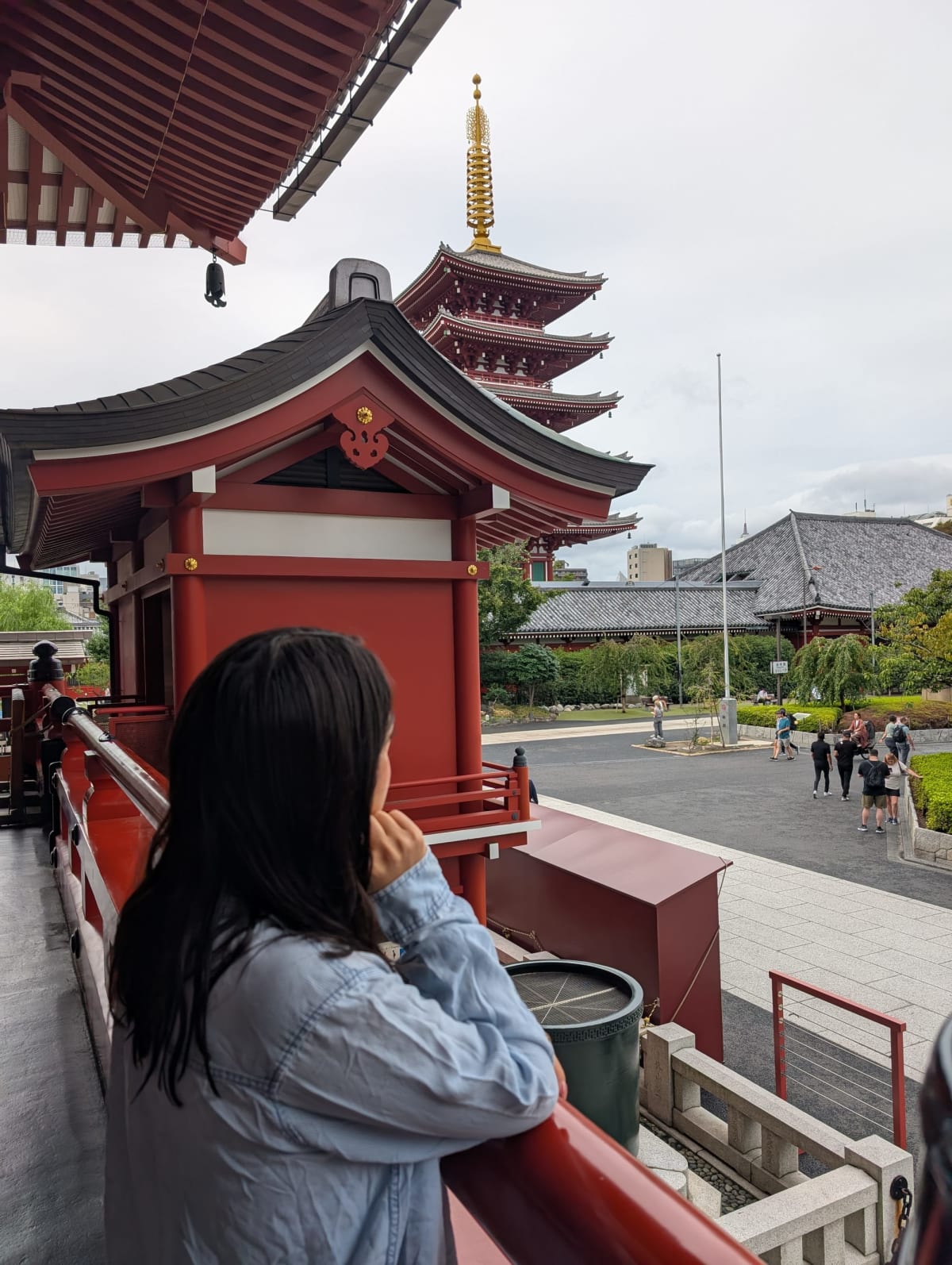
Lia found a spot on the elevated walkway near one of the side halls and stayed there a while, leaning on the red railing, watching the five-story pagoda over the rooftops while a slow current of tourists moved through the plaza below. I took the photo without her noticing, which is usually how the better ones happen. She wasn’t taking a picture of the pagoda herself. She was just looking at it, in the specific way you look at something once you’ve stopped trying to capture it and started actually seeing it — which, on a trip where we photographed almost everything, was rarer than it should have been.
Posing for the Postcard Version
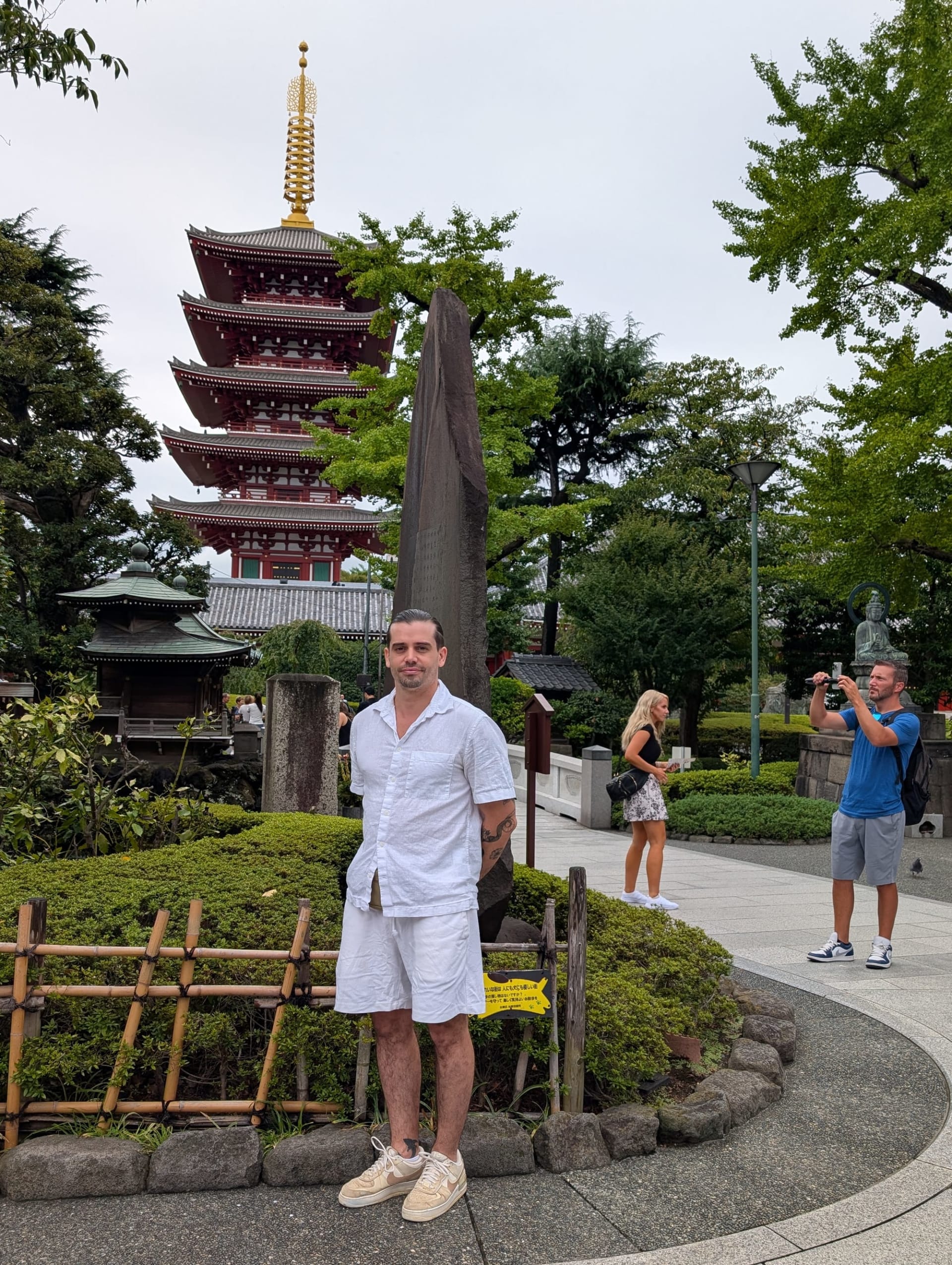
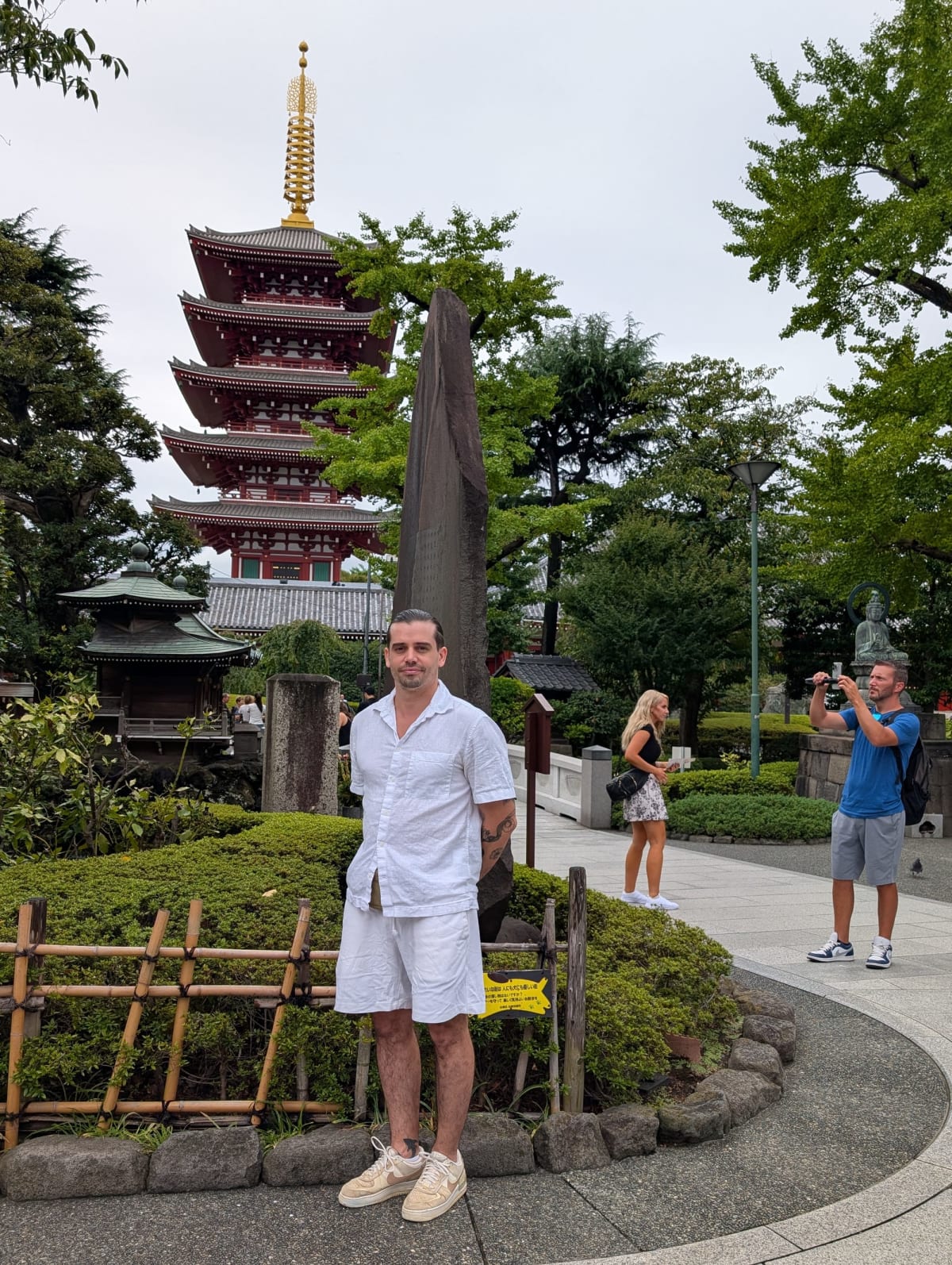
And then, a few minutes later, I was the one doing exactly what I’d just watched Lia not do — standing very deliberately in front of the pagoda and a carved stone monument I never did read the inscription on, waiting for someone to take my photo, in an outfit I’d chosen that morning with photos in mind. Behind me, in the same frame, a woman checking her phone and a man lining up his own shot of the pagoda, both of us doing the same thing at the same time without acknowledging each other. I’m not exempt from any of this. Senso-ji doesn’t ask you to choose between reverence and vanity. It just gives you room to do both within about thirty meters of each other.
Two Shrines Nobody Photographs
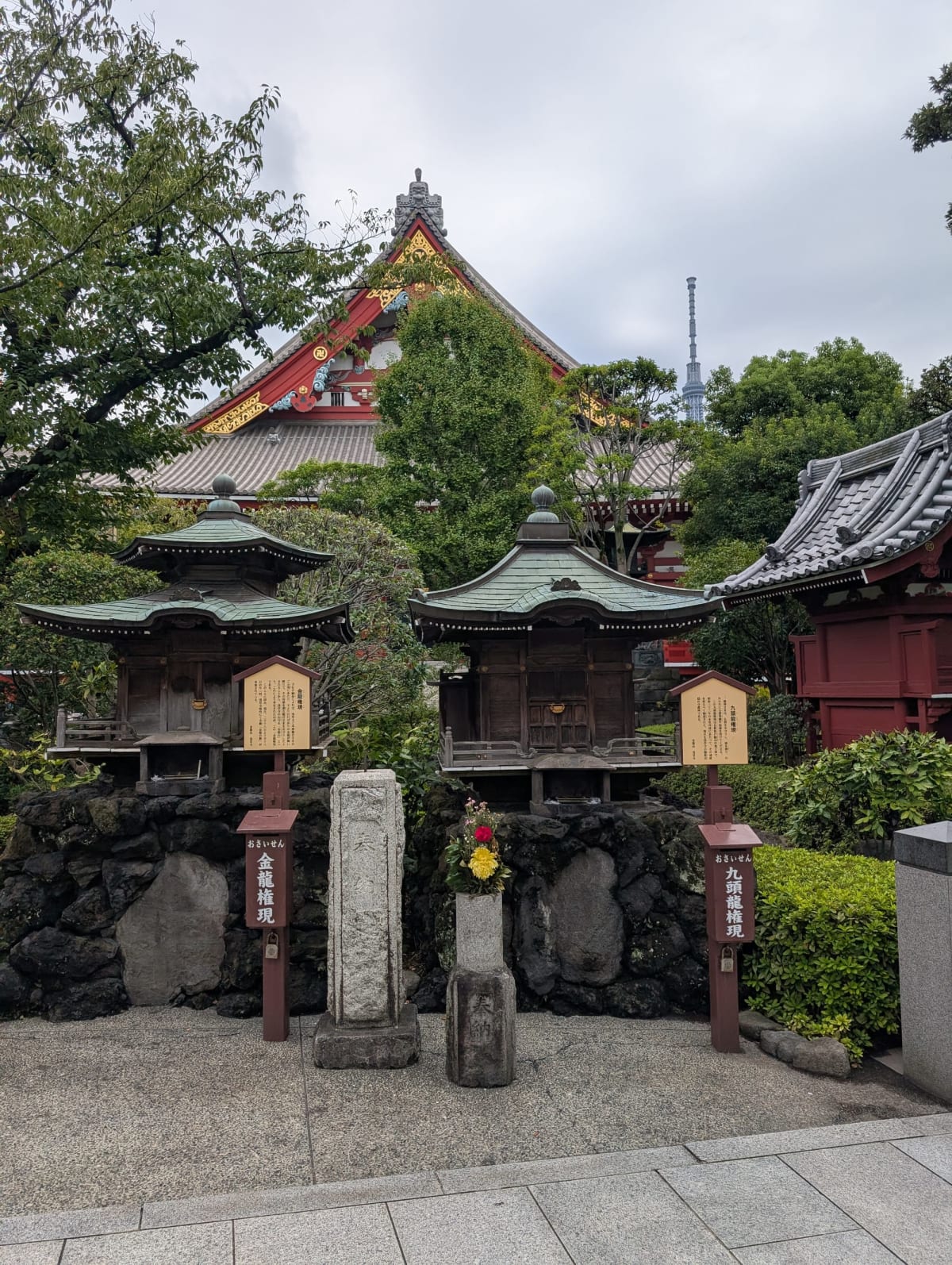
Off to one side of the main complex, past where most of the foot traffic bends back toward the shopping street, there are two small copper-roofed shrine buildings sitting on a raised bed of volcanic rock — Kinryu-gongen and Kuzuryu-gongen, dragon deities with their own dedicated offering boxes, easy to miss entirely if you’re moving in a group or following a guide’s flag. Almost nobody stopped there while we did. Look up past the roofline, though, and Tokyo Skytree is visible over the trees, a six-hundred-and-thirty-four-meter steel needle sharing the skyline with a pair of shrines that predate the tower by centuries. Nobody had engineered that view for a photo. It was just what happened to be behind the shrines that day, ancient and brand new occupying the same six inches of frame.
The Memorial in the Corner
The one part of the complex where the crowd genuinely thinned to nothing was a stone monument near the eastern edge, easy to walk straight past if you didn’t happen to look left at the right moment: a statue of a mother holding two children, hand-knitted red caps and shawls draped over the carved stone, a bilingual plaque in front of it. It commemorates the roughly 240,000 Japanese civilians who died trying to get home from Manchuria after Japan’s surrender in 1945 — starvation, cold, chaos — erected by survivors who did make it back, with an inscription that translates, roughly, to a pledge that this should never happen again. I stood there longer than I stood at most of the postcard spots. Nobody else did. That felt less like a failure of the other visitors and more like proof that Senso-ji has room for grief that doesn’t require an audience to be real.

Rejoining the Crowd
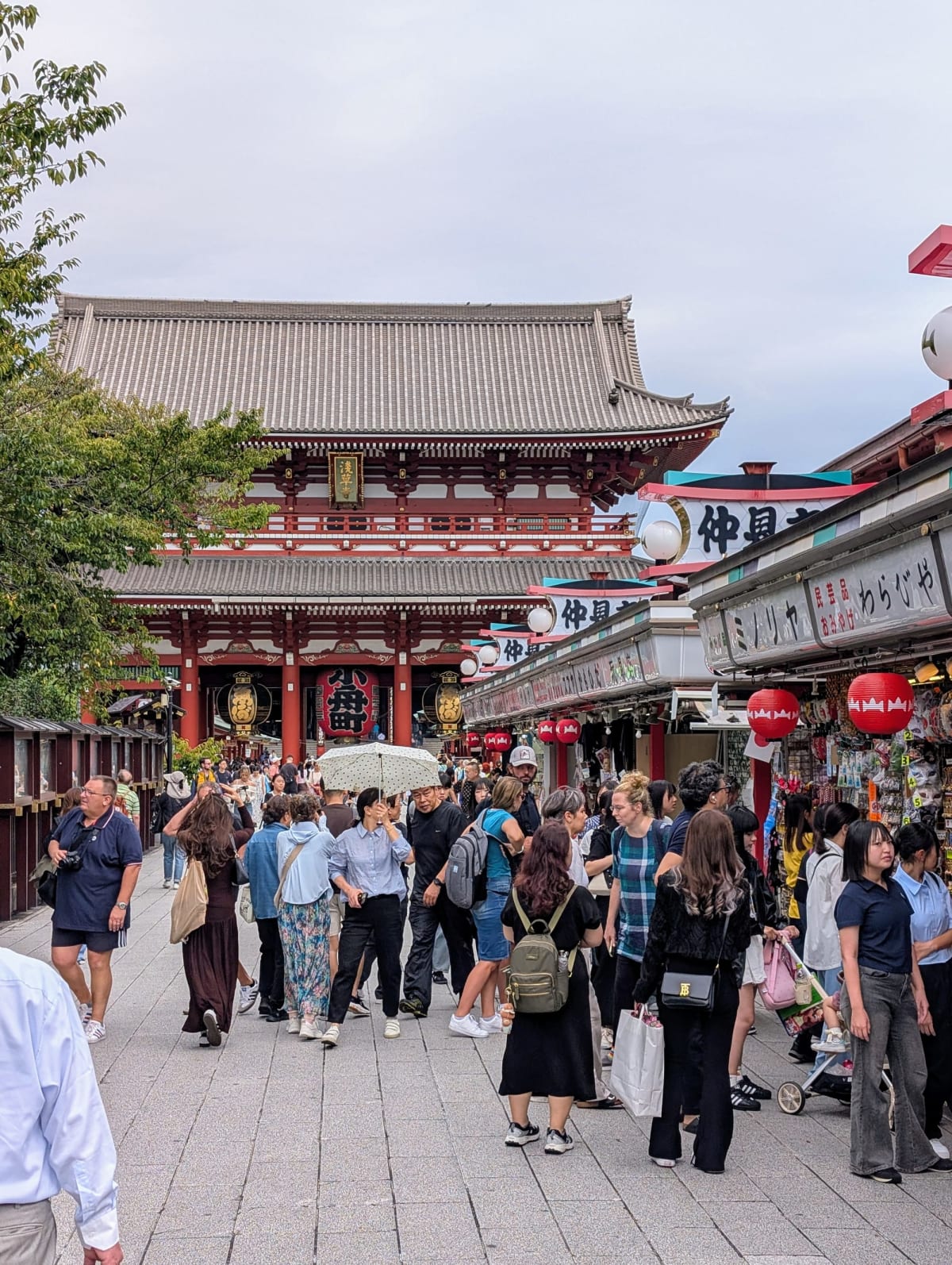
By the time we looped back toward Nakamise-dori, the street had filled in completely — a solid, slow-moving mass of people under the covered arcade, red lanterns hanging over souvenir stalls selling the same rice crackers and yukata and keychains that have probably been sold on this exact street for a century, the temple gate visible at the far end over everyone’s heads. It was, by a wide margin, the most crowded single block we’d stood on all trip. I didn’t find that discouraging. Thirty million people a year come through here for the same basic reason we did, and a shopping street this dense isn’t a sign that Senso-ji has been hollowed out by tourism — it’s the same commercial energy that’s been running alongside this temple since Edo-period pilgrims needed somewhere to buy their own rice crackers on the way in.
Matcha, Mont Blanc, and the Ordinary Ending
We ended the night the way you end most nights in Asakusa — in front of a matcha shop, reading a menu covered in more green desserts than either of us knew existed, Lia in her denim jacket studying the options like it was a decision that mattered. It wasn’t a temple moment. It didn’t need to be. That’s the part I keep coming back to about Senso-ji: the sacred and the completely mundane sit about forty meters apart from each other on the same street, and by the end of the evening I couldn’t have told you which one I’d come to Asakusa for. Probably both. Possibly the matcha soft serve, if I’m honest.