The Bow Is a Transaction, Not a Trick
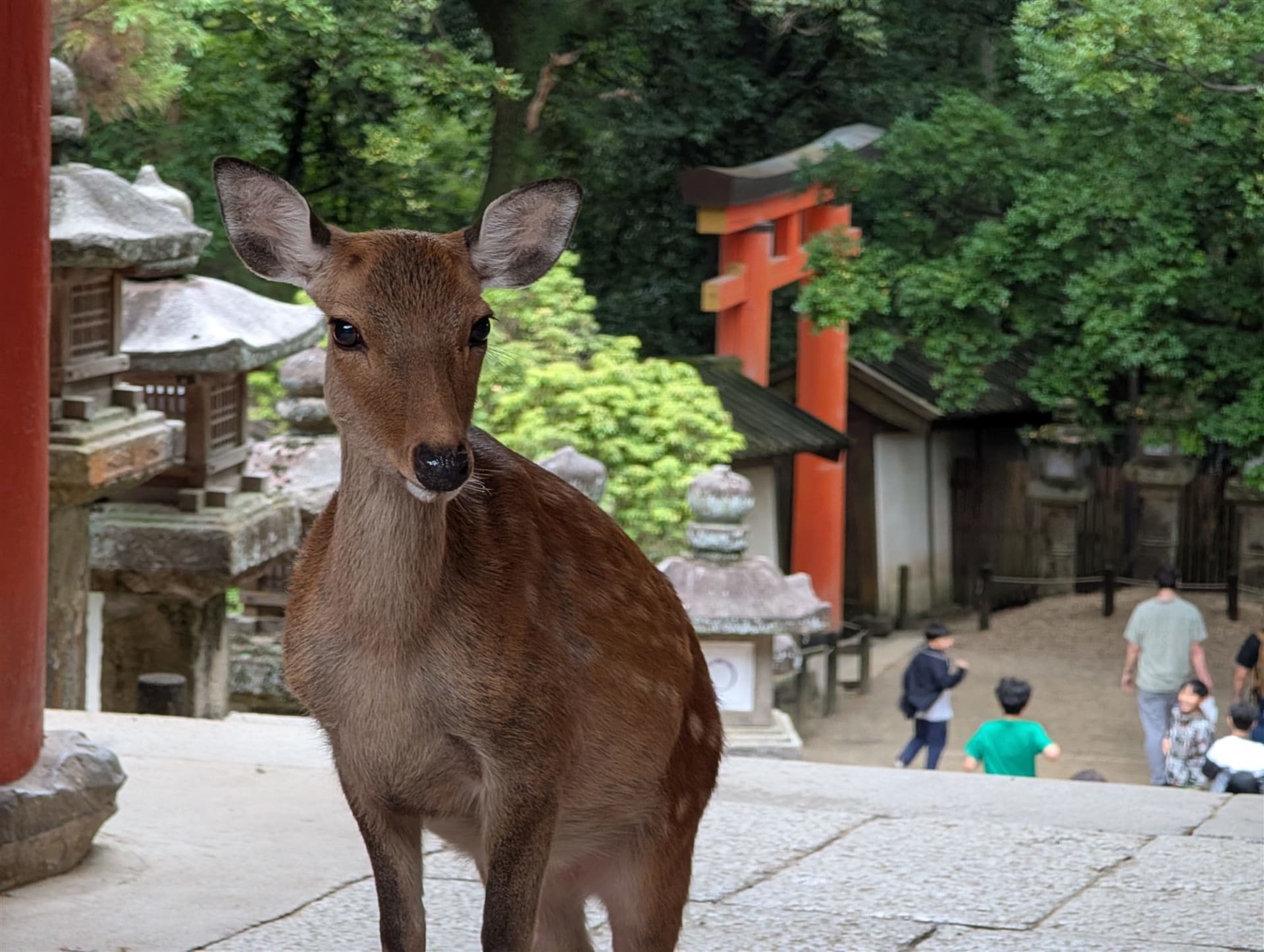
Everyone tells you the deer of Nara bow for crackers, like it’s a magic trick the town has trained into its wildlife for your amusement. It isn’t a trick. I got off the train from Kyoto, walked maybe four hundred meters toward Kasuga Taisha, and a deer lowered its head at me before I’d even reached for the rice-cracker stand — a quick, precise dip, gone in under a second, already calculating whether the gesture had produced a snack. It hadn’t, this time. The deer didn’t sulk or repeat the bow. It just turned and tried the tourist next to me. Watch enough of these exchanges in a row and the sentiment drains out of it fast: this is centuries of trained behavior refined into the most efficient possible loop — bow, receive, move on — and the deer doing it are running the numbers, not performing affection.
That’s the thing the postcard version leaves out: these aren’t tame animals in the petting-zoo sense. They’re wild cervids that happen to be very densely concentrated in a sacred forest, and they treat you less like a friend than like a vending machine that occasionally needs a small ritual to unlock.
~600–700 sika deer live inside Nara Park, protected by law as messengers of Takemikazuchi — the god who, according to the founding myth, rode into town from Kashima on the back of a white stag.
350,000 people live in the city around them. The deer came first, in the story anyway, and the town was built to accommodate that.
Sacred, yes. Cuddly, no.
I was there on an ordinary Friday afternoon in October, no festival, no special crowd, and it didn’t matter. The deer had already claimed the town.
The Whole Park Belongs to Them
It’s easy to picture Nara Park as a single clearing with a few dozen deer in it, because that’s the version that ends up on postcards. It isn’t that. It’s a genuinely enormous stretch of open lawn and forest — five hundred and two acres, bigger than most of the historic centers I’d walked through in Kyoto — and once you’re actually standing in the middle of it, the scale changes what the deer look like. They’re not props scattered for photos. They’re just living there, the way pigeons live in a European plaza, except these pigeons are the size of large dogs and weigh as much as a person and are, again, legally protected as sacred.
I found one lounging in the open grass, well back from the paths, antlers capped rather than sharp — a safety measure the park takes every autumn, sawing the tips down before rutting season so a startled buck doesn’t accidentally gore a toddler reaching for a cracker. It looked harmless, dozing there. It also, ten minutes earlier, had shoved its head hard into a teenager’s midsection when the kid ran out of crackers mid-feed and didn’t back away fast enough — a real hit, not a nuzzle, the kind that knocks the wind out of you and sends everyone nearby scrambling for their phones for the wrong reason. It didn’t get up when I crouched near it afterward, didn’t get up when a photographer a few meters away spent a full minute adjusting his lens. Around me, in every direction, more deer, more tourists, more of the same unhurried coexistence, and the same low hum of everyone silently negotiating how close is too close. Somewhere behind me a family was laughing at a fawn that kept stealing napkins out of an open bag. Nobody was chasing it off, but nobody was fully relaxed either.

What They’ll Actually Do to You
The park hands out a leaflet at the entrance, in four languages, listing the ways a sika deer will hurt you if you mishandle the transaction:
- Butting — a hard head shove, usually to a leg or midsection
- Kicking — front hooves, when cornered or startled
- Biting — sleeves, bags, occasionally forearms
- Chasing — if you run, which is exactly the wrong instinct
I watched a deer plant its head against a man’s leg and shove, unprompted, because his jacket pocket had the telltale crinkle of a cracker wrapper he had no intention of opening. I watched another follow a woman for a full block after her bag went empty, nosing at her purse the way a pickpocket cases a mark, patient and completely undeterred by her increasingly firm “no more, no more.” These aren’t petting-zoo animals that happen to live in a park. They’re wild cervids that have spent centuries figuring out exactly how much force gets a result from a species that mostly folds under mild aggression, and they use it. The bite marks I saw on a stranger’s forearm at the tea stand weren’t a story anyone told with alarm — just a shrug, an “ah, that one” gesture toward a stag by the fence, like identifying a difficult regular at a bar.
What’s actually happening in Nara Park isn’t magic and it isn’t a petting zoo. It’s a few hundred years of wildlife diplomacy — locals and shrine staff who’ve learned the deer’s tells, tourists who mostly haven’t, and an uneasy truce that holds up as long as everyone respects the boundaries the deer, not the humans, are setting. That version doesn’t fit in a caption. It’s the more interesting one.
A Shrine’s Worth of Kitsch
The walk up to Kasuga Taisha runs through a strip of shops selling mochi, wooden crafts, and an amount of stuffed-deer merchandise that suggests someone in this town has genuinely cornered the market. The actual, non-stuffed deer treat this street like an extension of the park. I found one with its whole head wedged into the doorway of a tea house — a hand-lettered sign apologizing that it was closed for the day taped to the glass right next to it — nose pressed to the window, utterly indifferent to the closure. It didn’t wander off while I watched. It just stood there, patient in a way that read as faintly offended, like a regular who’d shown up at his usual hour and found the shutters down.
A few doors along, a second deer had planted itself beside a trash can outside a souvenir shop, parked under a rack of lottery tickets and shrink-wrapped plush toys, its rear end practically resting against it like it had claimed the spot as shade. I stood there for a solid minute just looking at the juxtaposition: an animal this town considers a literal emissary of the divine, standing sentry over keychains. Nobody else on the street seemed to find it strange. That’s when it clicked that this contradiction isn’t really a contradiction here — Nara holds the sacred and the completely absurd in the same breath, and it doesn’t seem to cost the place anything.

The Other Temple Nobody Was Talking About
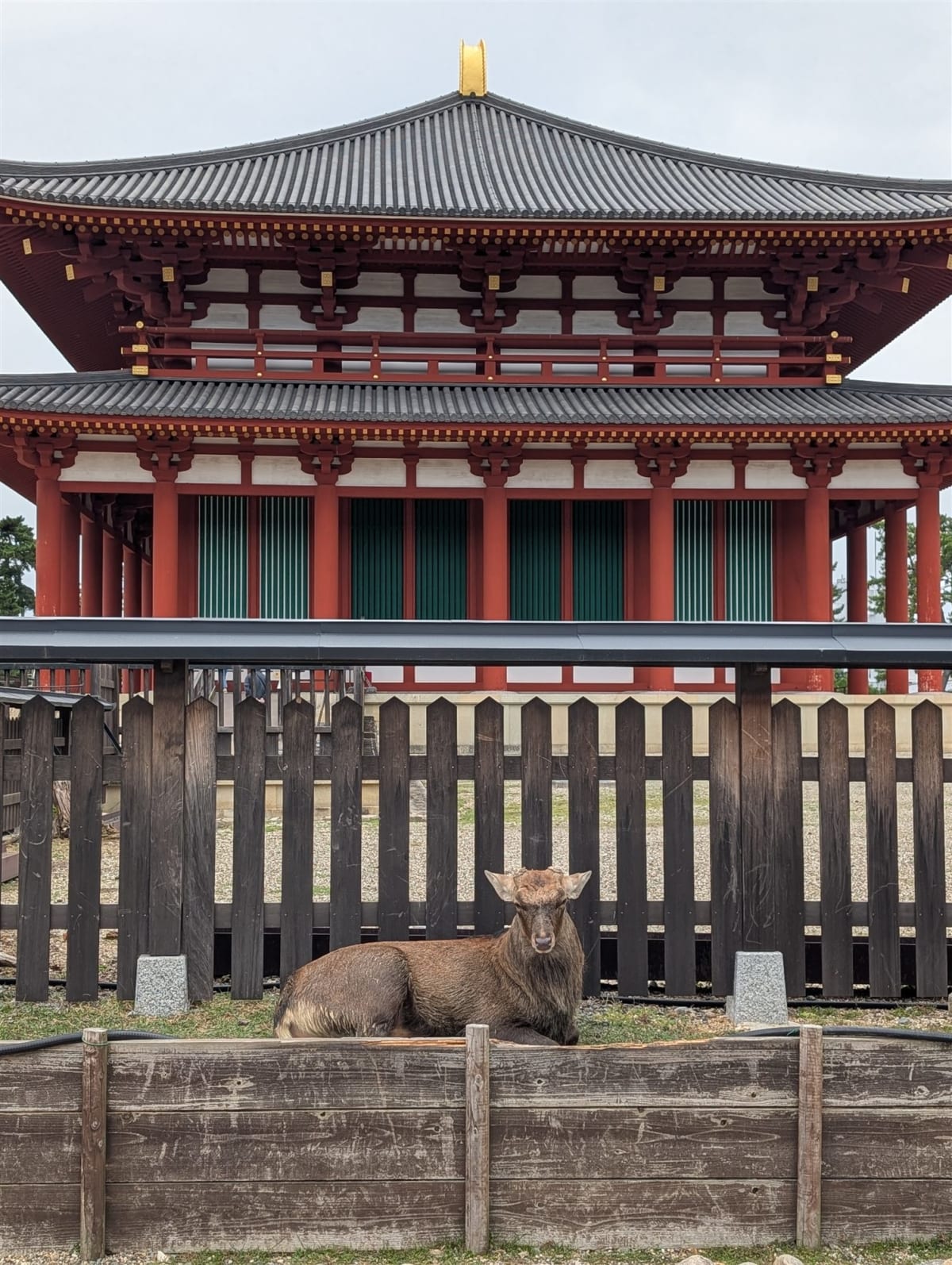
Todai-ji gets the top billing in every guidebook, and it earns it, but Nara has a second major temple complex that barely gets mentioned in the same breath — Kōfuku-ji, right at the edge of the park, close enough that you stumble into it without meaning to. What stopped me wasn’t the famous five-story pagoda, which I somehow never got a clean angle on through the trees. It was one of the reconstructed halls: two tiers of deep red lacquer and dark timber, green latticed shutters, gold fittings catching what little light the overcast afternoon had to offer, rebuilt with a precision that makes it look both brand new and somehow exactly as old as everything around it.
A deer was lying in the grass just behind the wooden fence at its base, seemingly unimpressed by any of this, chewing on something and watching me watch the building. Kōfuku-ji used to be the clan temple of the Fujiwara family, the power behind the throne for most of Japan’s Heian period, and it once had enough political weight to field its own army of warrior monks. Now it shares a lawn with wild deer and gets walked past by people on their way to see something else. I don’t think that’s a tragedy. I think it’s just what happens to power, eventually, everywhere — it gets absorbed back into the landscape, and something that used to intimidate emperors ends up as a nice place for a deer to nap.
What the Bronze Deer Is Actually Doing There
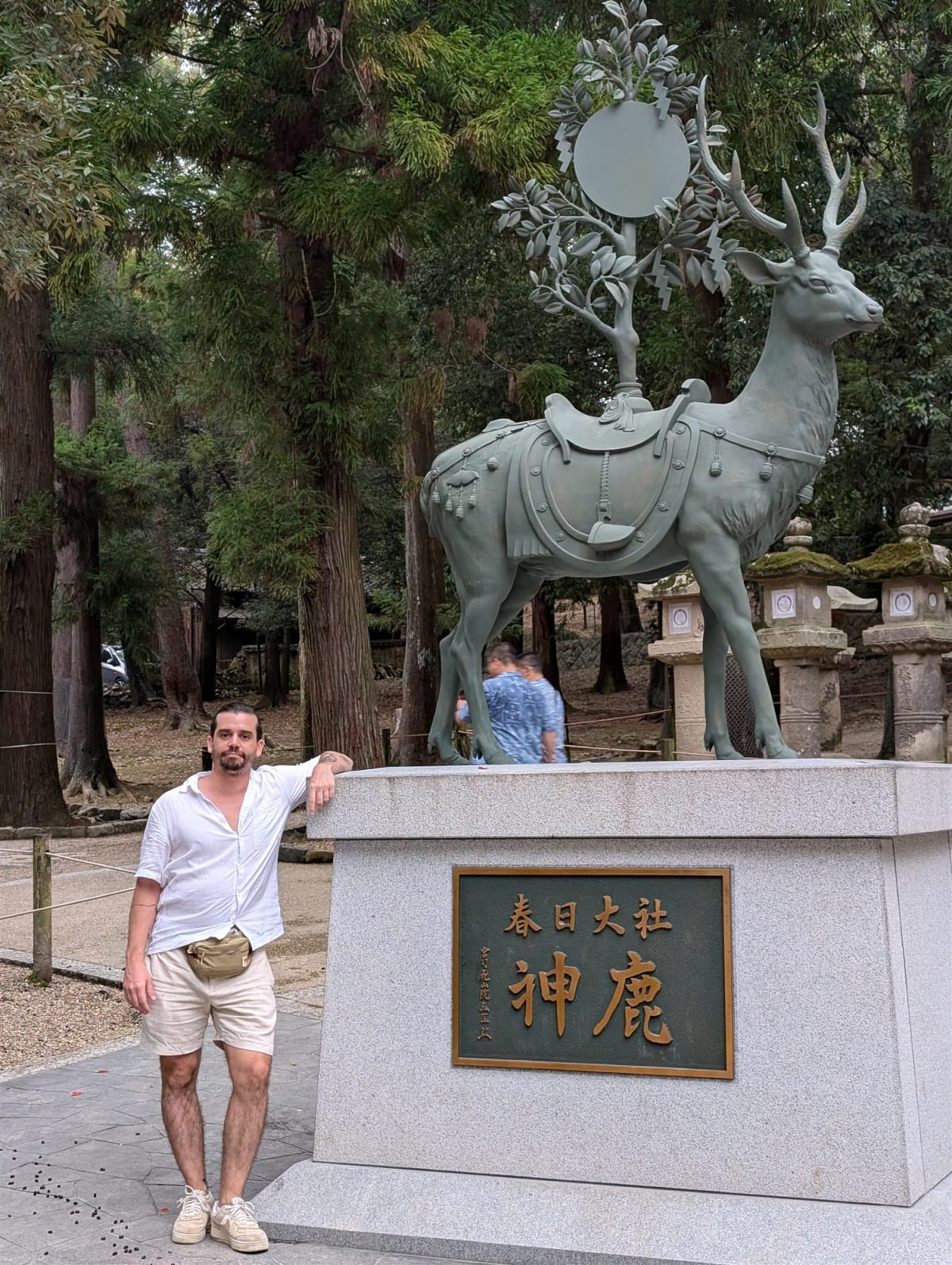
Just past Kasuga Taisha’s outer gate there’s a bronze deer statue, saddled like it’s expecting a rider — which, once you know the founding myth, makes sense. It’s not decoration. It’s the story made literal: the shrine exists because a god supposedly arrived here on the back of an animal exactly like it, and every deer wandering the park since has been read as a descendant of that same lineage, a living relic that happens to also eat rice crackers out of your hand.
I stood next to the statue for a photo and felt slightly ridiculous doing it — tourists lined up for the same shot the way people line up for any landmark — but it earns the ritual more than most. Most statues you photograph are commemorating something finished, something historical and sealed off. This one is standing next to the thing it commemorates, which is still walking around, still doing the job the myth assigns it, eight or nine hundred years later. It’s rare that a legend and its evidence share the same zip code.
The Corridor of Moss and Stone
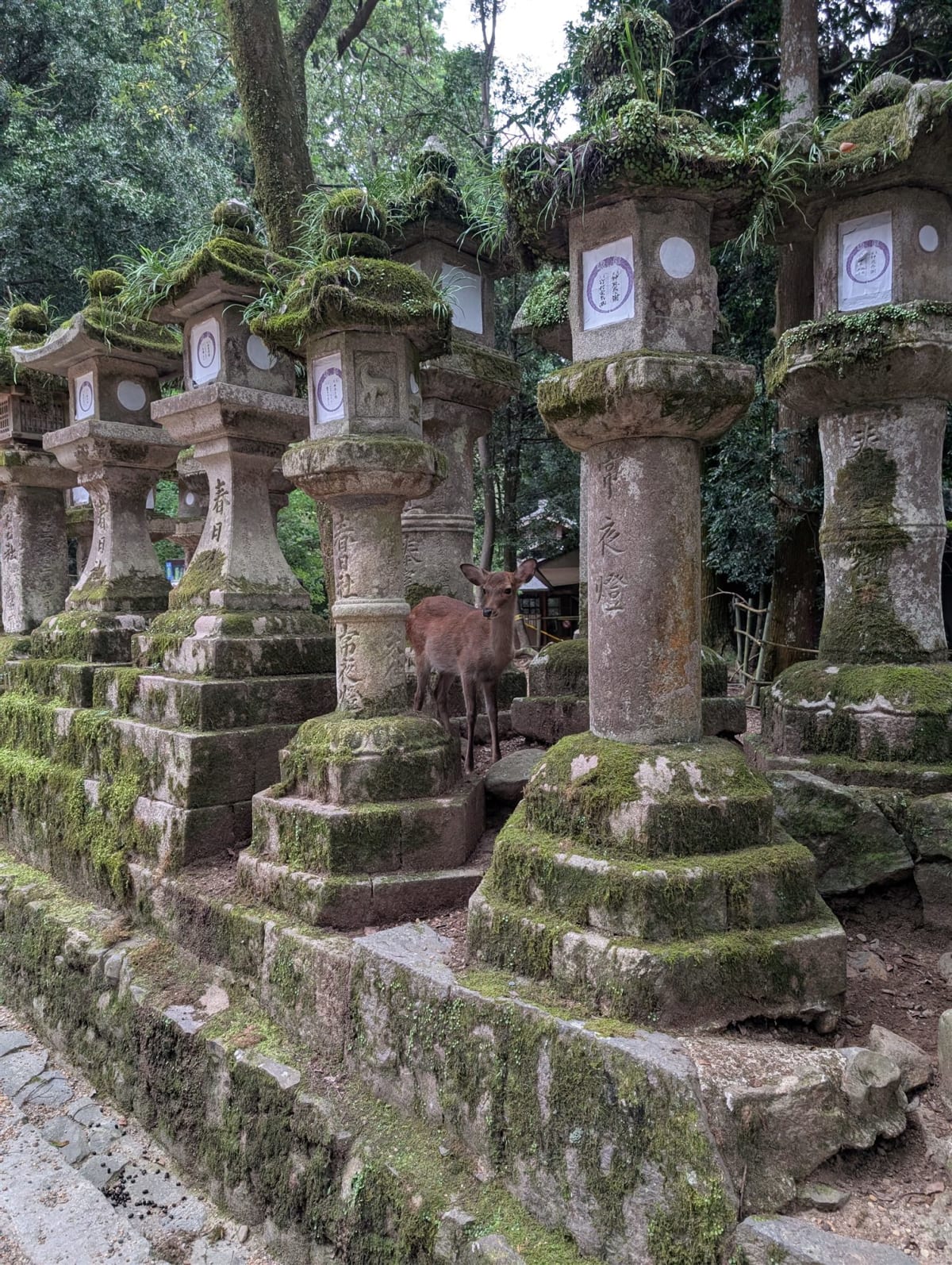
Past the statue, the path to Kasuga Taisha turns into something stranger and much quieter. The souvenir crowds thin out. The cedar forest closes in overhead. And then the lanterns start — close to two thousand stone lanterns, lined up in uneven rows on either side of the path, every single one furred green with moss and carved with the shrine’s name, 春日, the characters softened by what must be centuries of rain running down the same grooves. Twice a year, during festivals, every one of them gets lit at once, thousands of small flames stretching into the trees. I wasn’t there for that. It didn’t matter. Even switched off, in the gray light of an overcast afternoon, the path has a weight to it that’s hard to describe honestly without sounding like I’m overselling a pile of rocks. I’m not. A deer was standing between two of the tallest lanterns when I rounded a bend, positioned so precisely it looked staged, and it didn’t so much as glance at my camera.
Inside the shrine itself, the innermost corridors are strung with a different kind of lantern — bronze ones, hanging from the eaves, each donated by a worshipper and inscribed with a name or a wish, swaying just barely in whatever draft makes it in from the forest. I’d come to Nara for the deer, mostly, with the Buddha at Todai-ji as the other headline. I ended up standing under those hanging lanterns longer than I stood in front of either.
The One That Wasn’t Posing
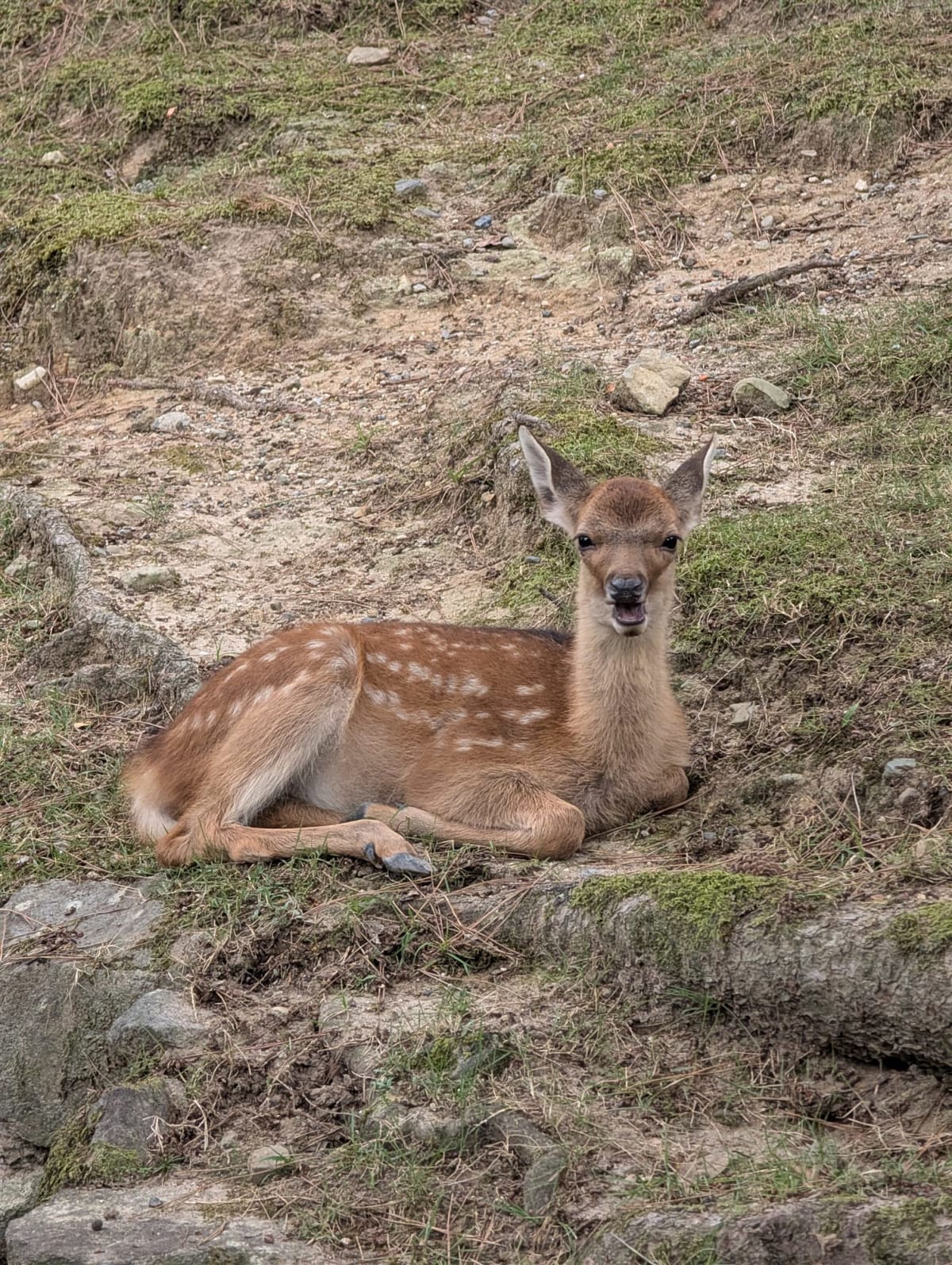
Not every deer in Nara works the crowd. On a mossy slope above one of the old moat walls near Kōfuku-ji, I found a fawn mid-yawn, or mid-bleat, mouth open in a way that made it look like it was heckling me — spotted coat, oversized ears, absolutely no interest in whether I found it charming. It didn’t move for the photo and it didn’t move after it either. It just sat there on the moss, doing whatever a fawn does with an ordinary Friday afternoon, in a spot that most people walking past wouldn’t have thought to look up at.
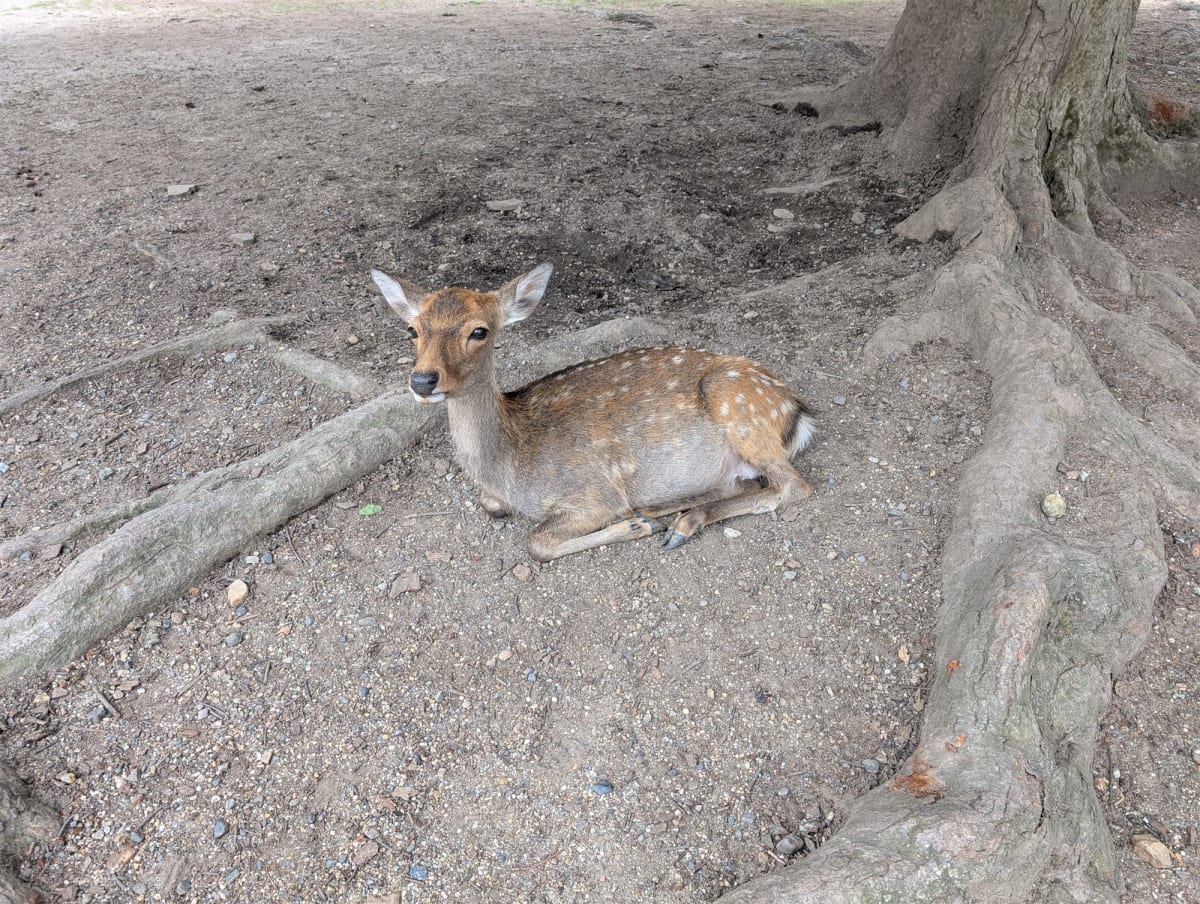
A little further on, closer to the lantern path, I found another one curled up under a tree, tucked between two roots like it had chosen the spot specifically for the cover, spotted coat blending almost exactly into the dirt and shade. It looked up when I got close, held perfectly still, and watched me the way you’d watch someone walk past your house — alert, mildly interested, not remotely concerned. It didn’t get up. It didn’t come over for a scratch. It just kept doing what it was doing, which was resting, and I liked it precisely because it wasn’t performing for anyone. Most of what you photograph in Nara is a deer that’s decided to interact with you. This one hadn’t decided anything. It was just there, being a deer, in a town that happens to worship it.
Quiet Water Behind the Shrine
If you keep walking past the main shrine buildings instead of turning back toward the park, you find the Manyo Botanical Garden almost by accident — I did, anyway, looking for somewhere quieter than the lantern path. It’s a planted collection of every species mentioned in the Man’yōshū, Japan’s oldest poetry anthology, each plant labeled with the verse that names it, which is a very specific and very Japanese way of turning a garden into a footnote to literature. A wooden boardwalk zigzags over a marshy stream lined with iris and pampas grass and opens onto a koi pond, orange shapes moving in loose knots under the trees.
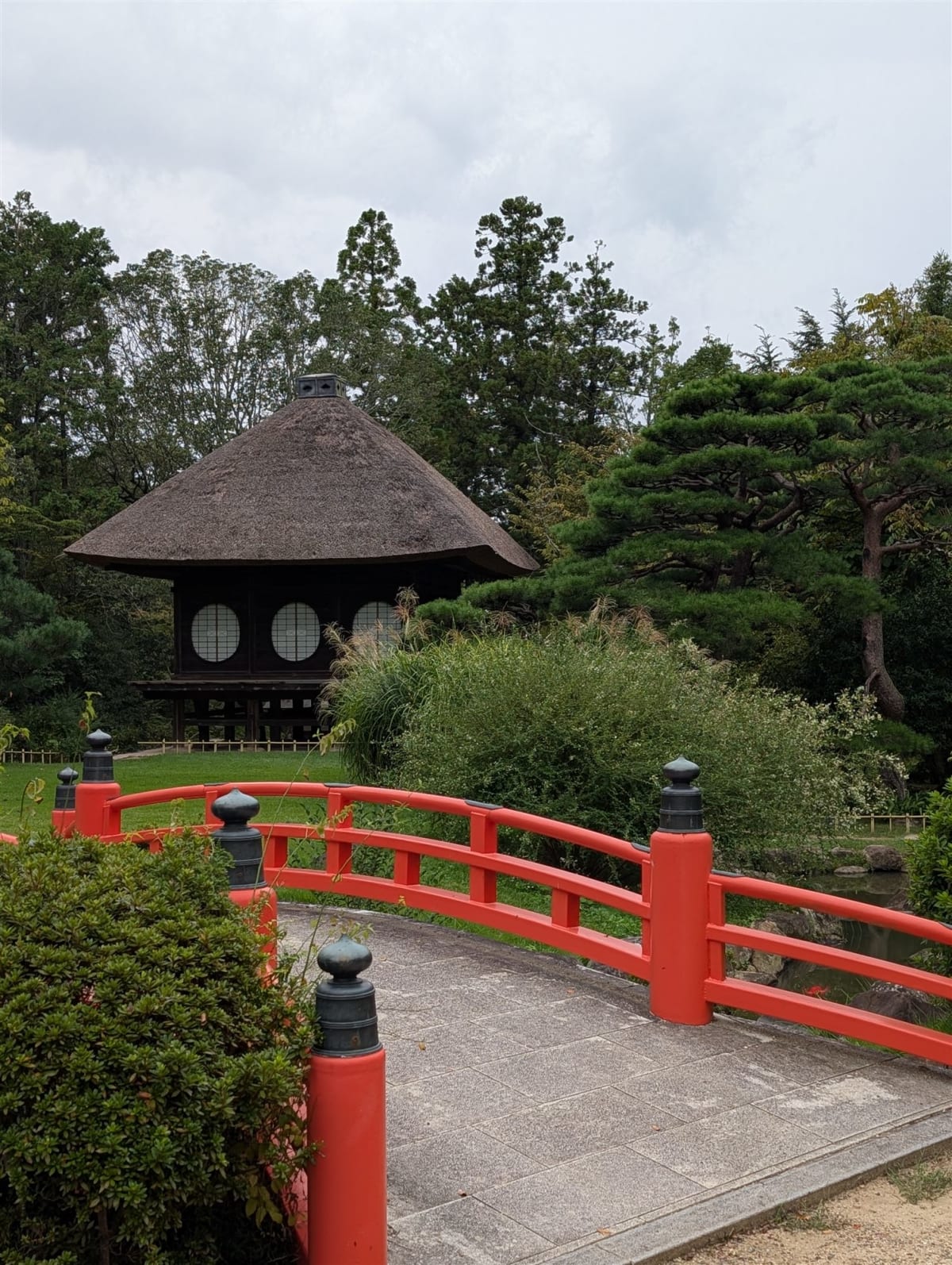
Deeper into the garden, past the pond, an arched vermilion bridge crosses a second stretch of water toward a thatched-roof pavilion — the kind of composed, deliberate beauty that looks almost too tidy after an afternoon of moss and weathered stone, like someone had built one corner of the garden specifically for the postcard. I’m not immune to that kind of thing just because I can see it being engineered. I stood on the bridge for a few minutes, the red railing warm from whatever sun had made it through the clouds, and let it be quiet. Almost nobody else was there. Everyone else was back in the park with the deer, which I understood — I’d been one of them twenty minutes earlier — but the ten minutes I spent just watching koi drift under that bridge, with nobody behind me and nothing in my hand to feed anything, turned out to be the stillest ten minutes of the whole day.
Gold Light, Grazing Deer
I walked back out in the late afternoon, past the great vermilion torii at the edge of the shrine grounds, the light starting to turn that heavy gold it gets right before it actually sets. Deer were grazing along the gravel road on either side, completely unbothered by the tour buses idling at the crossing, and it struck me that this was the whole day in miniature — sacred animals going about their business a few meters from diesel engines and gift shops, and neither one canceling the other out.

I ate kakinoha-zushi that evening near Naramachi — salmon and mackerel pressed into rice, wrapped in persimmon leaves that perfume the fish with something faintly bitter and green — and I kept thinking about how little of the day had actually been about the Great Buddha, which is supposedly the headline reason anyone comes here. It wasn’t the fifteen-meter bronze statue that stuck with me. It was a fawn under a tree root, a deer waiting outside a closed udon shop, and the fact that an entire town has organized itself, without any apparent friction, around the idea that the animals wandering its streets might actually be gods. I’ve been to places that ask you to suspend disbelief for an afternoon. Nara doesn’t ask. It just goes on believing, out loud, in broad daylight — and somewhere around the third deer that walked up to me like an old acquaintance, I found I didn’t have much disbelief left to suspend.