
Mount Kuwol
"For the first time on the whole trip, our guide stopped narrating and just stood next to us looking at the view, which told me more than anything she'd said all week."
A rugged, half-forgotten mountain in South Hwanghae with a clifftop temple that our guides seemed genuinely happy to show us.

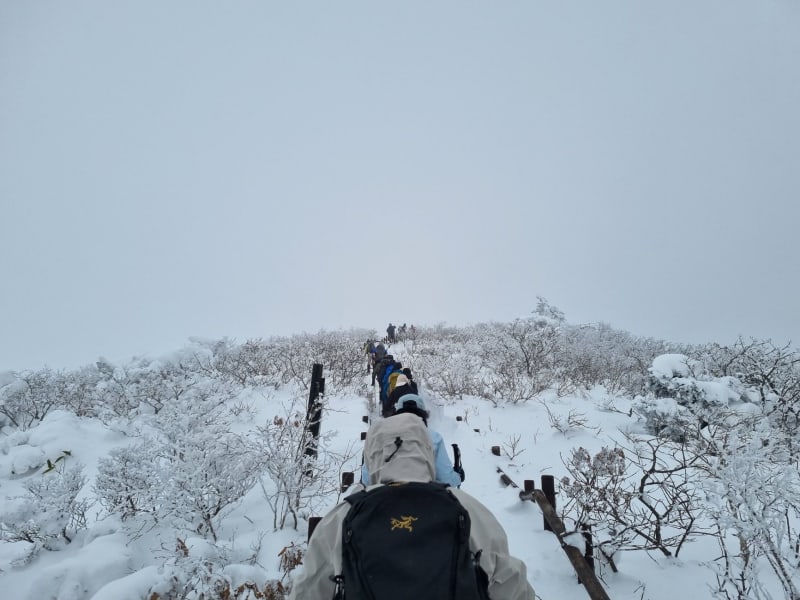
Mount Kuwol was a detour from a detour, added to our itinerary almost as an afterthought when the tour company realized we had an extra day before flying out of Pyongyang. It sits in South Hwanghae province, a couple of hours southwest of the capital, and unlike almost everywhere else we went, it isn’t built around a monument to the Kims — it’s just a genuinely striking limestone-and-granite mountain range, folded ridges covered in pine, with a scattering of old Buddhist temples tucked into its folds that predate the state by many centuries. Woljong-sa, the temple we were taken to, clings to a shelf partway up one of the peaks, and the walk up to it through the trees was the closest thing to an unscripted hour I had in the entire country.
Our guides seemed different here too, and I want to be careful not to overread that, but there was a shift. Mr. Pak, usually formal and watchful, pointed out a hawk circling below us in the valley without being asked a question first. Ms. Ri talked about hiking Kuwol as a student, something she volunteered rather than something scripted into her talking points. I don’t think it’s a coincidence that a mountain with no ideological content attached to it produced the most relaxed hour of guiding we got. Lia noticed it too — she said afterward it was the first time all week she’d seen either of them look like off-duty people rather than state employees performing a role, even if only slightly.

The temple itself is modest — a couple of pavilions, a bell tower, some weathered stone steps — and much of the original complex was reportedly damaged during the Korean War and rebuilt afterward, which is a familiar story at religious sites across the country. What stayed with me wasn’t the architecture so much as the silence. No loudspeakers, no recorded revolutionary songs piped through hidden speakers like we’d heard at nearly every other stop, just wind through pine branches and, once, a temple bell somewhere below us that nobody explained and I didn’t ask about.

We didn’t have time to push further into the range — there are supposedly waterfalls and caves deeper in that see almost no foreign visitors at all — but even the sliver we got felt like a genuinely different register of North Korea, one where the landscape was allowed to just be a landscape for an hour. On the drive back to Pyongyang, Ms. Ri fell asleep against the window, which somehow felt like the most honest thing I witnessed the entire trip.
When to go: Aim for autumn, when the pine and deciduous mix on the slopes turns properly colorful and the air is cool enough for the temple hike to feel like a hike rather than a slog; it’s rarely offered as a standalone stop, so ask your tour operator specifically if you want it added.
Keep exploring
More from North Korea
 north-korea
Mount Myohyang
A Buddhist mountain of thousand-year-old temples where the mist comes down thick enough to make you forget, for a moment, which century you're in.
Explore north-korea
Mount Paektu
A volcanic crater lake at 2,744 meters that Koreans on both sides of the border regard as the geographic soul of their civilization — and that the regime treats as a birthplace of gods.
Explore north-korea
Nampo
Pyongyang's port city on the Yellow Sea, where a tidal barrage the length of a small highway crosses the Taedong estuary and the country's best apples grow in the hills behind.
Explore north-korea
Panmunjom
The Joint Security Area where the Korean War never quite ended — a strip of concrete and painted lines where two soldiers stand a meter apart and do not look at each other.
Explore north-korea
Pyongsong
A closed science city an hour from Pyongyang, glimpsed only through a bus window on the one detour our guides ever allowed.
Explore north-korea
Pyongyang
The world's most choreographed capital, where every boulevard, monument, and smile has been arranged for an audience of one: you.
Explore