
Lons-le-Saunier
"The national anthem was written by a local, and the town has never let anyone forget it."
A salt-built spa town in the Jura and the birthplace of the man who wrote La Marseillaise, its arcaded main street and thermal park giving it a quieter, more civic charm than the Jura's postcard villages.

Lons-le-Saunier owes both its name and its early wealth to salt — the “saunier” comes from the saltworks that operated here from Roman times through the nineteenth century, drawing brine from underground deposits and evaporating it in vast pans. The town’s other, louder claim to fame is Claude Joseph Rouget de Lisle, born here in 1760, who wrote the words and music of what became La Marseillaise, and the connection is impossible to miss: a statue of him stands in the main square, and the house where he was born, on the Rue du Commerce, is marked with a plaque most passers-by seemed to already know about.
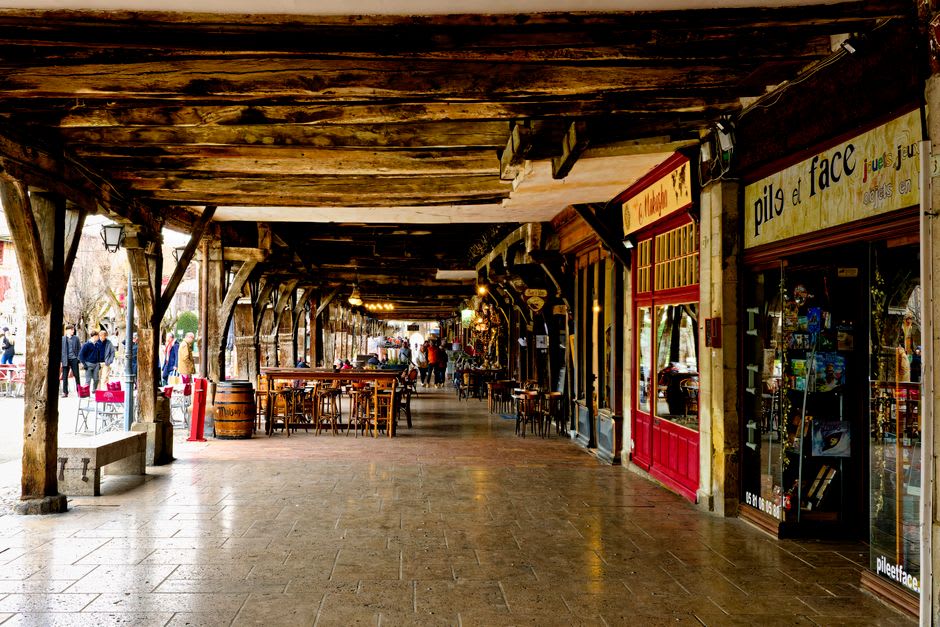
Walking under Les Arcades
The main street through the old town runs beneath Les Arcades, a covered stone gallery of thirteenth-century arcades that shelter shops and cafés from both sun and Jura rain, and gives the town centre a genuinely distinctive feel — we ducked in and out of the shade along it more than once, in the particular way you do when a street is designed for exactly that purpose. At one end, the Église des Cordeliers holds Rouget de Lisle’s tomb, moved here after his remains were returned from Paris.
Thermal water and a very old dinosaur
Lons-le-Saunier’s saline thermal springs are still used at the Parc des Bains, a green space built around the old bathhouse where locals walk, run, and occasionally still take the waters for respiratory treatment. More unexpectedly, the town’s museum holds the fossil of Plateosaurus, one of the earliest well-preserved dinosaur skeletons found in France, discovered in the surrounding countryside in the 1930s — a genuinely strange detour from salt and anthems that we hadn’t expected to find in a Jura market town.

When to go: Spring through autumn suits the town well, and it makes a practical, well-connected base for exploring the wine villages and reculées of the southern Jura.
Keep exploring
More of Jura
Keep exploring
More from Jura
 france
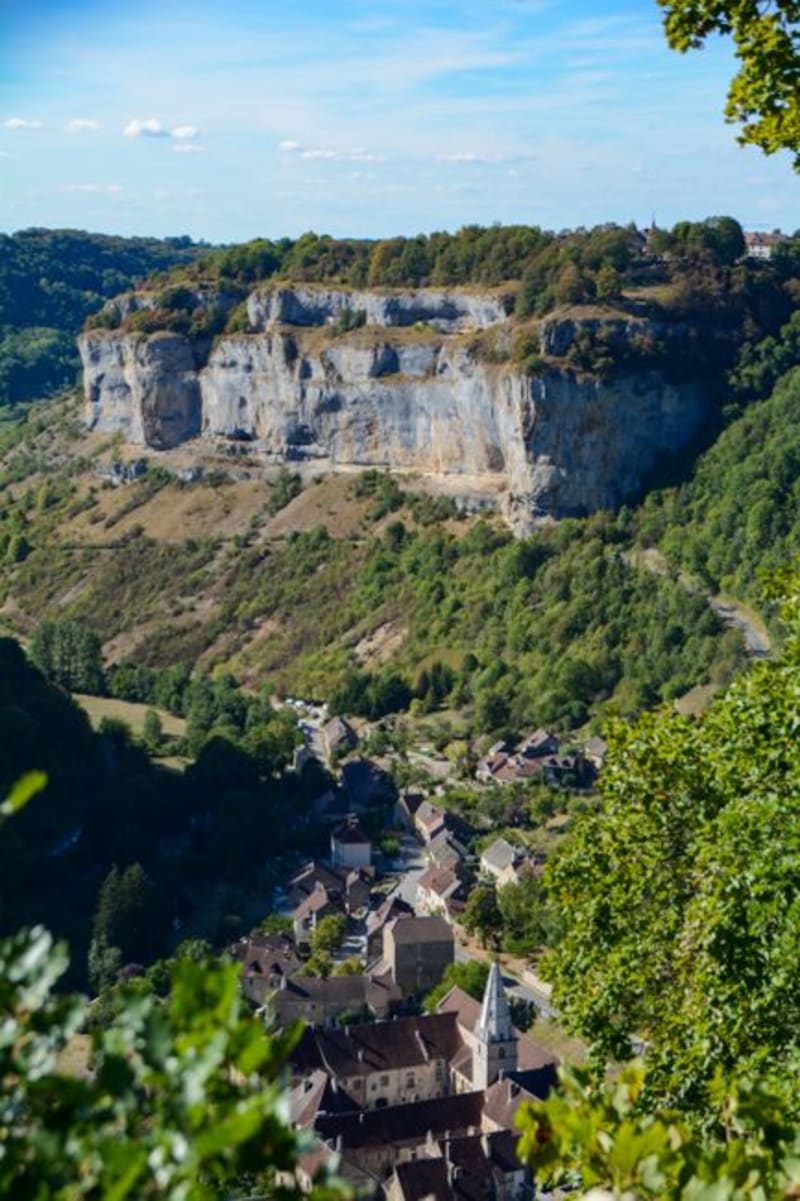
 Baume-les-Messieurs
A village hidden inside a dead-end limestone canyon in the Jura, built around an ancient abbey and surrounded by cheese cellars ageing the region's prized Comté in caves cut into the cliffs.
Explore france
 Château-Chalon
A clifftop village of barely one hundred and fifty people that somehow invented vin jaune, and where the ruined abbey above the vines gave us the single best view of the whole Jura wine country.
Explore france
 Pupillin
A village of maybe two hundred people and roughly as many wine cellars, self-declared capital of the Poulsard grape, where every second door seemed to open onto someone's family cave.
Explore france
 Arbois
The unofficial wine capital of the Jura, a stone-built town along the Cuisance river where Louis Pasteur did his early wine research and vin jaune, the region's strange, sherry-like specialty, still ages in oak for over six years.
Explore france
 Champagnole
A quiet forest town we used purely as a base, and which turned out to be the best decision of the whole trip once we found the Hérisson waterfalls a short drive away.
Explore france
 Salins-les-Bains
A UNESCO-listed saltworks built into a river gorge, where I walked underground galleries that funded the Franche-Comté for a thousand years before soaking in the same brine that made the town rich.
Explore