Fréjus
"Nowhere else on this coast makes you feel Rome's absence quite as literally as watching a rock concert inside its ruins."
Rome's oldest naval base on this coast, still readable in an amphitheater that hosts concerts instead of gladiators and an aqueduct that just quietly keeps standing in the middle of roundabouts and parking lots.

Fréjus doesn’t get talked about with the same reverence as Nîmes or Arles, and I think that’s mostly an accident of how it’s laid out — its Roman ruins are scattered through an ordinary modern town rather than gathered into one dramatic old center, so you have to go looking for them between roundabouts and apartment blocks. But the town, founded as Forum Julii under Julius Caesar and expanded by Augustus into the most important Roman naval port on this whole stretch of coast, has more genuine antiquity buried in it than almost anywhere else in Provence. We came on a day trip from Saint-Raphaël next door and ended up spending twice as long as planned just following the ruins from one end of town to the other.
An amphitheater still doing its job
The Arènes de Fréjus, built in the first century AD, is one of the oldest Roman amphitheaters in Gaul, and unlike the more famous ones it survived without ever fully becoming a picturesque ruin — the arena floor is still used for bullfighting-style events and, these days, summer concerts, which means you can watch a band play in more or less the exact spot gladiators once did. Much of the upper tiers collapsed centuries ago and the stone was scavenged for other buildings, which gives it a rawer, more broken-open feel than Arles’ amphitheater, but you can still walk the lower galleries and get a genuine sense of scale — it held around ten thousand people at its peak, more than the town’s population for most of its history since.

An aqueduct that outlasted the empire, and a cathedral built from its stones
Fragments of the Roman aqueduct that once carried water some forty kilometers from the hills near Mons still stand along the northern edge of town — broken arches marching through what’s now a fairly ordinary suburban street, easy to miss if you’re not looking, startling once you notice them. Fréjus’s other must-see sits at the opposite end of the historical timeline: the Cathédrale Saint-Léonce, whose fifth-century octagonal baptistery is one of the oldest Christian buildings in France, built when the empire’s authority here was already fading, using columns clearly scavenged from Roman structures nearby. The cathedral’s cloister, with a wooden ceiling painted with medieval grotesques — devils, monsters, everyday scenes — is the kind of quietly strange detail that makes Fréjus feel layered rather than merely old.

When to go: Spring and autumn keep the ruins walkable without summer heat bouncing off all that stone. If you want the amphitheater in use rather than just admired, check the summer concert schedule — seeing a show inside a Roman arena is worth planning a trip around.
Keep exploring
More of Côte d'Azur
Keep exploring
More from Côte d'Azur
 france
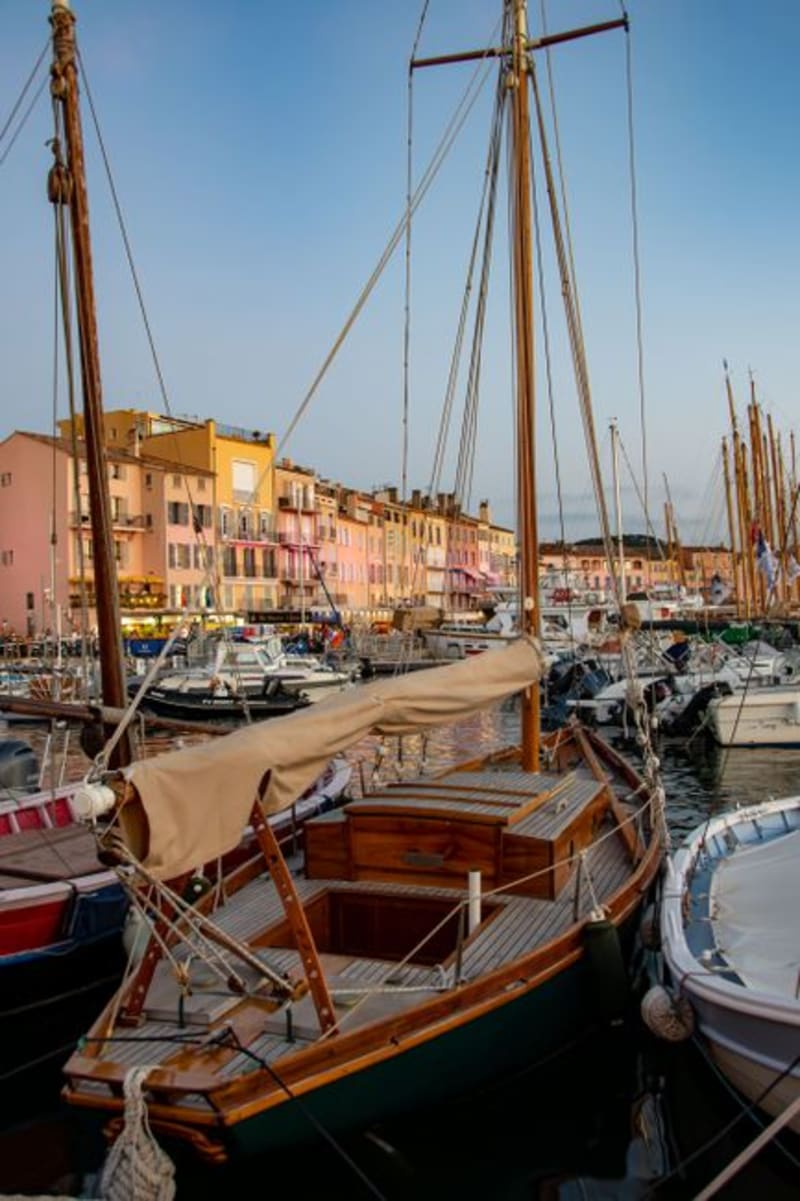
 Saint-Tropez
A former fishing village that became shorthand for Riviera glamour, still built around a small pastel harbour that fills, every evening, with a genuinely absurd number of yachts.
Explore france
 Théoule-sur-Mer
The last town before the red rock of the Estérel takes over the coastline entirely, where the water goes an almost unnatural turquoise against the porphyry cliffs and the coves empty out the moment you walk five minutes past the last parking spot.
Explore france
 Mandelieu-la-Napoule
A town that smells like mimosa every January and hides a genuinely strange fairy-tale château full of an American sculptor's gargoyles right on its waterfront.
Explore france
 Grasse
The self-declared perfume capital of the world, a hill town above Cannes where the air smells faintly of jasmine and three historic houses still blend scent the old way.
Explore france
 Cannes
A resort town built almost entirely around one curved bay and two weeks of May glamour, with a fishing quarter and a genuinely excellent market that outlast the film festival crowds.
Explore france
 Tourrettes-sur-Loup
The self-declared 'city of violets,' a medieval ramparts village above Vence where an entire local economy once ran on a single small flower, and where a March festival still throws the whole harvest into the streets.
Explore