
Vila Franca do Campo
"The boatman cut the engine inside the crater and for a second all I could hear was Lia's snorkel and the gulls nesting on the rim above us."
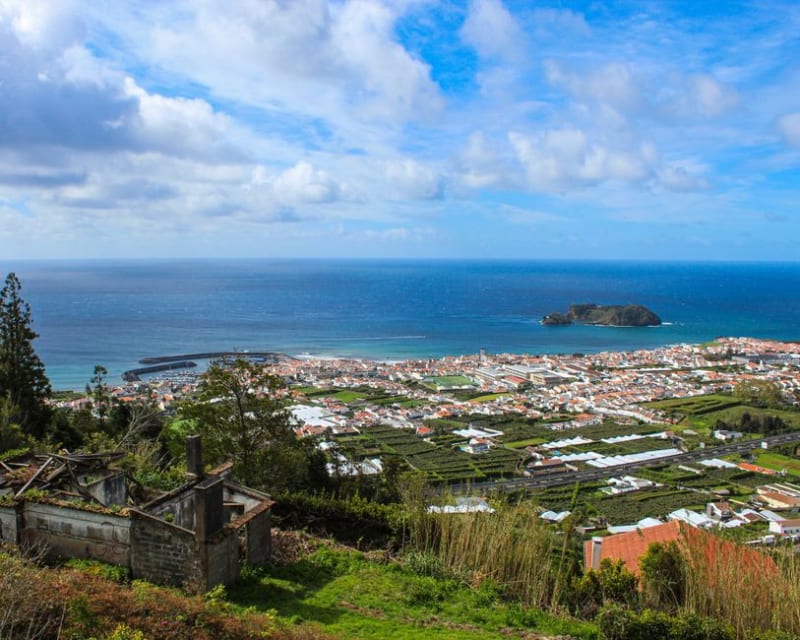
Sao Miguel's original capital, now a quiet fishing town facing a near-perfect flooded volcanic crater islet just offshore.

Vila Franca do Campo doesn’t advertise itself as much as it probably should, given that it was Sao Miguel’s capital until a 1522 landslide buried much of the town and killed a large chunk of its population, at which point the Portuguese crown decided Ponta Delgada was the safer bet and moved the seat of government there instead. Walking the current town, rebuilt inland from the original site, you’d never guess at that history unless someone told you — it’s a tidy, working fishing town with a hilltop chapel, Nossa Senhora da Paz, that we climbed mostly for the view and stayed for longer than planned because the light that evening turned the whole bay orange.
The real draw, though, sits about a kilometer offshore: Ilheu de Vila Franca, a nearly circular islet that’s actually the flooded crater of an extinct underwater volcano, its rim breaking the surface as a ring of cliffs around a lagoon of startlingly clear, calm water. It’s been a protected nature reserve since the 1980s, mainly for nesting seabirds, and access is limited to summer months with boats running out from the town’s small harbor. We booked a spot on one of the little tour boats, and the crossing itself was rougher than the payoff suggested it would be — but once you’re inside the ring, the water goes glassy and green-blue in a way that felt almost staged.

We swam and snorkeled for maybe forty minutes — visibility wasn’t spectacular, mostly volcanic rock and small fish, but the setting did all the work. Lia kept diving down to touch the black rock walls and surfacing to tell me how cold specific patches of water were, which became a running bit for the rest of the trip. Boats aren’t allowed to linger too long since it’s a reserve and the birds nesting on the cliffs get skittish, so we were back on the mainland by early afternoon, salty and a little sunburned.

Back in town we had coffee at a bakery on the main street and I kept thinking how strange it is that a place with this much geological drama sitting right offshore reads, from the street, as just another sleepy Sao Miguel town.
When to go: The islet reserve typically opens to swimmers from June to September only — check current dates before you go, and book the boat crossing for morning when the sea tends to be calmest.
Keep exploring
More from Azores
 azores
Angra do Heroismo
A UNESCO-listed harbor capital on Terceira where black basalt buildings and pastel facades still remember four centuries of Atlantic crossings.
Explore azores
Caldeira Velha
A warm volcanic waterfall and mineral pool tucked into fern-covered forest on Sao Miguel's flanks near Lagoa do Fogo.
Explore azores
Capelinhos Volcano
A gray lunar landscape on Faial's western tip, born from a thirteen-month eruption that buried a lighthouse and a village in ash.
Explore azores
Corvo Island
Europe's smallest municipality — one village, one road, one volcanic crater, and a quiet so complete it resets something in you.
Explore azores
Faial Island
The blue island of the Azores — hydrangeas, a marina full of Atlantic crossers, and a volcanic crater that swallowed a village in 1957.
Explore azores
Flores Island
The westernmost point of Europe, where waterfalls fall directly into the ocean and the continent feels like a rumour.
Explore