
Europe's smallest municipality — one village, one road, one volcanic crater, and a quiet so complete it resets something in you.

The flight from Flores to Corvo takes nine minutes. Nine minutes in a small propeller plane, a banking turn over cliffs, and you land on a strip of asphalt that is the whole of Corvo’s aviation infrastructure. There is one taxi, which is the same car driven by the same person who usually also knows where you’re staying and will drive you there without being told, because there are 434 people on this island and the information flows accordingly.
Vila do Corvo is the only settlement: a cluster of white houses with blue and yellow trim, a church, a couple of cafés, a cooperative where you can buy cheese and dried figs, a bar that opens when it opens. The streets are too narrow for cars in most places, paved in dark basalt cobblestone, and the whole village can be walked end to end in about twelve minutes. I walked it three times on the first day, each time slightly slower, letting the scale settle. The scale is the point. Nothing about Corvo is trying to be anything other than what it is: a small island where people live.

The Caldeirão is why most visitors come. A vast volcanic crater that takes up roughly a third of the island’s surface, it plunges three hundred metres from the rim to the floor, where two small lakes sit surrounded by pastoral land farmed by locals who access it by a single steep track. I walked the rim in the morning, the trail cutting through heather and ferns, with views that kept opening outward: the crater on one side, the Atlantic on the other, and on clear days the green hump of Flores visible to the south. The wind on the rim was constant and cold and I leaned into it and went slow.
At the crater bottom — which requires a longer descent and a scramble down a track that a farmer’s truck also uses, mud and all — the scale reverses. You’re inside the volcano now, looking up at walls of green that block the ocean entirely. The two lakes, Lagoa Caldeirão, reflect clouds. Cattle graze on the flat. The farmer I encountered there had brought his animals down by the same track I’d used and was not particularly interested in my enthusiasm for the landscape. He offered me a wedge of cheese from a cloth bag. It tasted sharp and clean and perfect.
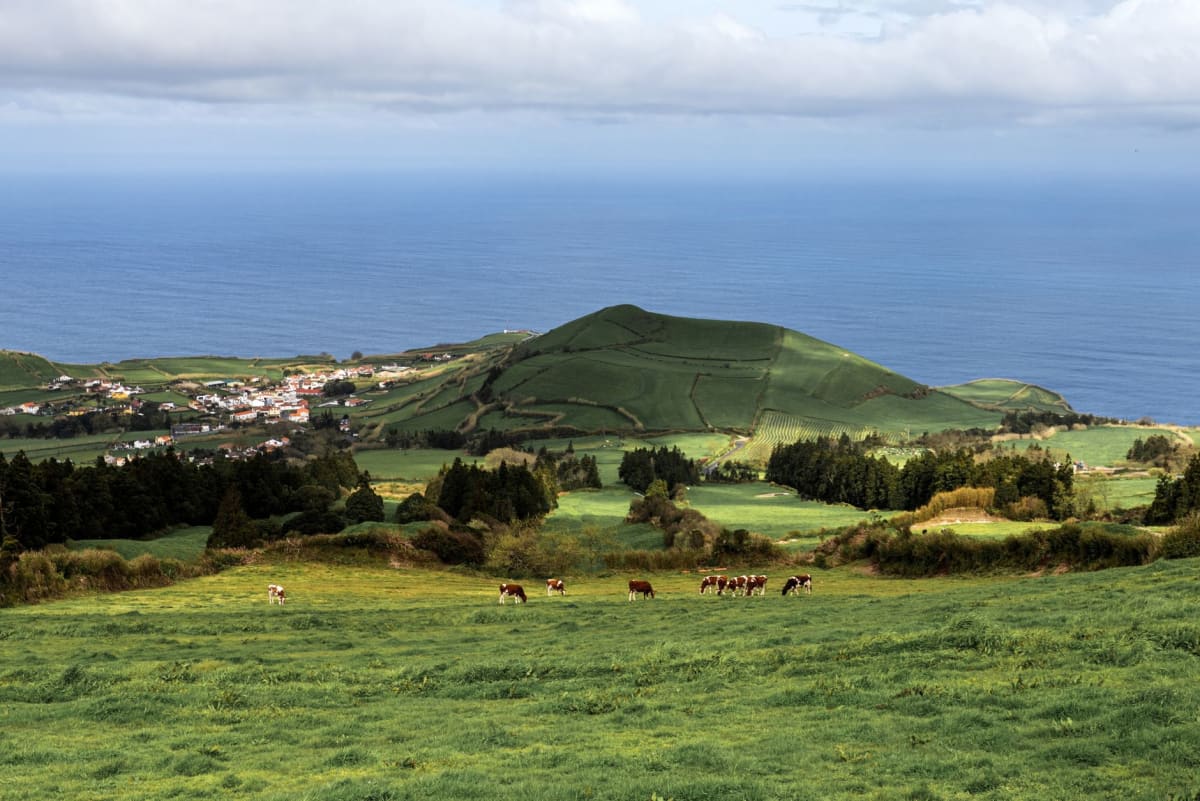
The evenings on Corvo are the strangest part. After dinner — which at my guesthouse meant whatever the family was eating, fish usually, with potatoes and local wine — the island goes quiet in a way that has physical weight. There is so little artificial light that the stars are enormous. I sat on the steps of the church one night for two hours just looking at the sky and thinking nothing in particular, which is harder than it sounds and more valuable than most things I do with two hours.
The supply boat from Flores comes twice a week. When it’s delayed by weather, the island manages. They’ve been managing for five centuries. The self-sufficiency is not rustic charm — it’s structural, it’s how the place works, and it creates a kind of calm in the residents that you feel immediately and cannot entirely explain.
When to go: June through September for stable weather and open trails. Flights from Flores fill; book weeks in advance. The island has limited accommodation — two or three guesthouses at most — and fills during summer. If you’re flexible, shoulder season in May or October is quieter and the light is extraordinary.
Keep exploring
More from Azores
 azores
Faial Island
The blue island of the Azores — hydrangeas, a marina full of Atlantic crossers, and a volcanic crater that swallowed a village in 1957.
Explore azores
Flores Island
The westernmost point of Europe, where waterfalls fall directly into the ocean and the continent feels like a rumour.
Explore azores
Furnas
A thermal valley where the earth cooks your lunch and the sulphur gets into everything, including your idea of what a landscape should be.
Explore azores
Graciosa Island
The pale island — whitewashed windmills, calm seas, and a thermal cave so strange it was used as a wine cellar for a century.
Explore azores
Lagoa do Fogo
São Miguel's highest crater lake, hidden in cloud most of the day, and heartbreakingly clear when it finally shows itself.
Explore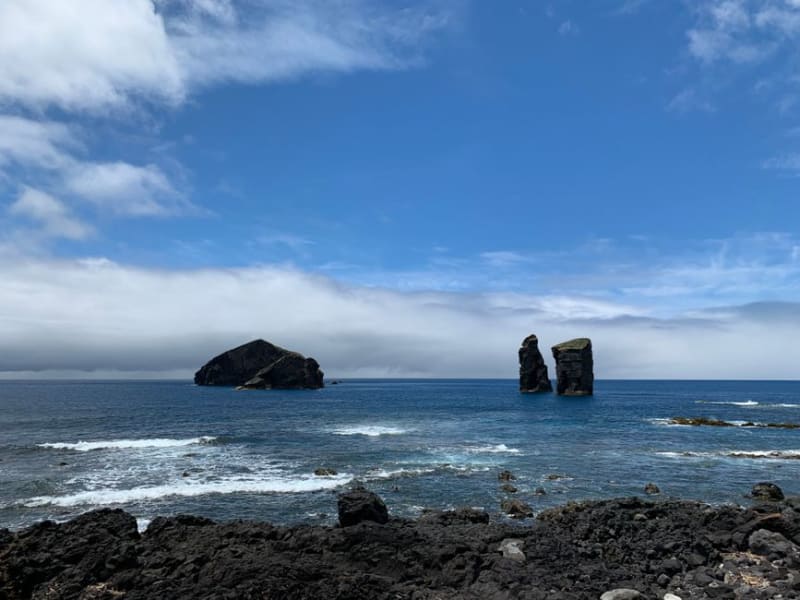 azores
Mosteiros
A black-sand village on Sao Miguel's west coast where volcanic rock pools trap the Atlantic into calm, swimmable seawater lagoons.
Explore