Kodaikanal
"I woke up to fog so thick it was inside the room, and went back to sleep very happily."
A hill station at 2,100 meters in the Palani Hills, built around a star-shaped lake and hidden inside a cloud forest that smells of eucalyptus and cold water.

Up into the Palani Hills
The road to Kodaikanal climbs through fourteen kilometers of hairpin bends from the plains, rising from paddy fields and banana groves into deciduous forest and then into the shola — that dense, low-canopied montane jungle unique to the Southern Indian highlands. At some point on the ascent the temperature drops abruptly and you can smell the moisture in the air changing, becoming something colder and more complex. By the time you reach the lake the air is genuinely cool and smells of pine resin and wet stone.
Kodaikanal was established as a retreat by American missionaries in 1845, which explains the slightly anomalous grid of churches and colonial bungalows around the lake. It attracted the British administration for the same reasons the missionaries liked it: escape from the lowland heat. The bungalows are still there, most of them converted to guesthouses or private hotels, wrapped in gardens of roses and rhododendrons that shouldn’t work at this latitude but do because of the altitude.
The Lake and the Circling Path
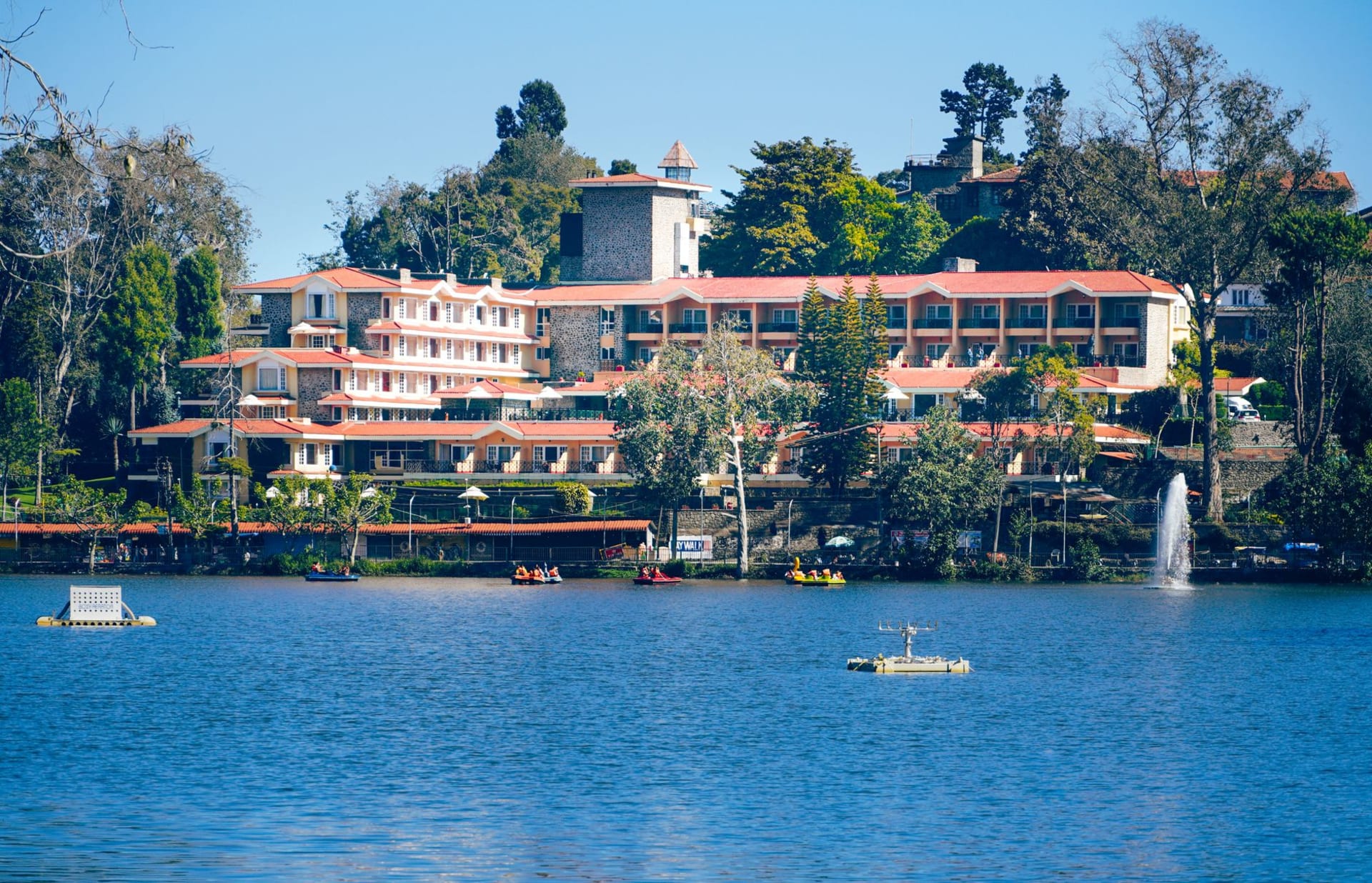
Kodaikanal Lake is artificial, created by a dam in 1863, and star-shaped — five points radiating from the center in a design that appears deliberate and is. Walking the five-kilometer path around it is the standard Kodaikanal morning activity, and it rewards the effort: the water changes color with the light, the mist comes and goes in layers, and the forest crowd noise from the town center fades entirely on the far side where the trees press close.
Lia found a small rowboat rental near the main landing and we spent an hour on the water one afternoon when the mist had dropped to just above the surface. The silence out there was the kind that amplifies small sounds — water against the hull, a bird I couldn’t identify, the far-off ring of a bicycle bell. We didn’t say much. There wasn’t much to add.
Coaker’s Walk and the Cliff View
Coaker’s Walk is a promenade along the cliff edge south of the lake, built by a Lieutenant Coaker in the 1870s and still offering the same view: when the mist clears, which it does unpredictably, the Palani Hills drop away to the plains almost two thousand meters below. The view can appear and vanish in minutes. I walked it three mornings in a row and got a clear view once, for about fifteen minutes, before the cloud came back in from the valley.
The shola forests on the hillsides below the town shelter rare plant communities that exist nowhere else — it’s a Biosphere Reserve. There are trekking routes into the forest that require a local guide, and the effort is worthwhile: the understory smells of dark earth and fern and something I’ve only ever encountered at altitude in the humid tropics.
Cheese, Chocolate, and Cold-Weather Eating
Kodaikanal produces two things that surprise visitors: chocolate and fresh cheese, both holdovers from the missionary and colonial settlement era. The chocolate shops along the main commercial street are legitimately good — homemade, dense, and sold by weight. The cheese is mostly soft and fresh, nothing elaborate, but welcome after weeks of South Indian food.
In the evenings the restaurants near the lake serve hot soups and corn dishes and masala chai that is actually necessary rather than optional. The cold here is real.
When to go: April through June is peak season as Indians escape the plains heat — crowds are heavy and prices spike. September through November, after the monsoon, the forest is intensely green and the waterfalls in the surrounding area are full. December through February is cold — genuinely cold at night, near 5–8°C — and wonderful if you’ve brought layers and want the place mostly to yourself.
Keep exploring
More from Tamil Nadu
 tamil-nadu
Madurai
One of the oldest continuously inhabited cities on earth, and the Meenakshi temple at its center makes that fact feel not like history but like something still in progress.
Explore tamil-nadu
Mahabalipuram
A seventh-century Pallava port city where the sea has been eating the stone monuments for thirteen hundred years, and they're still magnificent.
Explore tamil-nadu
Ooty
A British hill station marooned in the Nilgiris at 2,200 meters, where eucalyptus forest, tea estates, and a toy train conspire to make you forget you're in South India.
Explore tamil-nadu
Pondicherry
A former French colonial enclave on the Coromandel Coast where Tamil culture and French urban planning collide in a town of yellow walls, bougainvillea, and excellent croissants.
Explore tamil-nadu
Rameswaram
An island at the tip of a peninsula, twenty kilometers from Sri Lanka, where one of Hinduism's most sacred pilgrimage sites rises from a landscape that feels scraped clean by salt wind.
Explore tamil-nadu
Thanjavur
The Chola capital that gave South India its defining aesthetic — a city where a thousand-year-old granite temple still sets the visual standard for everything around it.
Explore