
Mineral de Pozos
"The mine ruins cast long shadows in the afternoon and nobody I asked could agree on exactly what had happened here, which seemed right for a ghost town."
A ghost town turned artist colony in the high desert of Guanajuato, where the crumbling ruins of 19th-century silver and copper mines share the landscape with galleries, mezcal bars, and painters who came for the light and quietly never left.

I came on a Tuesday in February, when the light hits the meseta at a low angle all day and turns the ruins a color somewhere between rust and gold. The bus from San Luis de la Paz dropped me at the edge of the zócalo just after noon. There were maybe three other people in the square. A dog was asleep against the church steps. I stood for a moment wondering if I had gotten off at the wrong stop, then a man came out of a doorway carrying a canvas and I understood I was in the right place.
Ruins and the People Who Paint Them
Pozos — locals almost never say the full name — was a mining boomtown in the late 1800s and was almost completely abandoned by the 1950s. The mines that produced silver, copper, and a brief fever of speculation now stand open to the sky, their stone walls still intact enough to walk through but wild enough that cacti grow through the floors. I spent an afternoon in the Hacienda de Cinco Señores ruins, where a photographer from Mexico City had set up a small exhibition in one of the roofless chambers, prints clipped to string between the walls. It was the strangest gallery I have been to. The light came in differently every twenty minutes. Two painters working nearby told me they came every dry season because, they said, nowhere else in Mexico gives you this quality of afternoon diffusion. I did not argue. It is the kind of ruin that makes you want to make something rather than just look.

Mezcal in a Ghost Town
The town’s small commercial strip along Calle Zaragoza holds a handful of galleries, a couple of guesthouses, and two or three places that sell mezcal from the region. I stopped into one whose name I never caught — painted wood sign, three tables, a man behind a counter — and spent longer than I intended working through small pours of a tobalá from Guanajuato state. The owner explained that Pozos had been legally dead, not just abandoned: it was officially depopulated for decades before people started coming back in the 1990s, first a few artists, then slowly more. The mezcal was smoky in a restrained way, nothing showy. We talked through the afternoon while the light outside shifted.

The Sunday Market
On weekends a small tianguis spreads across the zócalo — local ceramics, dried herbs from the desert, the occasional piece of silver jewelry made in town. It is not a market for tourists in the way San Miguel’s Mercado de Artesanías is; the vendors are mostly local and the prices reflect that. I bought a small clay whistle shaped like a dog, the kind made with pre-Hispanic techniques that a handful of artisans in the area have revived. It cost forty pesos. I have carried it since.

Getting There
The easiest approach is a bus to San Luis de la Paz from San Miguel de Allende (roughly 90 minutes), then a local colectivo or taxi the remaining 20 kilometers to Pozos. Some people drive from San Miguel directly — about an hour on federal highway 57D toward Querétaro, then state roads north. There is no bus station in Pozos itself; confirm your return options before you go.
Keep exploring
More of Guanajuato
Keep exploring
More from Guanajuato
 mexico
 San Luis de la Paz
At the northeastern edge of Guanajuato where the Bajío hills roughen into the Sierra Gorda, San Luis de la Paz carries its Pueblo Mágico distinction quietly — colonial arcades, a handsome plaza, and a Sunday tianguis where Chichimec Jonaz artisans still lay out their embroidered work alongside dried chiles and Sierra Gorda produce. The town was founded specifically as a peace settlement after decades of failed military campaigns against the Chichimec confederacy, a history the locals have not forgotten.
Explore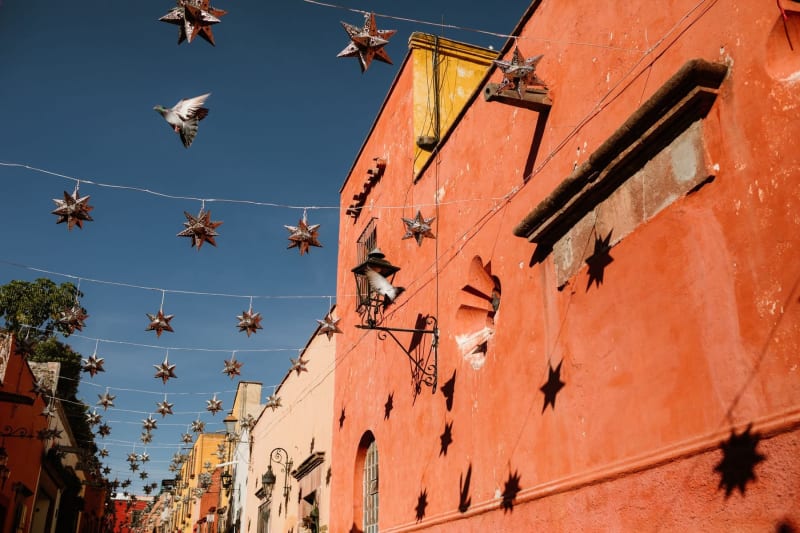 mexico
 San Miguel de Allende
A hilltop colonial gem where pink parroquia bells ring over cobblestones and artists have gathered for decades.
Explore mexico
 Dolores Hidalgo
The town where Miguel Hidalgo rang the church bell on September 16, 1810, and set off a revolution. Today Dolores is better known for hand-painted talavera and the strangest ice cream menu in the republic — shrimp, mole, tequila, and corn, all sold in the shadow of the Parroquia de Nuestra Señora de los Dolores.
Explore mexico
 Dolores Hidalgo
The town where Mexican independence was declared in 1810 is also, improbably, the country's capital of eccentric ice cream — shrimp, beer, chicharrón — and some of the finest Talavera-style ceramics you will find anywhere in Guanajuato. The patriotic drama and the bizarre helado sit side by side on the main plaza, and somehow both feel entirely Mexican.
Explore mexico
 Xichú
Xichú sits at the end of a long canyon descent in Guanajuato's Sierra Gorda, far enough from the main circuit that its huapango arribeño tradition has survived nearly intact. Every January, trovadores converge for an overnight verse duel in the central plaza; the rest of the year, the draw is quieter — canyon trails that see almost no traffic, cold-water cascades, and a kitchen built on dried chiles and river fish.
Explore mexico
 Comonfort
Comonfort is a colonial town on the Laja River between San Miguel de Allende and Celaya, known locally for its ceramics and known to very few people outside the region for the Cañada de la Virgen — a pre-Columbian pyramid complex on the edge of a river canyon 25km from town that was only opened to visitors in 2011. On a clear morning with the light coming low across the canyon, the site felt like a real discovery rather than an attraction.
Explore