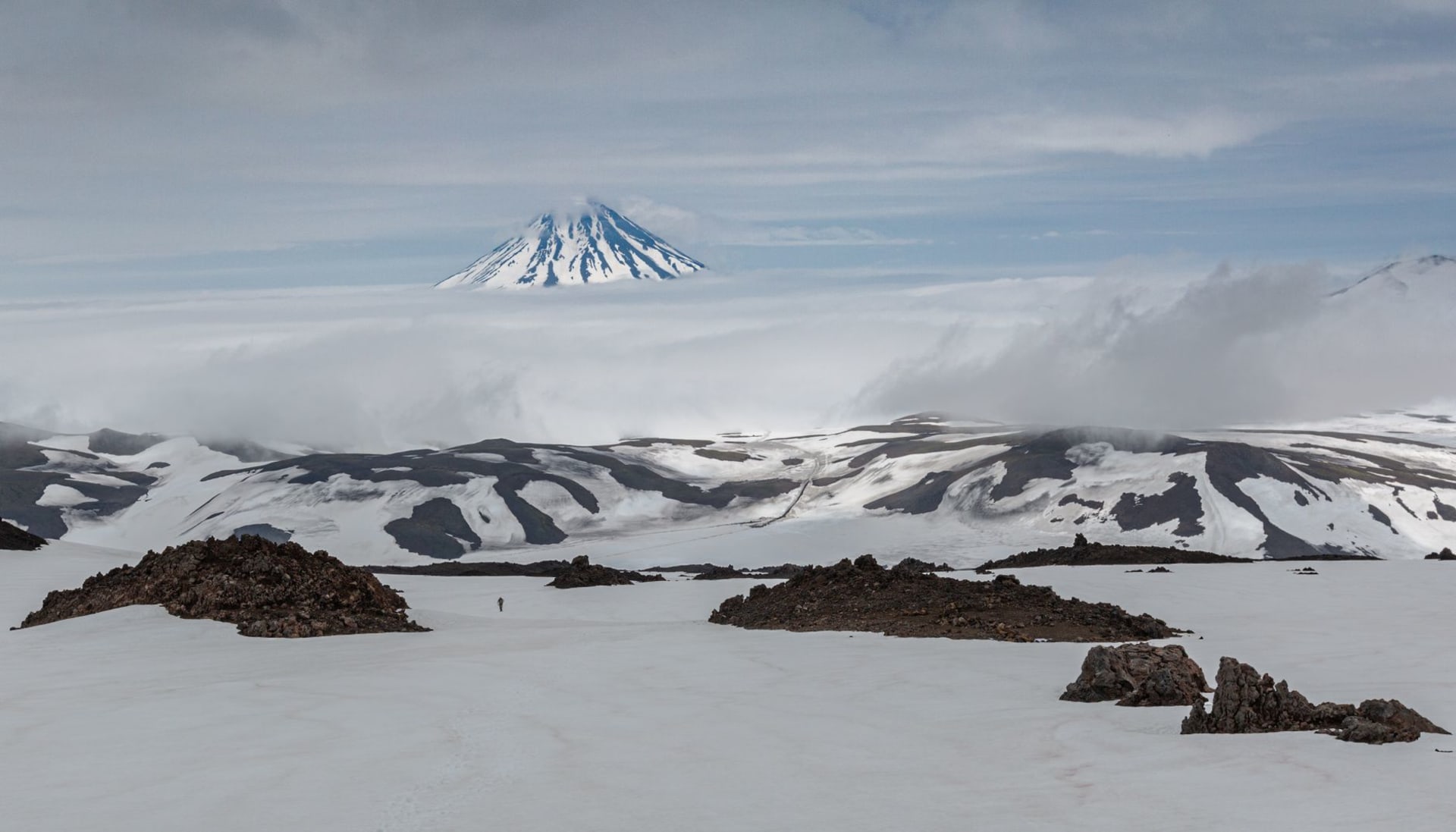
Klyuchevskaya Sopka
"The taxi driver pointed at it and said something that meant 'it erupted last Tuesday' — like that was just weather."
Eurasia's highest active volcano rises 4,750 metres from the tundra and erupts with the casual regularity of something that has never needed a reason.

The first thing the taxi driver in Petropavlovsk did was point east and make a gesture with his hand — fingers splayed outward, a kind of explosive bloom — and say something emphatic in Russian. My guesthouse host translated later: he said Klyuchevskaya erupted last week and you can probably still see the ash on the snow from the road to Klyuchi. This is how Kamchatka introduces its most dramatic feature: not with reverence, but with a local’s matter-of-fact relationship to the extraordinary. The volcano has been in near-continuous eruption for centuries. Ash falls on the town of Klyuchi the way rain falls elsewhere.
The drive north from Petropavlovsk takes most of a day along roads that alternate between asphalt and ambitious gravel, through birch forest and tundra that flattens out as you push north, and then suddenly the Klyuchevskaya Group appears — half a dozen volcanoes clustered together in the central Kamchatka depression, and Klyuchevskaya towering above them all. At 4,750 meters it is the highest active volcano in Eurasia and among the most active on Earth, and its cone is textbook perfect: symmetrical, steep, enormous. When the cloud lifts you see the full height of it and feel a specific kind of smallness that has nothing to do with ego and everything to do with geology.

The town of Klyuchi sits at the volcano’s base, a small logging and science settlement where the Institute of Volcanology maintains a monitoring station that has been tracking Klyuchevskaya’s activity since the Soviet era. The scientists here are pragmatic in the way that only people who live next to an active supervolcano can be: they talk about eruption indexes and lava flow vectors the way other people talk about traffic. I spent an afternoon in the station common room looking at their seismographs — actual paper rolls with ink traces, the kind you see in movies — and watching the needle move with every small tremor the mountain produced.
Trekking on Klyuchevskaya requires permits, a local guide, and a clear-eyed understanding of risk. The crater itself is inaccessible during active eruption phases, which is most of the time. But the lower flanks can be climbed, and the approach through the lava fields of past eruptions — black basalt in fantastic formations, some flows recent enough that the rock still has a raw, unweathered look — is one of the most otherworldly walks I’ve taken anywhere. Volcanic bombs from past eruptions lie scattered across the slope: boulders the size of washing machines that were thrown from the crater and landed here, sometimes kilometers from the summit, cooling in mid-air into aerodynamic shapes.

At night, during active periods, the crater glows. It is a faint orange at the summit, visible from the town on clear nights, pulsing faintly — the mountain breathing. I sat outside the guesthouse in Klyuchi at midnight and watched it for twenty minutes in temperatures that were pushing toward zero even in August, unwilling to go inside. There is something ancient and irreducible about that glow. The volcano does not know I am watching and would not care if it did.
When to go: July through September for the clearest summit views and most accessible trekking conditions. August gives the best chance of seeing the crater glow against a dark sky without full midnight sun. Book guides through the Klyuchi Institute of Volcanology or established operators in Petropavlovsk — unguided ascent on active flanks is both dangerous and officially prohibited.
Keep exploring
More from Kamchatka
 kamchatka
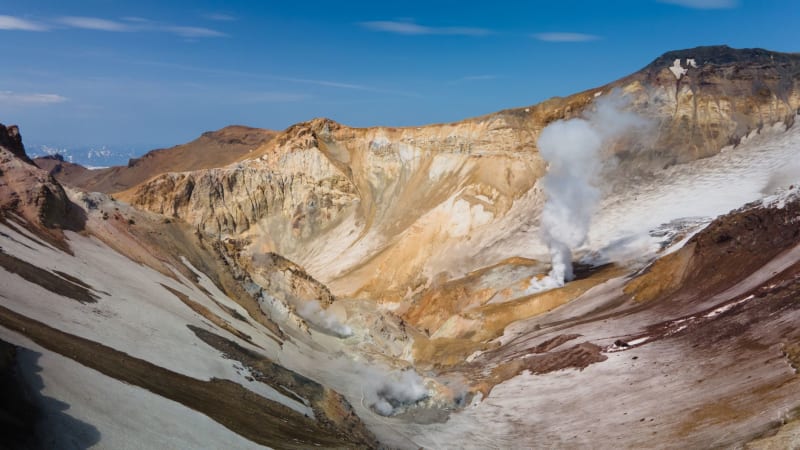
 Kronotsky Nature Reserve
A UNESCO biosphere with the world's densest brown bear population, active volcanoes, and salmon rivers where the fish run so thick you can hear them from the bank.
Explore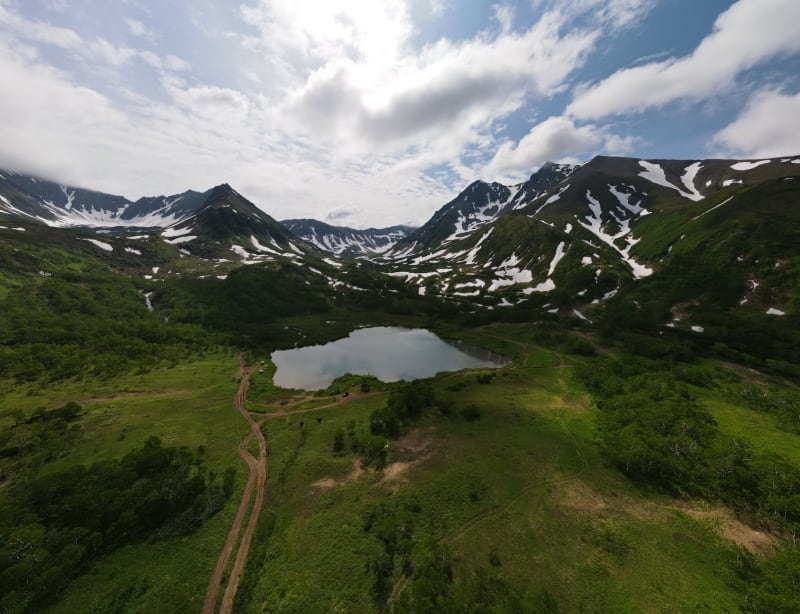 kamchatka
 Kurilskoye Lake
A volcanic caldera lake in the southern peninsula where tens of thousands of sockeye salmon spawn each August and the bears know exactly when to show up.
Explore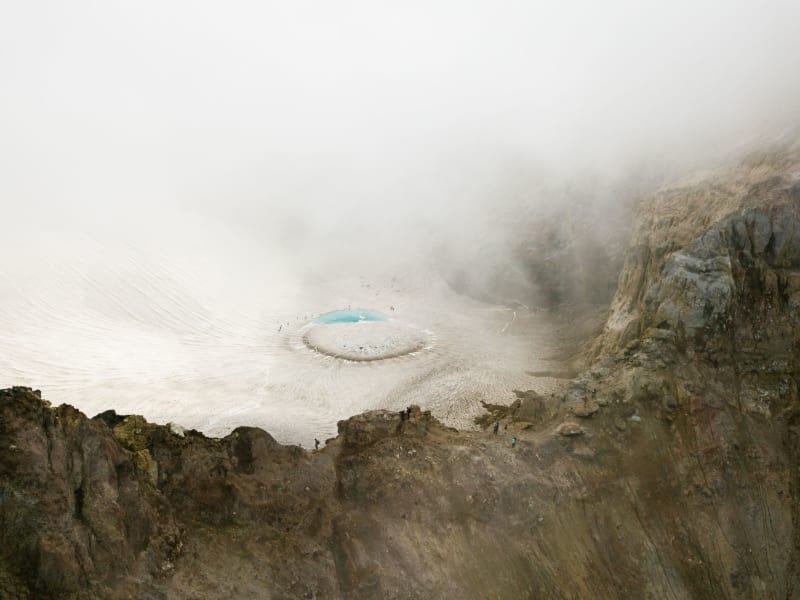 kamchatka
 Mutnovsky Volcano
An active volcano in southern Kamchatka you can actually walk into — craters, acid streams, and sulfur-stained ice beneath a glacier that the earth is slowly consuming.
Explore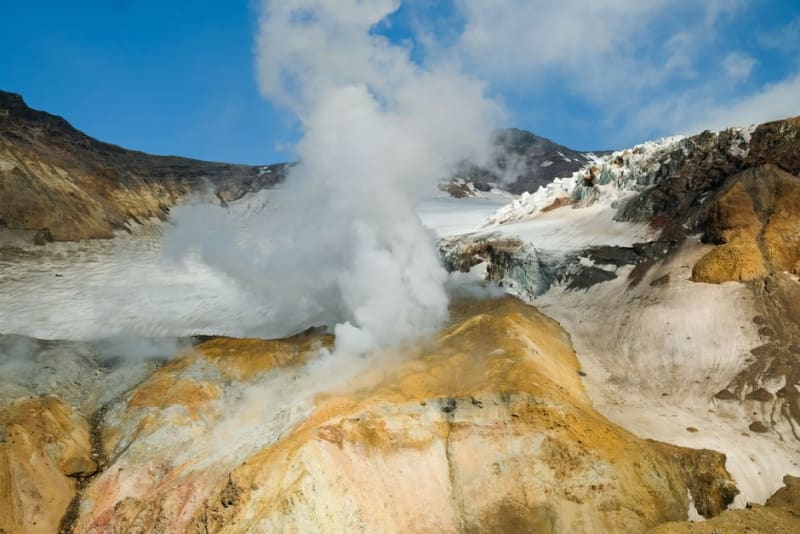 kamchatka
 Nalychevo Park
A wide nature park of hot springs and wildflower meadows reachable only on foot or by helicopter, ringed by three volcanoes.
Explore kamchatka
 Ozernovsky
A remote fishing settlement near the Kuril Lake salmon-spawning grounds, where the salt-air smell of the cannery never quite leaves.
Explore kamchatka
 Paratunka
Natural volcanic hot springs an hour from Petropavlovsk where locals soak in geothermally heated water while snow falls on the fir trees above.
Explore