
Bartica
"Bartica smells like outboard motor fuel and woodsmoke and something else — possibility, maybe, or the particular hope of people heading somewhere they've never been."
Where the Essequibo, Mazaruni, and Cuyuni rivers converge and the gold rush never quite ended — a working town at the threshold of everything beyond.

You reach Bartica by speedboat from Parika, about two hours upriver from the coast, and the journey itself is preparation. The Essequibo is one of the widest rivers in South America — at its mouth it spans thirty kilometres — and even here, far inland, it moves with the authority of something that knows it has a long way to go. The banks shift between dense forest and occasional clearings where small communities have pulled dugout canoes above the waterline. The water is clear over sand in places, tea-brown over darker substrates, and on the crossing to Bartica you begin to understand why this river was the route into the country’s interior for three centuries of colonial extraction and Amerindian trade alike.
Bartica sits at the confluence of three rivers — the Essequibo, the Mazaruni, and the Cuyuni — and this geography has always made it the staging post for everything beyond. Gold miners heading for the interior pass through here. Timber workers, diamond prospectors, men carrying equipment for operations I never fully identified. The waterfront market, a low row of wooden buildings above the landing, is where boats unload and load again and where the commerce of the interior flows through in both directions. I spent a morning watching the traffic and drinking bush rum at a waterfront bar whose sign had been bleached illegible by years of sun, talking to a miner from the Mazaruni goldfields who had been coming to Bartica to resupply for seventeen years and who described the interior with the intimate knowledge of someone who has spent more of his life in forest than out of it.

The town grid behind the waterfront is wider and more established than you might expect — there are churches, a secondary school, a cricket ground where games were under way on the afternoon I walked past. The gold boom cycles have brought money and then removed it repeatedly over a century, and Bartica wears that history in a certain pragmatic solidity: nothing too polished, nothing entirely neglected, the infrastructure of a place that has learned not to count on permanence but has built something durable anyway. The Chinese restaurants serve large plates for modest prices. The rum shops open early. The bakeries that line one of the side streets sell pine tarts and cheese rolls and a dense, slightly sweet bread that I ate warm, standing on the pavement, and could not stop thinking about for the rest of the day.
Marshall Falls, a few kilometres by boat, is where Bartica residents go on weekends — a series of cascades over granite boulders where the water runs clear enough to see the bottom, and where it is entirely possible to have a pool to yourself if you time it right. I went on a Thursday afternoon with a boat operator named Claude who had grown up swimming these falls and who watched me navigate the slippery rocks with the patient amusement of someone who has seen tourists do this before.

What Bartica offers is not the polished experience of a tourist destination but the authentic texture of a town that is fully itself, operating on its own logic, hospitable to visitors in a matter-of-fact way rather than a curated one. I stayed two nights and felt, both times, like I was moving at the right speed for the place.
When to go: Bartica is accessible year-round by speedboat from Parika. The dry seasons (February to April and August to September) make the river crossings more predictable and the roads around town more navigable. The town fills up on long weekends when Georgetowners come up to escape the coast — arrive midweek for a quieter experience and better chances of getting a room without advance booking.
Keep exploring
More from Guyana
 guyana
 Fort Kyk-Over-Al
A crumbling Dutch archway on a river island where three Guyanese rivers meet, and where empire once watched the water for enemies.
Explore guyana
 Georgetown
A city of painted wooden houses on stilts, where Caribbean heat and East Indian spice collide at the edge of the Demerara River.
Explore guyana
 Iwokrama Rainforest
One of the last pristine tropical rainforests on earth, where a canopy walkway puts you level with harpy eagles and silence costs nothing extra.
Explore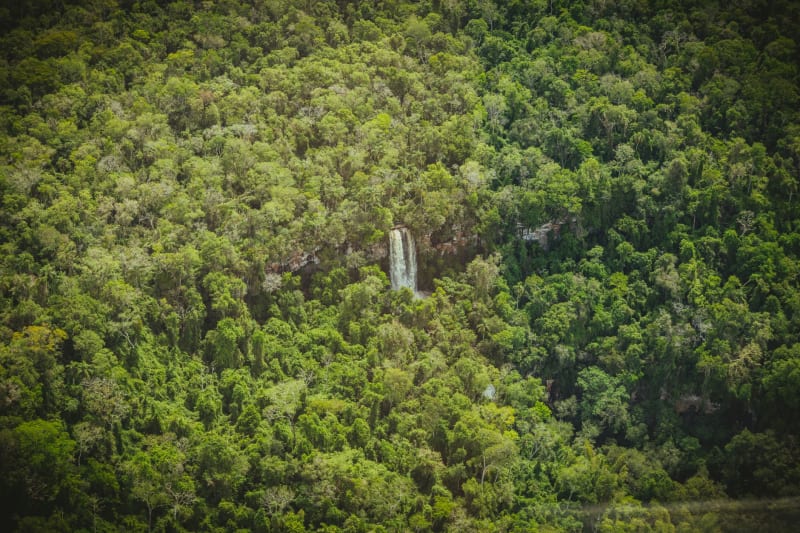 guyana
 Kaieteur Falls
Four times the height of Niagara, surrounded by nothing but tepui plateau and cloud forest — and not a single railing between you and the edge.
Explore guyana
 Karanambu
A former cattle ranch turned conservation lodge on the Rupununi River, world-famous for its giant river otters and the night-blooming Victoria amazonica lilies.
Explore guyana
 Lethem
A red-dust frontier town at the end of the coastal road, where Amerindian culture and cowboy rodeo share a border crossing with Brazil.
Explore