Vaison-la-Romaine
"One bank is two thousand years old, the other is nine hundred, and the bridge between them has outlasted both."
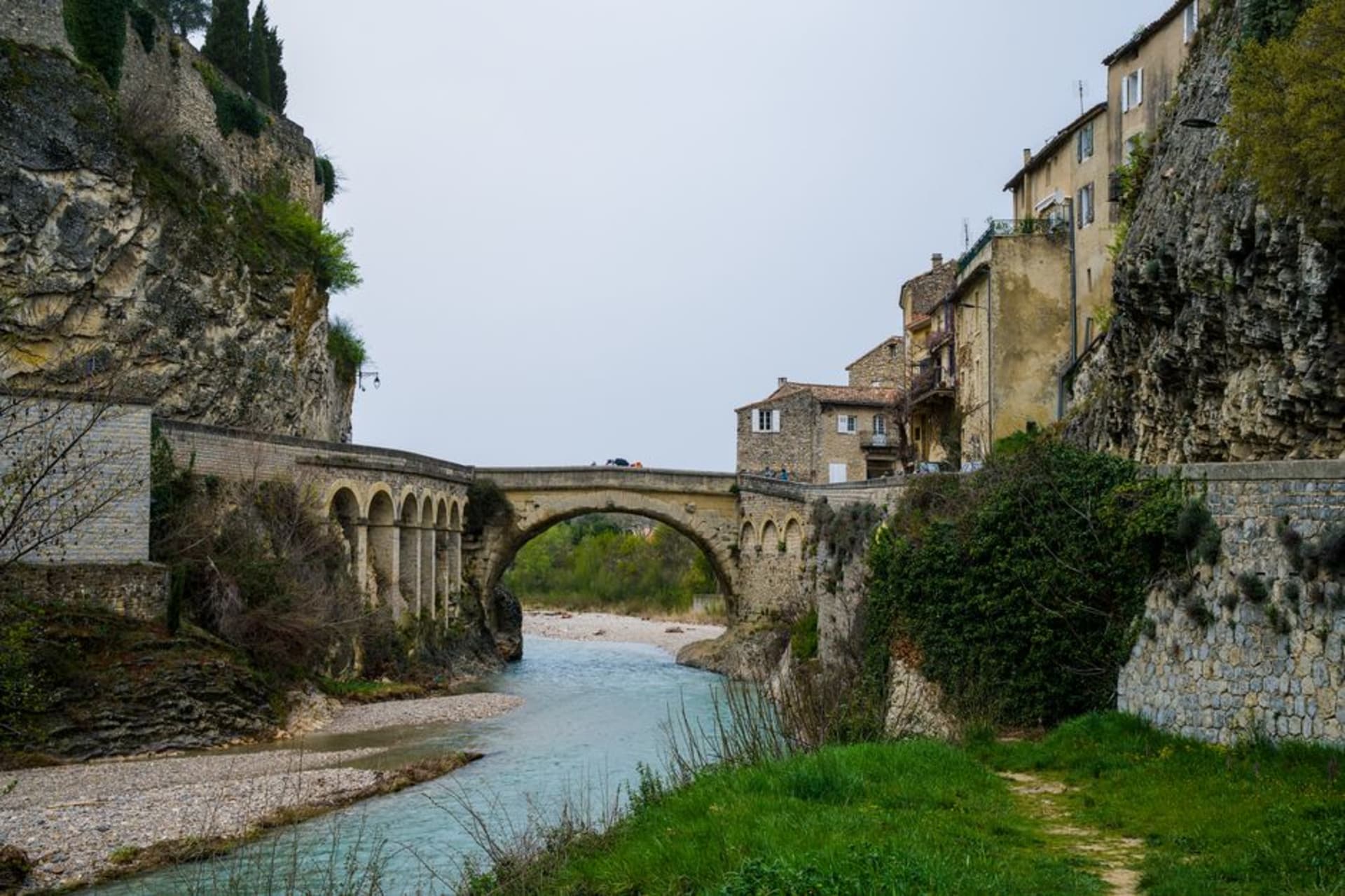
A town split by the Ouvèze river into a Roman city of excavated ruins on one bank and a medieval hilltop citadel on the other, connected by a bridge the Romans built and the floods never quite took.

Vaison splits cleanly down the middle. On one side of the Ouvèze river, excavated Roman townhouses and a theatre sit open to the sky in what’s one of the largest archaeological sites in France; on the other, a medieval village climbs a rocky hill to a ruined counts’ castle, its lanes so narrow that Lia’s shoulders brushed both walls at once more than once. A single bridge — Roman-built, nearly two thousand years old — connects the two, and has done so through wars, earthquakes, and a catastrophic 1992 flood that destroyed nearly everything else along the riverbank without taking the bridge down.
A Roman city with its roof lifted off
The Puymin and Villasse quarters lay out an entire Roman neighbourhood at ground level — colonnaded courtyards, mosaic floors, the plumbing of villas that belonged to some of Roman Gaul’s wealthiest families, and a theatre carved into the hillside that still hosts a summer festival, actors performing to the same stone tiers Roman audiences sat in. Walking the site in the late-afternoon heat, cicadas going full volume, it felt less like a museum and more like a town that had simply had its roof and its people quietly removed.

The hill town that survived by hiding
The medieval Haute-Ville was built in the twelfth century as a defensible retreat when the lowland Roman town became too exposed to raiders, and it still reads that way — a single fortified gate, steep stepped lanes, houses stacked against each other for structural support as much as space. We climbed to the ruined château at the top as the light went orange, looked back down at the Roman ruins across the river doing the same thing they’d been doing since before the medieval town existed, and got, not for the first time in Provence, a slightly dizzy sense of how much time was stacked up in front of us.

When to go: Come for the Tuesday market, one of the oldest in Provence, and stay for the Roman theatre’s summer festival if the dates line up. Spring and early autumn keep the ruins walkable without the midday sun turning the site into a furnace.
Keep exploring
More of Provence
Keep exploring
More from Provence
 france
 Séguret
A village stacked into a hillside below the jagged Dentelles de Montmirail, small enough to see in twenty minutes and beautiful enough that we stayed for two hours anyway.
Explore france
 Carpentras
A market town with the oldest synagogue still in use in France tucked behind an ordinary-looking door, and a Friday market smelling so strongly of truffle in winter that I followed my nose before I found the stall.
Explore france
 Orange
A workaday Rhône town wrapped around the best-preserved Roman theatre in Europe, where the wall still throws sound the way its engineers intended two thousand years later.
Explore france
 Isle-sur-la-Sorgue
A town split into channels by the clear, fast-running Sorgue river, its old waterwheels still turning beside one of the biggest antiques markets in France.
Explore france
 Gordes
A village of pale stone stacked in tiers up a Luberon cliff face, visible from the valley floor for kilometres before you've worked out how to actually drive up to it.
Explore france
 Sault
A windswept plateau town where the lavender fields run right up to the edge of Mont Ventoux, and the nougat shops smell like honey from the street before you've even found the door.
Explore