Arc-et-Senans
"I've toured a lot of factories in my head from old photos. I never expected one built like a temple."
A salt factory built as a utopia, half-moon shaped and dropped into the Jura countryside by an architect who wanted to redesign society along with the buildings, and who only ever finished the half.

I’d read about the Saline Royale before we went and still wasn’t prepared for how strange it looks in person. Claude-Nicolas Ledoux, the architect Louis XVI put in charge of the royal saltworks, was given a practical brief — process brine piped in from Salins-les-Bains, evaporate it into salt, do it efficiently — and used it as an excuse to build something closer to a philosophical statement than a factory. The result, finished in 1779, is a row of severe neoclassical buildings arranged in a semicircle, colonnaded and pedimented like Greek temples, built to produce salt.
An ideal city that stopped at the half
Ledoux’s real ambition was bigger than the saltworks itself. His engravings from the period show the semicircle we walked through as only half of a planned circular city, a full utopian settlement with housing, a market, even a church, radiating outward from the director’s house at the center like spokes. None of the rest was ever built — the money and the political will ran out before the Revolution swept away what remained of royal patronage for grand architectural gestures — so what stands today is a fragment of an idea rather than the idea itself. Walking the grass courtyard at the center, it’s oddly easy to feel the missing half anyway, the way the buildings curve as if waiting for the rest of the circle to close.

Salt that never quite paid for itself
The saltworks operated for about a century, boiling Salins brine in enormous cauldrons inside the workshop buildings, but it was never especially profitable — the piped brine lost concentration over the eight kilometers from Salins, and cheaper salt from elsewhere in France undercut it steadily. It closed in 1895, decayed for decades, and was rescued and restored starting in the 1960s, eventually becoming a UNESCO World Heritage site and a venue for exhibitions and events. Inside one of the wings, a small museum on Ledoux’s broader work made me want to detour to his other buildings, most of which, unlike this one, no longer exist.

When to go: Spring through early autumn, when the courtyard gardens are in bloom and the site sometimes hosts open-air exhibitions in the evening light.
Keep exploring
More of Jura
Keep exploring
More from Jura
 france
 Arbois
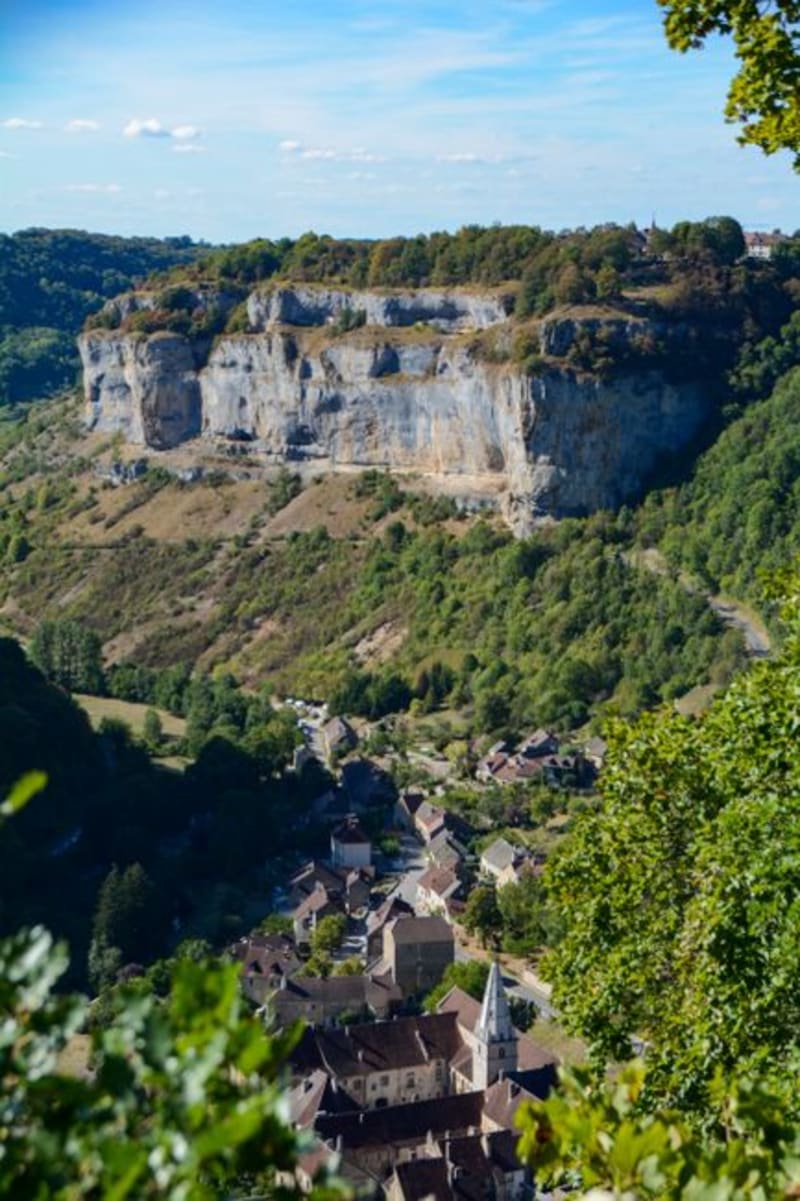
The unofficial wine capital of the Jura, a stone-built town along the Cuisance river where Louis Pasteur did his early wine research and vin jaune, the region's strange, sherry-like specialty, still ages in oak for over six years.
Explore france
 Salins-les-Bains
A UNESCO-listed saltworks built into a river gorge, where I walked underground galleries that funded the Franche-Comté for a thousand years before soaking in the same brine that made the town rich.
Explore france
 Pupillin
A village of maybe two hundred people and roughly as many wine cellars, self-declared capital of the Poulsard grape, where every second door seemed to open onto someone's family cave.
Explore france
 Dole
The town where Louis Pasteur was born in a tannery by the canal, and where the old quarter's arcaded streets convinced me the Jura had a proper city hiding at its edge all along.
Explore france
 Champagnole
A quiet forest town we used purely as a base, and which turned out to be the best decision of the whole trip once we found the Hérisson waterfalls a short drive away.
Explore france
 Château-Chalon
A clifftop village of barely one hundred and fifty people that somehow invented vin jaune, and where the ruined abbey above the vines gave us the single best view of the whole Jura wine country.
Explore