The Temples of Chiang Mai — Where Gold Meets Silence
The Moat and the Morning
I arrived in Chiang Mai on the overnight train from Bangkok — fourteen hours in a second-class sleeper that cost less than a decent meal in Paris, the bunk narrow, the sheets surprisingly clean, and the rhythm of the rails the kind of lullaby that only works when you surrender to it completely. The train pulled into the station at dawn, and I walked out into air that was ten degrees cooler than Bangkok, scented with frangipani and the faint smoke of incense from a temple I could not yet see. The old town was a fifteen-minute walk away, bounded by its medieval moat — a square of water and brick walls that has defined the city’s shape since King Mengrai founded it in 1296. Inside that square, over three hundred temples occupy an area smaller than the sixth arrondissement. I had ten days. It was not enough.
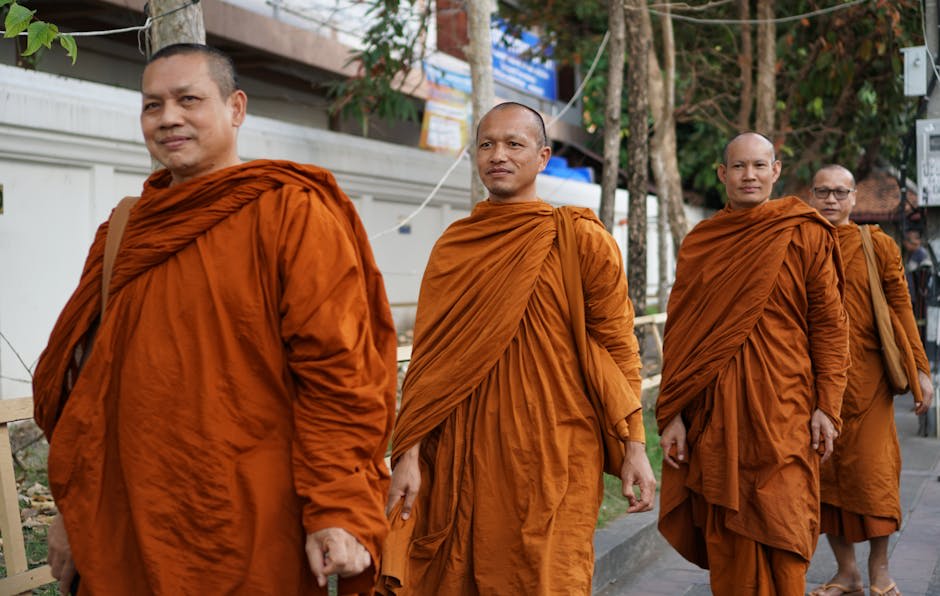
The first morning set the pattern. I woke before the alarm, stepped outside the guesthouse on Ratchadamnoen Road, and found the monks already walking. They moved in single file, barefoot, their alms bowls cradled like something precious, and the residents of the old town knelt on the pavement with offerings of sticky rice and fruit. No one spoke. The only sounds were footsteps and birds and the distant hum of a motorbike on a parallel street. I stood at a respectful distance, watching, and something about the formality of it — the discipline, the daily repetition, the quiet insistence that some things are too important to rush — recalibrated my sense of what mornings are for.
Wat Chedi Luang, the first temple I entered, set an impossible standard. The ruined chedi — originally over eighty metres tall before the 1545 earthquake reduced it — dominates the old town’s skyline with a presence that is more geological than architectural. The brickwork is exposed, the stucco long gone, and the elephant buttresses that ring the base have been partially restored with a care that respects the ruin rather than disguising it. I climbed the steps to the upper platform and looked out across the temple grounds, where monks in saffron sat on benches reading phones with the same concentration they would bring to scripture. The sacred and the mundane, coexisting without friction. Thailand does this better than any country I know.
The Art of Sitting Still
What the temples of Chiang Mai taught me, over ten days of visiting them, is that the point is not to see them all. The point is to sit inside one long enough for the silence to do its work. Wat Phra Singh, near the western gate, houses the Phra Phuttha Sihing Buddha in a chapel decorated with murals from the nineteenth century — scenes of Lanna life painted with a delicacy and humour that made me linger for over an hour, reading the images like a graphic novel. Market vendors selling fruit. Men courting women. Elephants being led through streets. A cat asleep on a windowsill. The artist — anonymous, as they almost always are — had the gift of noticing the small things, and the murals feel less like religious art and more like a love letter to daily life in a city that was already centuries old when they were painted.
Wat Umong was different. Located in the forest at the base of Doi Suthep, away from the old town’s density, this temple was built in the fourteenth century by King Ku Na for a revered monk who preferred meditating in the woods. The tunnels beneath the stupa — dark, cool, their walls bearing traces of frescoes that time and moisture have reduced to ghostly outlines — create a space that is less a temple and more a cave, in the oldest sense of that word: a place of withdrawal, of deliberate removal from the noise of the world. I sat in one of the tunnels for twenty minutes, listening to nothing, and when I emerged into the sunlight the forest seemed louder and more alive than it had before I went in.
The monks at Wat Umong run a meditation retreat that is open to visitors — free, donation-based, taught in English by a Thai monk named Phra Ajahn who spoke with the particular clarity of someone who has spent decades choosing his words carefully. I attended a single session and found it simultaneously simple and impossibly difficult: sit, breathe, notice. The instruction was minimal. The challenge was enormous. My mind, accustomed to the constant stimulation of travel — new sights, new meals, new languages — resisted stillness the way a child resists bedtime. But by the end of the hour, something had shifted. Not peace, exactly, but a lowering of volume. A gap between thoughts where there had been none.
The Sunday Market and the Night
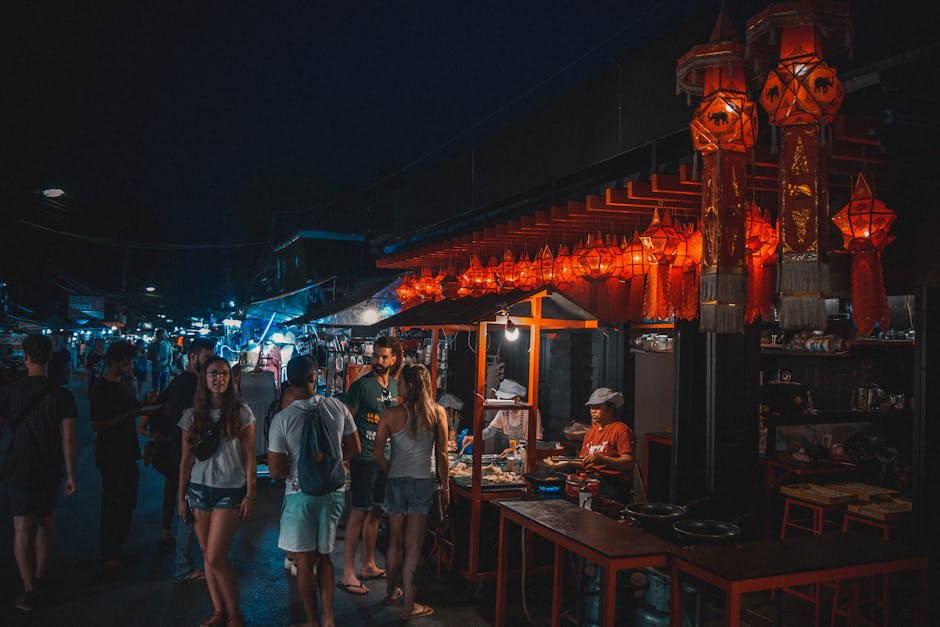
Every Sunday, the old town’s main street — Ratchadamnoen Road — closes to traffic and fills with vendors, lanterns, musicians, and the smell of food cooking on charcoal. The Sunday Walking Street Market is Chiang Mai’s weekly celebration of itself, and it is one of the best markets I have experienced anywhere in Southeast Asia. The textiles are exceptional — hill tribe fabrics in indigo and vermillion, hand-embroidered by Hmong and Karen artisans from the surrounding mountains who sit behind their stalls with the patient confidence of people who know the quality of their own work. I bought a jacket from a Hmong woman who told me, through her daughter’s translation, that the pattern I had chosen represented a journey — not a specific journey, but the idea of one, the act of leaving and returning, stitched into cloth.
The food at the market is the other revelation. Sai ua — the northern Thai sausage made with lemongrass, galangal, and kaffir lime — is grilled over charcoal until the casing blisters, and the taste is so complex it takes three bites before your palate can separate the individual ingredients. Kanom krok — coconut pancakes cooked in cast iron moulds — are crispy on the outside and custardy within, served in pairs and eaten with your fingers. I ate my way from one end of the market to the other, stopping at every stall that had a queue of locals, and I was not hungry again until the following afternoon.
The night itself, in Chiang Mai, has a quality I have not found elsewhere. The heat of the day dissipates, the temple bells ring at intervals that feel more musical than functional, and the streets empty slowly until you are walking alone under the trees that line the moat, the water reflecting the streetlights and the occasional bat skimming the surface. I walked the entire perimeter of the moat one evening — about six kilometres — and the city revealed itself in layers: the murmur of a prayer from behind a temple wall, a family eating dinner on their porch, a cat watching me from a wall with the territorial confidence of a creature that knows it belongs here more than I do.
Doi Suthep and the View
The road up Doi Suthep is a series of switchbacks through forest that thickens and cools as you climb. The temple at the summit — Wat Phra That Doi Suthep, the most sacred in Chiang Mai — is reached by a staircase of 306 steps flanked by naga serpent balustrades that writhe upward in a riot of green and gold ceramic scales. I climbed them in the early morning, when the mist was still caught in the trees and the staircase was almost empty, and by the time I reached the top my calves were burning and the air smelled of pine and incense in equal measure.
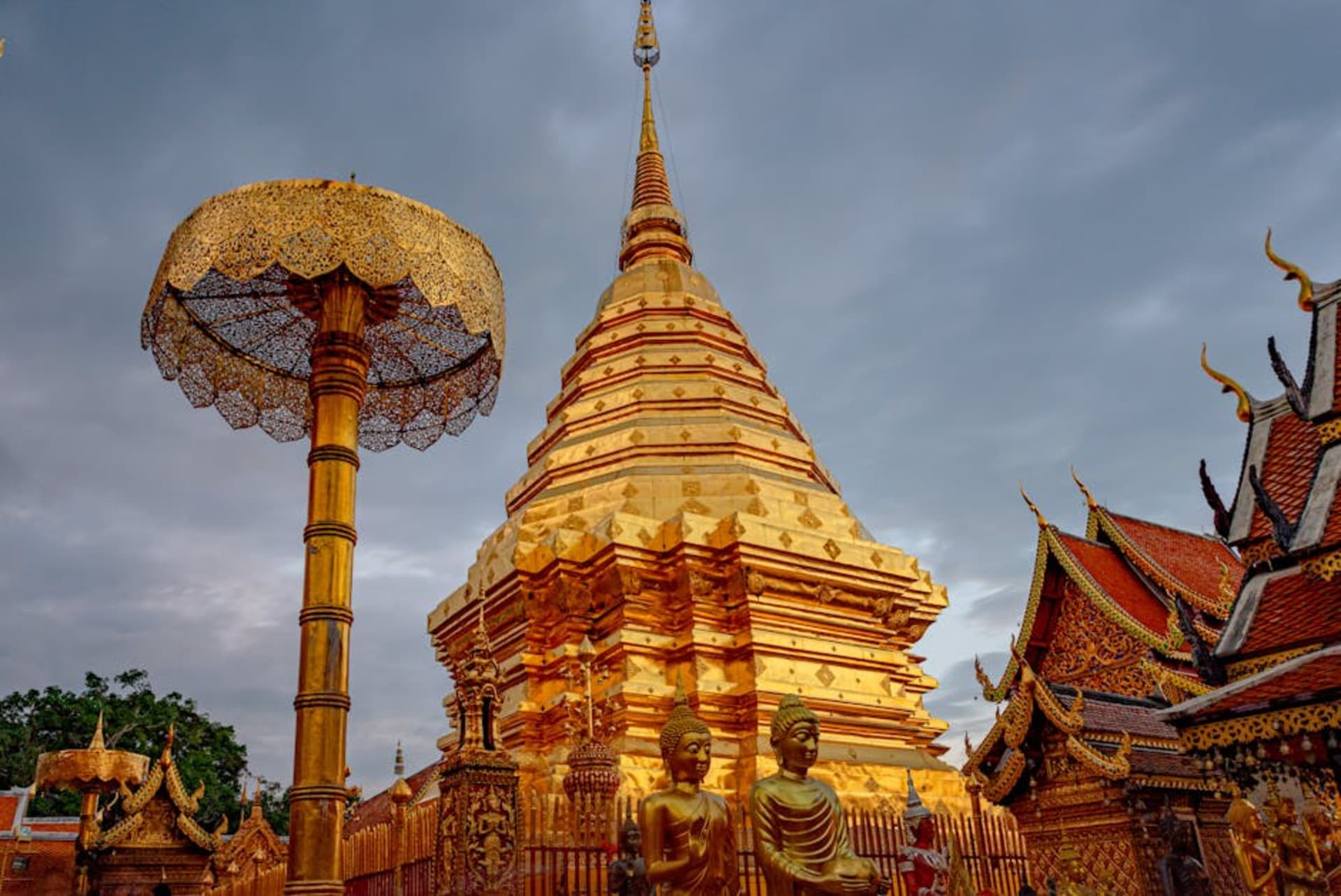
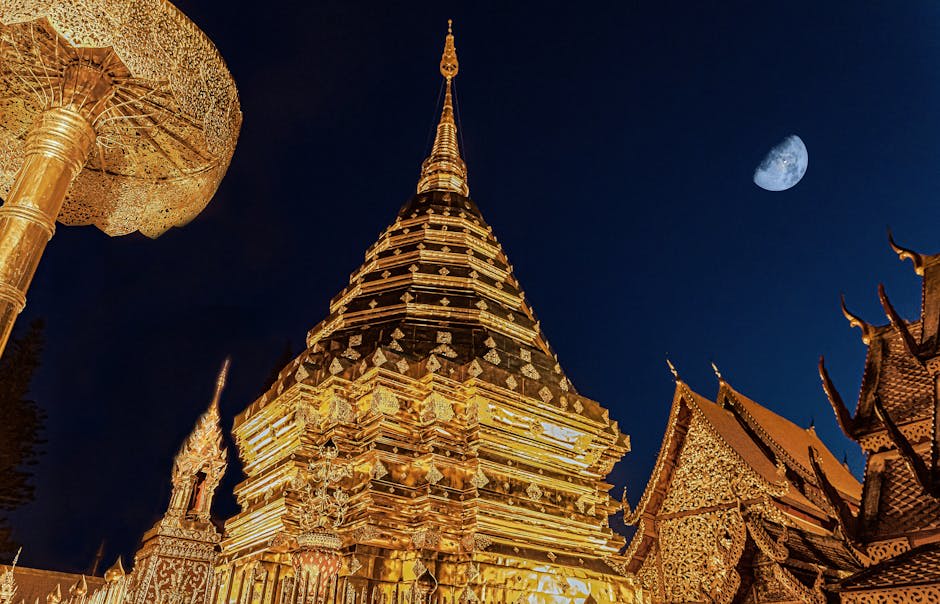
The golden chedi at the summit is blinding in direct sunlight — literally, physically blinding, the gold leaf reflecting the sun with an intensity that forces you to look away and then look back, as if the temple is teaching you something about the relationship between beauty and pain. The views over the valley are immense — Chiang Mai spread below like a map, the old town moat visible as a perfect square, the mountains rising to the west in shades of green that deepen with distance. I circumambulated the chedi three times, as the Thai visitors did, walking clockwise with lotus flowers in hand, and a monk blessed me with a sprinkle of water and a murmured prayer that I did not understand but that I felt, in some untranslatable way, as genuine kindness.
What the Temples Hold
I have visited temples in a dozen countries — the Gothic cathedrals of France, the mosques of Morocco, the shrines of Japan, the ancient churches of Ethiopia. Each tradition builds its sacred spaces differently, and each one asks a different question of the visitor. The cathedrals ask you to look up. The mosques ask you to listen. The Japanese shrines ask you to notice. The temples of Chiang Mai ask you to sit down.
This is not a metaphor. Every temple I entered in Chiang Mai had a place to sit — not a pew, not a bench, but a floor, polished teak or cool tile, where you remove your shoes and lower yourself and simply remain. The Buddhas do not demand anything. They do not threaten or promise or exhort. They sit. And after ten days of sitting with them, in temples large and small, famous and forgotten, crowded and empty, I began to understand that the practice is not passive — it is the most active thing you can do with your attention. To sit in a temple in Chiang Mai is to practice being present in a world that has made distraction its primary industry.
I left Chiang Mai on the morning train south, watching the rice paddies and the mountains recede through the window, and I carried with me not photographs (though I had hundreds) or souvenirs (though I had a few) but a particular quality of silence that had settled into my chest over ten days and that I could still access — can still access, months later — when the noise of the world becomes too much. The temples gave me that. I do not know what else to call it except a gift.
Voyagez avec intention
Guides sélectionnés, destinations paisibles et récits qui valent la peine d'être lus — envoyés quand nous avons quelque chose qui mérite d'être partagé.
Pas de spam. Désabonnement à tout moment.