
Tiger Leaping Gorge
"I've walked a lot of trails. The high path at Tiger Leaping Gorge is the only one where I stopped to check whether I was still in the same country."
One of the deepest river gorges on earth, where the Jinsha River cuts between two mountains over 5,000 meters high and a two-day trail rewards you with views that feel fundamentally unfair.

The geography, because it earns its reputation
Tiger Leaping Gorge runs for sixteen kilometers between Jade Dragon Snow Mountain to the south — 5,596 meters — and Haba Snow Mountain to the north — 5,396 meters. The river at the bottom sits at around 1,600 meters, which means the gorge walls rise nearly four vertical kilometers above the water. This is not a natural setting that performs modesty.
The Jinsha River — this upper section of the Yangtze — is not calm here. It descends 200 meters over the length of the gorge, and the sound of it reaches you long before you can see it: a sustained low roar that becomes the soundtrack of the whole hike. The “tiger leap” refers to a narrow point where, according to legend, a tiger evaded hunters by leaping across the river on a midstream boulder. The boulder exists. The tiger presumably does not.
The high trail
There are two routes through the gorge: the low road along the river (touristy, accessible by bus, mostly uninteresting on its own) and the high path — a day and a half trail that follows the cliff face above the gorge before descending to the river at the halfway guesthouse. I did the high path. There is no good argument for the low road if you are in reasonable health and have the time.
The trail starts in Qiaotou and climbs steeply from the first hour — the notorious “28 Bends,” a series of switchbacks that gain 500 meters in about two kilometers. My calves registered their objection clearly. At the top, the gorge opened in both directions below me and the Jinsha was a white line at the bottom and the mountains were simply everywhere, and the complaining seemed beside the point.
The middle section of the high path levels out and follows the cliff through farming villages and walnut orchards. The walnut trees here are ancient and enormous. A farmer’s wife outside Nuoyu sold me a bag of fresh walnuts for almost nothing and watched me eat them with the patience of someone who has watched many foreigners eat walnuts.
Tina’s Guesthouse
The halfway guesthouse — Tina’s, run by the same family for decades — is the standard overnight stop on the high path. The rooms are simple, the beds are hard in the way that only matters before you’ve spent eight hours walking, and the terrace has a view directly into the gorge that I ate dinner in front of without speaking for about twenty minutes. The staff runs the kitchen with calm efficiency. The food is honest and enormous, which is exactly right.
In the morning, from the terrace at six AM before anyone else was up, the gorge was still in shadow and the river sound was the only thing. Jade Dragon Snow Mountain caught the first light on its glacier cap and glowed for maybe fifteen minutes.
The descent to the river
The lower path at the far end drops to the river itself, where a famous midstream rock — the “Tiger Leap Stone” — sits in the rapids. The water is close enough to feel as spray and the noise is comprehensive. I stood on the viewing platform and felt the bass frequency of the river in my sternum. The scale is most immediate at river level: looking up from the bottom at walls you’ve just spent two days walking along is a genuinely recalibrating experience.
When to go: March to May and September to November are the reliable windows. The summer monsoon (June to August) makes the high trail slippery and landslide-prone — the gorge takes this weather seriously. Winter is cold but clear, and the trail can be done with layers. Avoid spring festival crowds.
Keep exploring
More from Yunnan
 yunnan
Weishan
A quiet Ming-dynasty walled town that once thrived as a caravan stop on the ancient Tea Horse Road.
Explore yunnan
Xishuangbanna
A pocket of subtropical rainforest at Yunnan's southern tip where the Dai people, wild elephants, and the best tea in the world share the same canopy.
Explore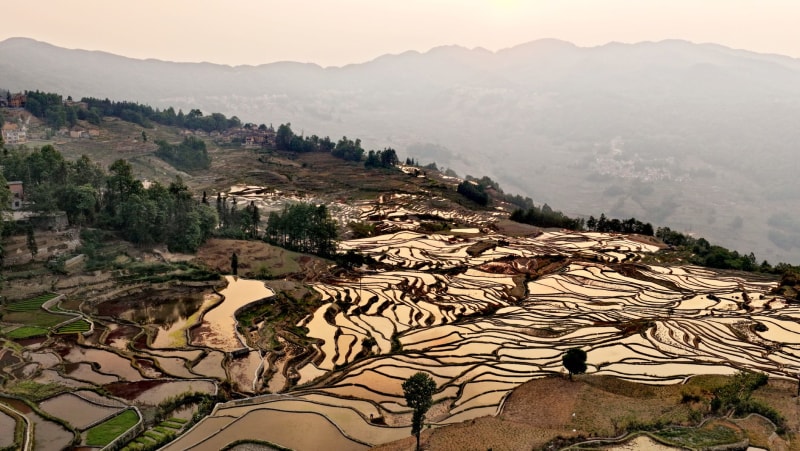 yunnan
Yuanyang Rice Terraces
A thousand-year-old Hani terracing system carved into the Red River highlands — water-filled mirrors stacked against the sky at altitudes that shouldn't produce rice.
Explore yunnan
Baoshan
A highland city ringed by coffee plantations and jungle-thick mountains at the edge of the Gaoligong range.
Explore yunnan
Dali
A Bai minority town flanked by mountains and a vast lake where the breeze smells of mint and the backpackers have been here long enough to start their own restaurants.
Explore yunnan
Deqin
A Tibetan county at Yunnan's northwestern edge where Meili Snow Mountain rises to 6,740 meters and cloud pilgrimages have been happening for centuries at a viewpoint that requires nothing more than patience.
Explore