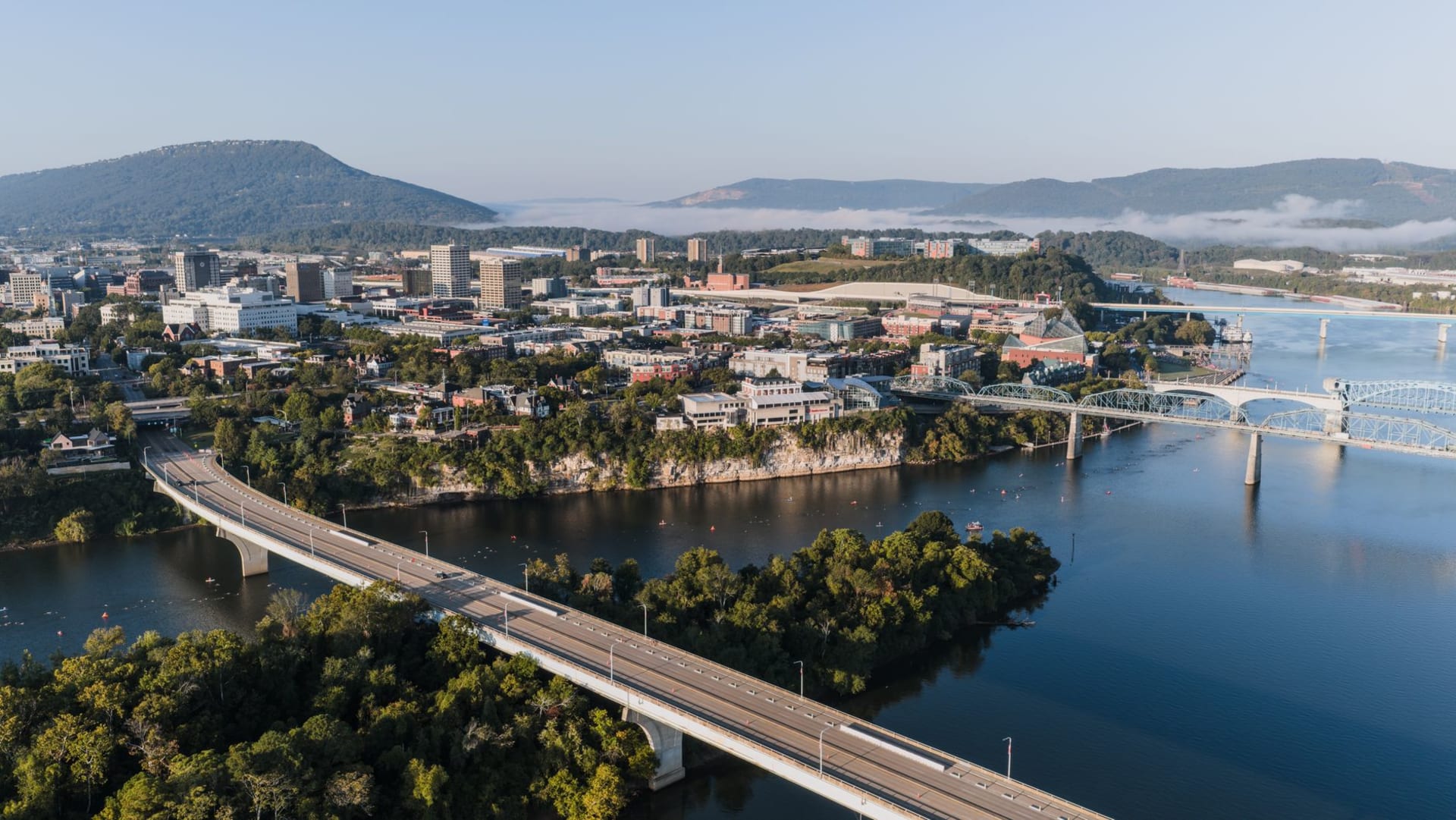
Chattanooga
"Chattanooga is the American Rust Belt story that went the other direction."
A former industrial city that rebuilt itself around the Tennessee River and a surprisingly good arts scene, with Lookout Mountain rising above it all like a promise someone actually kept.

In the 1960s, Chattanooga had the worst air pollution of any city in the United States. The steel plants and foundries had turned the sky a permanent grey-brown, and the Tennessee River was a channel you didn’t go near. By the 1990s, a sustained effort to clean up the air, restore the riverfront, and rebuild the downtown had begun transforming it. Now Chattanooga is the kind of mid-sized American city that larger cities quietly study: walkable, livable, and genuinely interesting without having tipped into the self-satisfaction that usually follows.
The Riverfront and the Walnut Street Bridge
The Tennessee Aquarium sits at the north end of a riverfront park that runs from the aquarium to Ross’s Landing without a single visual interruption worth resenting. The aquarium itself is organized around the Tennessee River watershed — freshwater fish, river otters, paddlefish in tanks that simulate actual current. It’s the kind of aquarium where you end up reading every placard.
The Walnut Street Bridge, dating to 1891 and now pedestrian-only, is one of the longest pedestrian bridges in the world and the simplest way to understand the city’s geography. You cross it from downtown to the Northshore neighborhood, which has coffee shops, bookstores, and a farmers market on Saturdays that sells genuinely excellent goat cheese from farms in the surrounding valleys.
Lookout Mountain
The Civil War significance of Lookout Mountain — the November 1863 “Battle Above the Clouds” that opened the path to Atlanta — is less immediately apparent than the view, which is simply spectacular. Point Park at the summit looks out over seven states on a clear day, with the Tennessee River bending below in a horseshoe the color of pewter.
Rock City, just over the Georgia line on the mountain’s south side, is the kind of American roadside attraction I find impossible to resist: gnome gardens, a swinging bridge over a gorge, enormous sandstone formations with names like “Lover’s Leap” assigned to them by a woman named Frieda Carter in the 1930s who then hired barn painters to advertise on 900 roofs across the Southeast. The “See Rock City” barns are still out there. The attraction itself, as pure Americana, is worth two hours.
Bluff View Art District
On a limestone bluff above the river, a cluster of restored turn-of-the-century homes now holds the Hunter Museum of American Art and a collection of galleries, restaurants, and a sculpture garden that takes the phrase seriously. The Hunter’s collection runs from Hudson River School landscapes to contemporary works, and the building — a 1905 Classical Revival mansion connected by a glass-and-steel addition to a 1975 Brutalist tower, which was then connected to a 2005 contemporary wing — is a strange, accidental architectural argument about time.
I had coffee at the Back Inn Café on the bluff terrace one morning with fog sitting on the river below. A great blue heron stood on a rock in the channel. I wrote three pages in my notebook without looking up.
Outdoor Access
Chattanooga has positioned itself aggressively as an outdoor destination, which is mostly justified. The Tennessee Riverwalk runs six miles along both banks. Signal Mountain to the north has rock climbing routes that draw serious climbers. Lookout Mountain Bike Park below the summit has trails for riders from cautious to reckless. The city runs a free electric shuttle downtown, which makes moving around without a car genuinely practical.
When to go: March through May and September through November are ideal — mild temperatures, low humidity, and the river takes on good color in autumn. Summer is hot and humid but manageable if you’re on the water. Avoid the week between Christmas and New Year’s when Rock City runs a lighting event and the mountain roads back up for miles.
Keep exploring
More from Tennessee
 tennessee
 Clarksville
A riverside city on the Cumberland River shaped by the rhythms of nearby Fort Campbell, with a walkable historic downtown and unexpected honesty.
Explore tennessee
 Cumberland Gap
A forested mountain pass where Daniel Boone's Wilderness Road once carried thousands of settlers west, still straddling three states in quiet wilderness.
Explore tennessee
 Franklin
A Civil War battlefield town with a Main Street pretty enough to distract you from the fact that some of the bloodiest five hours in American history happened in its front yards.
Explore tennessee
 Gatlinburg
The mountain resort town that is fully, unashamedly itself — pancake houses and moonshine tastings and a SkyBridge that deposits you 680 feet above a valley and dares you not to be impressed.
Explore tennessee
 Great Smoky Mountains
The most visited national park in America earns its crowds with ancient ridgelines wrapped in blue haze, wildflower meadows that bloom in sequence all spring, and valleys that smell like wet earth and cedar.
Explore tennessee
 Jonesborough
Tennessee's oldest town, a perfectly preserved main street in the eastern hills that reinvented itself as the storytelling capital of the country.
Explore