
Chishang
"An entire township built its identity around a single tree in a rice field, and having stood in front of it, I understand completely why."
A rice-farming township in the East Rift Valley famous for a single tree standing alone in an emerald paddy, and for some of the best rice in Taiwan.

Chishang sits in the middle of the East Rift Valley, the long agricultural corridor pinched between the Central Mountain Range and the Coastal Mountain Range that runs most of the way from Hualien to Taitung. The township’s economy runs almost entirely on rice — Chishang rice carries a premium reputation across Taiwan, historically served to the Japanese imperial household during the colonial period — and the flat valley floor here has been organized into paddies so precisely rectangular they look landscaped rather than farmed.
The Tree, and the Milk Ad That Made It Famous
In the middle of one particular paddy stands a single camphor tree, alone, with nothing around it but rice and mountains on the horizon in both directions. It became famous almost by accident after appearing in a Taiwanese milk commercial decades ago, and has since become one of the most photographed single trees in the country. I rented a bicycle at the township’s main crossing and rode out to it along a raised path between paddies, arriving to find perhaps a dozen other cyclists doing exactly the same thing, all of us circling the tree at a respectful distance like it might notice.

Cycling the Valley Floor
Chishang’s real appeal isn’t the single tree so much as the cycling network built around it — a flat, well-marked loop of roughly twelve kilometers through paddies, past irrigation channels, and along a stretch that briefly climbs a low ridge for a panoramic view back over the whole valley. I stopped at a roadside stand for a bowl of Chishang bento, the township’s signature packed rice lunch, sold from the same style of wooden box that’s been used since the Japanese era, and ate it sitting on a low wall with the mountains doing their quiet work in both directions.

When to go: May through June and September through October, when the rice is at its greenest before and after harvest. Avoid mid-summer harvest windows when the paddies are cut and brown rather than lush; the valley can also flood briefly during typhoon season.
Keep exploring
More from Taiwan
 taiwan
Chuhuo Fire Ridge
A scrubby hillside near Kenting where natural gas seeping through cracked rock burns in small, permanent flames — day and night, rain or shine.
Explore taiwan
Cijin Island
A narrow sandbar island off Kaohsiung harbor, reached by a five-minute ferry, where a lighthouse, a beach, and a seafood street set the pace.
Explore taiwan
Cingjing
A high-altitude farm region in Nantou County where rolling green hills, sheep grazing at 1,750 metres, and a European-style guesthouse village feel improbably transplanted from the Alps.
Explore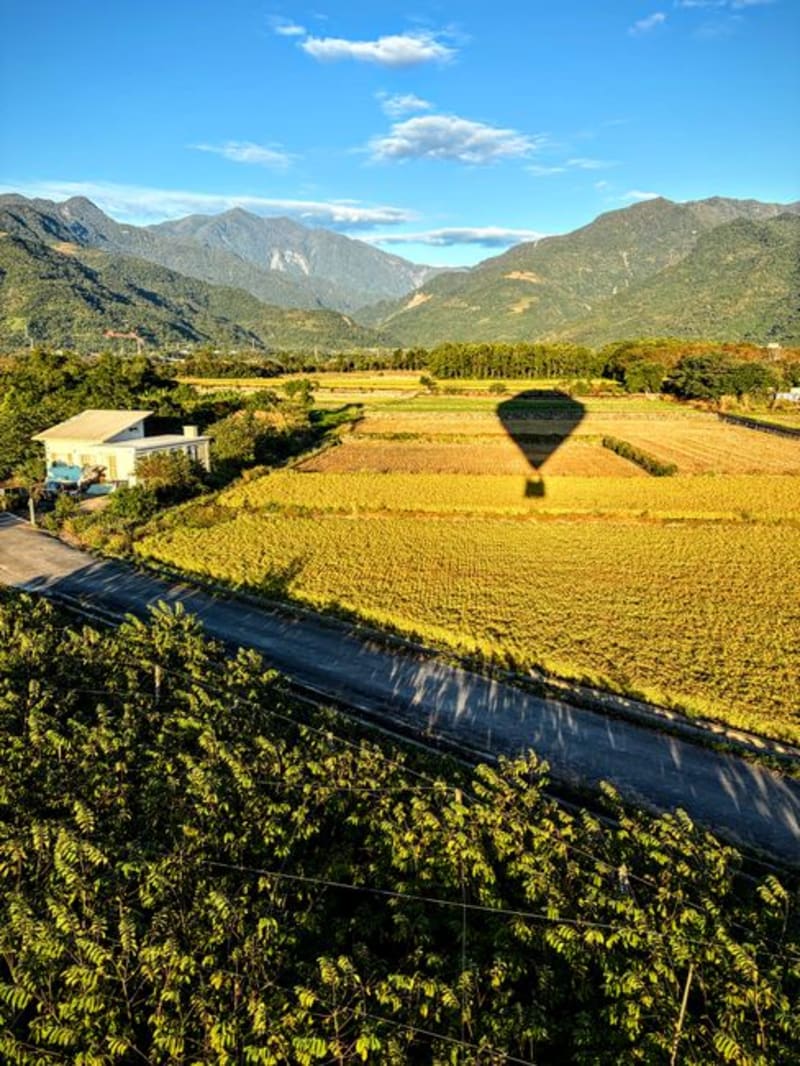 taiwan
Cingjing Farm
A high-altitude sheep farm turned alpine retreat, where Nantou's mountains fold into grassy terraces and the air finally goes cold.
Explore taiwan
Dadaocheng
A nineteenth-century merchant quarter of tea houses, herbal apothecaries, and Dihua Street's slow-burning revival.
Explore taiwan
Dajia
A coastal Taichung town whose Mazu temple pilgrimage draws millions of walkers each spring, and whose fields grow Taiwan's most prized rice.
Explore