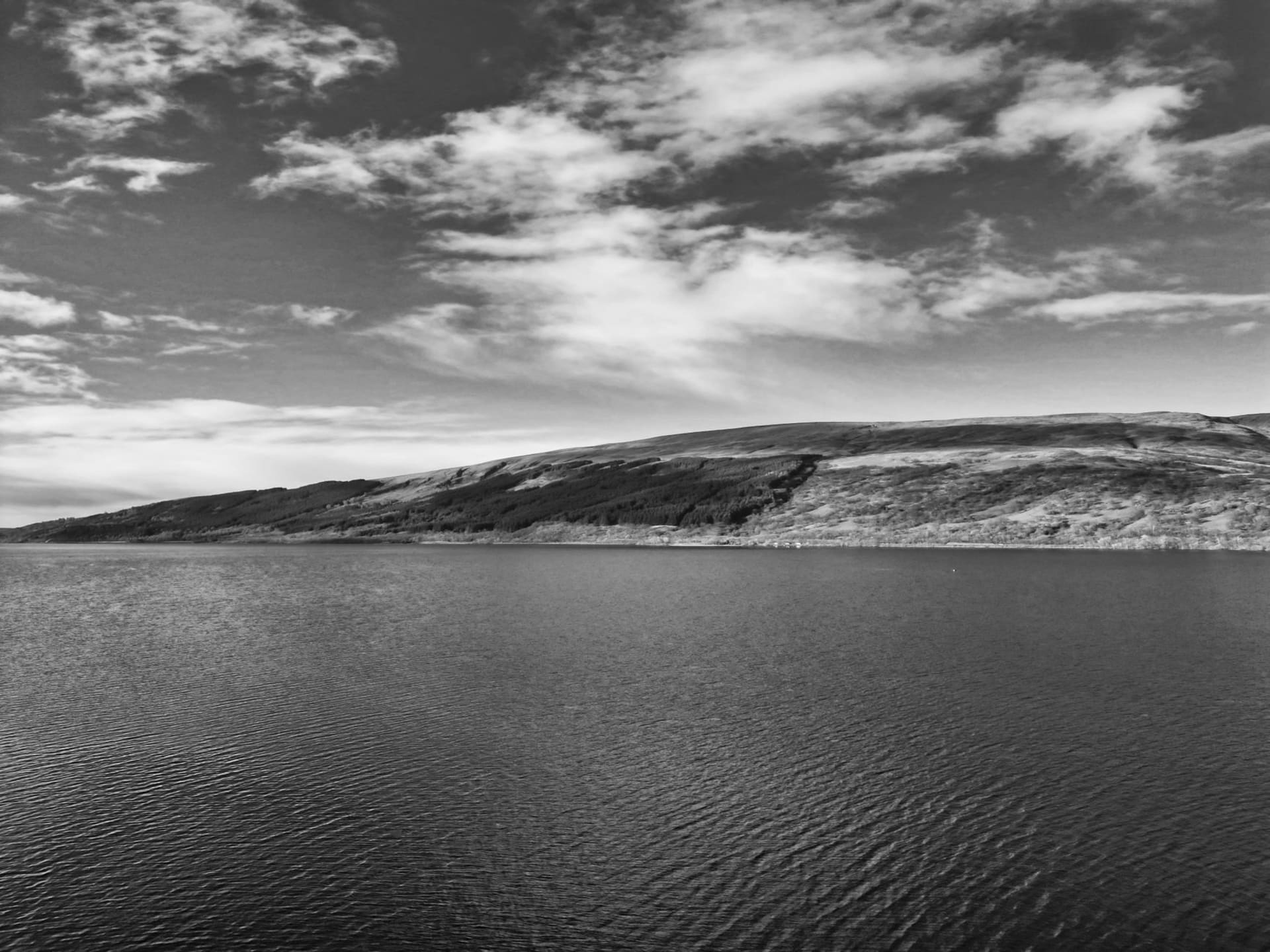
Scotland's largest loch and its most democratic landscape — serene enough for a Sunday morning canoe and wild enough to humble you by afternoon.

The loch is bigger than you expect and darker than you expect. Most photographs show Loch Lomond in morning mist or late light, which flatters it. In reality the water is a deep peat-brown, clear enough to see the bottom in the shallows but dark in the middle in the way that deep, cold, peaty Scottish water is always dark. I found this more interesting than the pale blue version I’d been expecting, and more honest.
Loch Lomond is twenty-four miles long and at its widest five miles across. The southern end is shallow and studded with small wooded islands; the north narrows and deepens between steep hillsides that drop almost directly to the water. These two ends feel like different landscapes — the south pastoral and accessible, the north already Highland, the sky bigger, the hills more demanding.
The Highland Boundary Fault
The Highland Line runs across Scotland from Arran to Stonehaven, and Loch Lomond sits directly on it. On the east shore, the Rob Roy Way climbs up from Drymen through birch and oak woodland before the trees thin out and the ground becomes open moorland. You can walk from one side of the geological boundary to the other in an afternoon and feel the shift — the soil, the vegetation, the quality of light all change within a few kilometers.
The view from the top of Conic Hill, sitting right on the fault line itself, gives you the whole southern loch laid out below: the islands in their exact positions, the low Lowland hills beyond, Ben Lomond rising on the far shore. It’s a twenty-minute scramble from Balmaha car park and worth every muddy step. I did it on a gray morning, arriving at the top just as the cloud thinned, and the loch appeared below me in stages, which was better than seeing it all at once.
Ben Lomond
Ben Lomond at 974 meters is Scotland’s most southerly Munro and probably its most climbed, which means the path from Rowardennan is well-worn — but also that on a summer weekend you will share it with people in trainers who got the weather forecast wrong. The route is straightforward if steep, and the summit ridge gives views down both sides of the loch simultaneously. I went up in September when the heather was out and the bracken had turned amber, and the combination of colors on the hillside was almost excessive. Scotland occasionally tips into the theatrical and you just have to accept it.
On the Water
The best way to understand Loch Lomond is to get onto it. Canoes and kayaks can be rented from several points on the south shore. The National Park has designated wild camping spots on the loch-shore islands accessible only by boat, and a night on Inchtavannach or Inchmurrin — waking up to the sound of water and absolutely nothing else — resets something in the system that ordinary accommodation doesn’t reach.
Lia and I rented a kayak for a half-day from Luss, paddled out to one of the smaller islands, ate lunch on a flat rock with the loch glassy around us, and were back before the afternoon clouds arrived. It was one of those uncomplicated good days that don’t require any embellishment after the fact.
When to go: May and June for long days and wildflowers on the hillsides. September for heather color and smaller crowds. July and August are popular — Loch Lomond is only thirty miles from Glasgow and the car parks at Rowardennan and Luss fill early on summer weekends. Winter walking is possible with proper gear; the loch in January has a pewter-and-bare-branch severity I find compelling, but go early and tell someone your route.
Keep exploring
More from Scotland
 scotland
Oban
A small west-coast port that punches well above its weight — seafood straight off the boats, a distillery in the middle of town, and ferries to islands most people never find.
Explore scotland
Orkney Islands
A windswept archipelago where Neolithic chambered tombs predate the pyramids and the light in June never quite surrenders to dark.
Explore scotland
St Andrews
A windswept coastal town where medieval ruins, golf's birthplace, and a world-class university create an improbable but entirely coherent whole.
Explore scotland
Stirling
The hinge of Scottish history, where a castle on a volcanic plug and a battlefield below it explain more about this country than most museums ever will.
Explore scotland
Cairngorms
Britain's largest national park, where the plateau sits high enough to feel genuinely arctic and ancient Caledonian pines glow orange in early morning light.
Explore scotland
Edinburgh
A city built on two volcanic rocks and a millennium of drama, where every alley seems to hide a pub and a ghost.
Explore