
Serravalle
"In Serravalle nobody was dressed for the towers. They were dressed for Tuesday, which is exactly what I wanted to see."
San Marino's largest and most modern town — where the real population lives, shops, and quietly ignores the tourists on the ridge above.

A friend who had visited San Marino the previous year told me to go to Serravalle if I wanted to understand the place. “The historic center is a theme park,” she said, not unkindly. “Serravalle is where people actually live.” She was half right. The historic center is not a theme park — it is a genuinely old fortified city that happens to sell a lot of crossbows and regional grappa — but Serravalle is indeed where the majority of San Marino’s thirty-four thousand residents do their actual living, and the difference in atmosphere is immediate and complete.
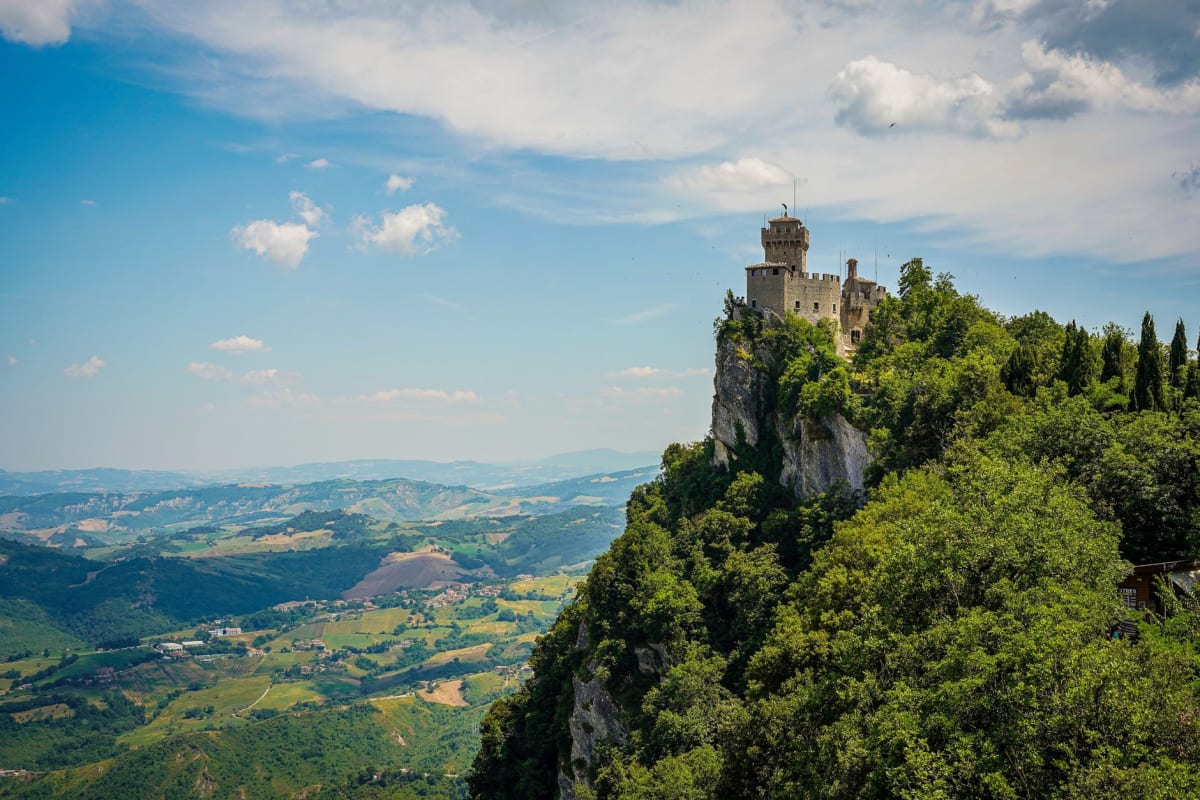
I took a bus from Borgo Maggiore, twenty minutes on a route that wound through the hills past vineyards and small farms, and got off in Serravalle’s commercial center to find myself in something that looked and felt like a prosperous small Italian city: supermarkets, pharmacies, hardware stores, a car dealership, a gym, a gelateria doing brisk business in the mid-morning. The hills of Monte Titano were visible to the south, the towers tiny and reassuring on the skyline, but here in Serravalle they were background. Nobody was looking at them.

What Serravalle has that the historic center does not is a proper local food culture. I had lunch at a trattoria on a side street where the menu was handwritten and changed daily and the ribollita — a thick bean and bread soup that had no business being on the menu in April but was there regardless — was so good I had two bowls and was late catching the next bus. The owner, a woman of about sixty who cooked and served and handled the cash register with equal authority, explained that her mother had run the place before her and that it had been on the same street for thirty-five years. The soup was a family recipe. The wine was from Faetano. A table of four men in construction clothes was having the same lunch, louder and faster than me but with apparent equal satisfaction.
The medieval quarter of Serravalle, a smaller fortified area separate from the commercial town, is worth an hour: a stone gate, a few towers of its own, narrow lanes where laundry hangs between windows and cats sleep on warm steps. It is what the historic center of the capital might look like if it were inhabited by ordinary people going about ordinary lives rather than operating as a destination. The church of San Giovanni has a Romanesque apse and a quiet interior that receives almost no visitors because there is nothing to buy or photograph inside it, which makes it one of the more genuinely peaceful places I found in the whole country.
San Marino’s duty-free status, a remnant of its historical independence from Italian tax structures, means Serravalle also has a commercial energy driven by Italians crossing the border specifically to shop. Supermarkets and tobacco shops do particularly strong business. It is a peculiar aspect of microstate economics — a country whose GDP is partly built on its neighbors coming in to buy cigarettes and electronics at a slight discount — and Serravalle wears it without self-consciousness.
When to go: Any day works, but weekday mornings have the most authentic local energy. The trattoria culture means lunch is the meal to prioritize. Avoid Sundays when many local shops close. The bus connection from Borgo Maggiore and the historic center runs regularly throughout the day.
Keep exploring
More from San Marino
 san-marino
Acquaviva
San Marino's smallest municipality by area — a hillside of olive groves and quiet lanes where the republic's agricultural roots are still visible.
Explore san-marino
Borgo Maggiore
The real gateway to San Marino — a Wednesday market town at the foot of the cliff that most visitors rush past on their way up.
Explore san-marino
La Cesta
The highest of San Marino's three towers holds a museum of ancient weapons and views that make everything else feel small.
Explore san-marino
Chiesanuova
The quietest of San Marino's nine castles, a green shoulder of hill in the southwest where the republic forgets to perform for tourists.
Explore san-marino
Dogana
San Marino's largest, flattest, and most modern town, a border settlement of shopping strips and roundabouts where the country stops feeling medieval.
Explore san-marino
Domagnano
A quiet castello of olive groves and stone farmhouses, famous for a Gothic gold hoard dug up by a farmer in 1893.
Explore