Camargue
"The Camargue is the place where Provence forgets to be pretty and becomes something rawer and harder to name."
A wild wetland delta where flamingos wade in pink clusters and white horses drift across salt flats at the edge of France.

I left Arles on the D570 heading south and within twenty minutes the landscape had changed so completely it was hard to believe I was still in the same department. The vineyards and limestone hills disappeared; the land went flat, then flatter, then began to reflect. On either side of the road the étangs — the shallow salt lakes — stretched to the horizon, their surfaces broken only by the pink smears of flamingo flocks standing in water the color of old glass. A sign warned of bulls on the road. I slowed down. The air coming through the window smelled of salt and marsh gas and something animal I could not identify, and I felt the specific pleasure of arriving somewhere that has not been organized for my benefit.

The Étang de Vaccarès is the largest lake in the Camargue and the heart of the nature reserve, and in the early morning it holds more birds than I had seen outside of a documentary. Herons and egrets in the reed margins, avocets picking through the shallows, and the flamingos — always the flamingos, improbably pink against the grey water and the grey sky, moving with a slow dignity that makes them look like they are deciding whether to bother. I pulled off onto a dirt track near Salin-de-Badon and walked the dyke path for an hour with binoculars and a thermos of coffee, and at one point a white Camargue horse appeared from the reed bed fifty metres away, looked at me with an expression that was not quite curiosity and not quite indifference, and walked slowly back into the grass.
The Camargue horse — stocky, cream-coloured to pure white, with a mane that moves in the mistral like something in a mythology — is native to the delta and has been here longer than the gardians, the Camargue cowboys who still work the herds of black bulls on the open plains. The bulls are the other livestock of the delta, descended from a breed that has barely changed since the Romans noted their presence. They are not the same animal as a Spanish fighting bull — smaller, faster, used in the local Course Camarguaise in which young men dodge rather than kill — and seeing them graze in the open saltings alongside the flamingos and the horses creates a landscape tableau that feels simultaneously prehistoric and deeply French.

Saintes-Maries-de-la-Mer, at the southwestern tip of the Camargue, is a pilgrimage town and beach resort and cowboy village all at once, a combination that in theory should not work and in practice produces something genuinely odd and rather wonderful. In May it fills with Roma pilgrims who have travelled from across Europe to venerate Saint Sara, the patron saint of the Roma people, whose statue is carried from the church to the sea in a procession that is part religious ceremony and part festival. The rest of the year the town is quieter, windswept, slightly melancholy in the best sense, with a beach that runs for miles in both directions and a church fortified against Saracen raids that looks more like a castle than a place of worship.
When to go: April and May are the peak months for bird migration, when the étangs are at their most populated and the spring light is exceptional. October brings the second major flamingo congregation of the year. Summer is hot, buggy around the marshes, and crowded at Saintes-Maries. Come early in the day whatever month you visit — the Camargue at dawn is a different place than at noon.
Keep exploring
More from Provence
 provence
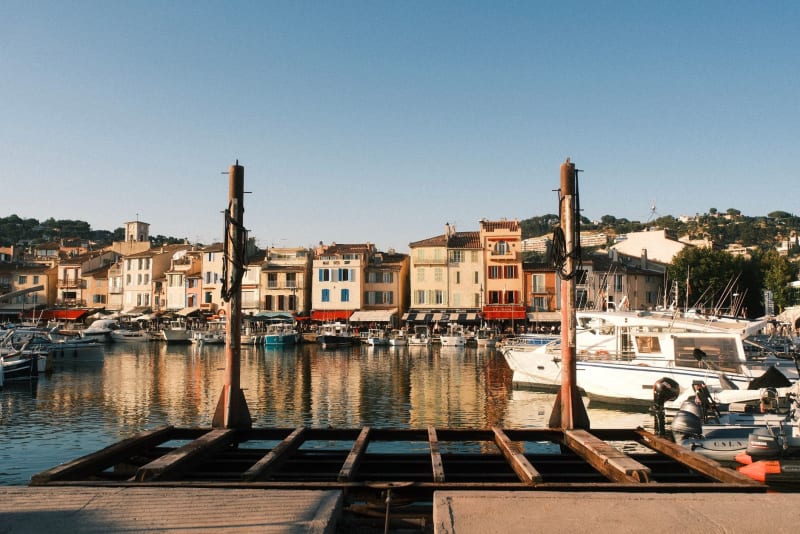
 Cassis
A fishing port squeezed between white limestone cliffs and an impossibly blue sea, with a wine so local it barely leaves the village.
Explore provence
 Forcalquier
A market town in Haute-Provence that the lavender country surrounds and the tour buses mostly overlook.
Explore provence
 Gordes
The most photographed village in Provence, stacked on a limestone cliff above the Luberon, beautiful and fully aware of it.
Explore provence
 Gorges du Verdon
A turquoise river carving a 700-meter canyon through the limestone of upper Provence, Europe's grandest gorge hiding behind the lavender fields.
Explore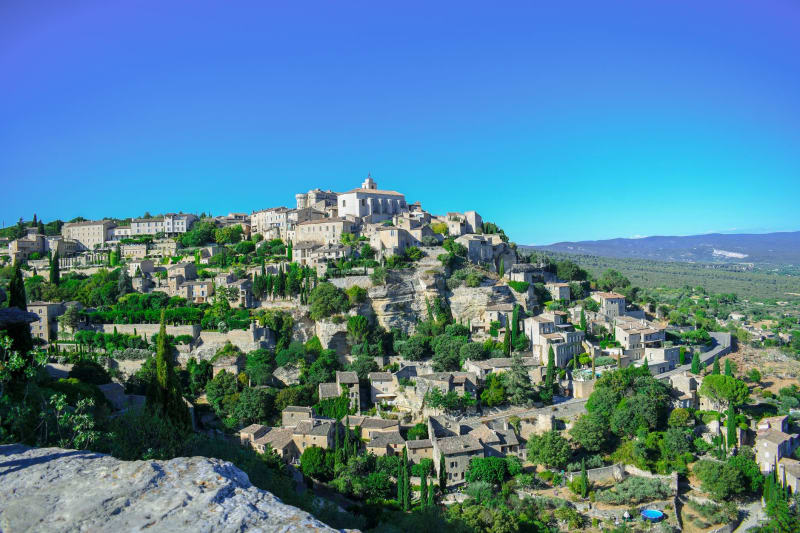 provence
 Les Baux-de-Provence
A fortress village on a limestone spur in the Alpilles, half-ruined and entirely compelling against the white rock sky.
Explore provence
 Lourmarin
A honey-stone Luberon village where Renaissance towers, a Nobel laureate's grave, and a Friday market slow every clock to noon-wine pace.
Explore