
Jao Flats
"Everything at Jao Flats is doubled — the clouds, the birds, the light. The water turns the sky into a mirror and refuses to give it back."
The inner delta's great floodplains where water and sky blur at golden hour until you can't tell which one is holding the hippos.

The helicopter dropped us on a small dry island in the middle of the Jao Flats, which from the air had looked like a dark comma in an immensity of silver water. On the ground, that immensity revealed itself differently — not infinite but present, the water extending to a horizon marked only by a thin strip of papyrus and, beyond it, more sky. The silence was operational rather than empty. There were lapwings calling somewhere. A reed warbler was doing something complicated in the papyrus. Red-shouldered widowbirds were crossing the open water in that lurching, exaggerated flight that makes them look permanently surprised. And then, off to the north, a group of three wattled cranes walked slowly through the shallows, their movements so deliberate they seemed to be choosing each footstep individually.
The Jao Flats are a vast seasonally flooded grassland in the western inner delta, surrounding the private concession that gives them their name. When the annual flood arrives from Angola — typically peaking in July and August — the flats fill to a depth of twenty to sixty centimetres across an area that stretches for tens of kilometres. This is the delta at its most primordial, a drowned grassland where the water is shallow enough to walk in and deep enough to conceal channels that will swallow a vehicle to its roof without warning.

The wildlife of the Jao Flats operates on a different scale from the woodland safari experience. In the mopane forest you count individual animals. Here you count herds, and the herds are large. Red lechwe — the delta’s characteristic antelope, with its raking hindquarters adapted to running through water — move through the flats in herds that can reach several hundred animals. They come and go from the flood margins in a rhythm that the predators have learned to anticipate. I watched a cheetah — a species more associated with dry savanna but not uncommon here — attempt a hunt on the floodplain edge at dawn, the lechwe scattering into the water where the cheetah would not follow, the whole pursuit ending in shallow water with both parties equally undignified and the lechwe upright.
The flats are exceptional for large wading birds. Wattled crane — one of Africa’s most vulnerable birds — uses the Jao Flats as a breeding ground in numbers that represent a significant proportion of the global population. Seeing fifty wattled cranes in a single morning is not unusual here; in other parts of Africa it would be a life event. Saddle-billed storks stalk the shallows with imperial dignity. Open-billed storks spiral overhead in thermals. The African jacana, that improbable bird that walks on lily pads and is therefore the mascot of everything the delta represents, picks its way across floating vegetation islands with the confidence of an animal that has never had cause to doubt its choices.
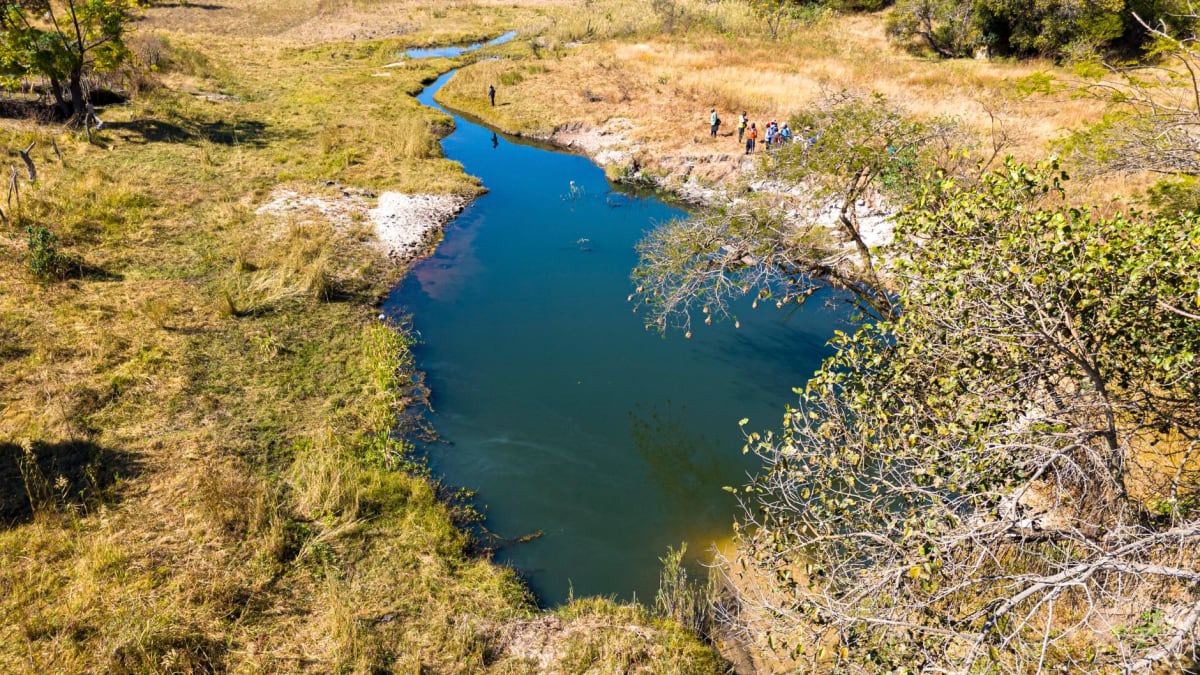
Mokoro travel across the flats is the appropriate mode of transport, and the experience of sitting just above the water’s surface while moving through this silver world is one of those things that is difficult to account for in practical terms but very easy to account for in terms of what it does to your nervous system. You stop cataloguing. You stop thinking about itineraries. The water goes on, the sky goes on, the papyrus marks the horizon, and the mokoro moves with barely a sound. The pole goes in and comes up trailing glassy drops. This is the version of the Okavango that exists in your head when you’re not there.
When to go: July and August for peak flooding of the Jao Flats, when the water is at its highest and most visually spectacular. Wattled crane breeding activity peaks from June through September. The flats begin filling from May and drain from October, so the window of full flood is relatively tight. Access is by light aircraft to the private concession airstrip only — no road access exists to the inner delta at this latitude.
Keep exploring
More from Okavango Delta
 okavango-region
Khwai Village
A community concession on the edge of Moremi where the village and the wilderness share no fence, and the safari revenue actually stays local.
Explore okavango-region
Maun
The dusty, chaotic gateway town that earns your gratitude precisely because it never pretends to be the destination.
Explore okavango-region
Moremi Game Reserve
The only wildlife reserve in Africa established by a local community, where dry woodland and flooded channels operate as one impossibly rich ecosystem.
Explore okavango-region
Nxamaseri
A remote fishing camp deep in the Okavango Panhandle where the day's rhythm is set entirely by tigerfish and river light.
Explore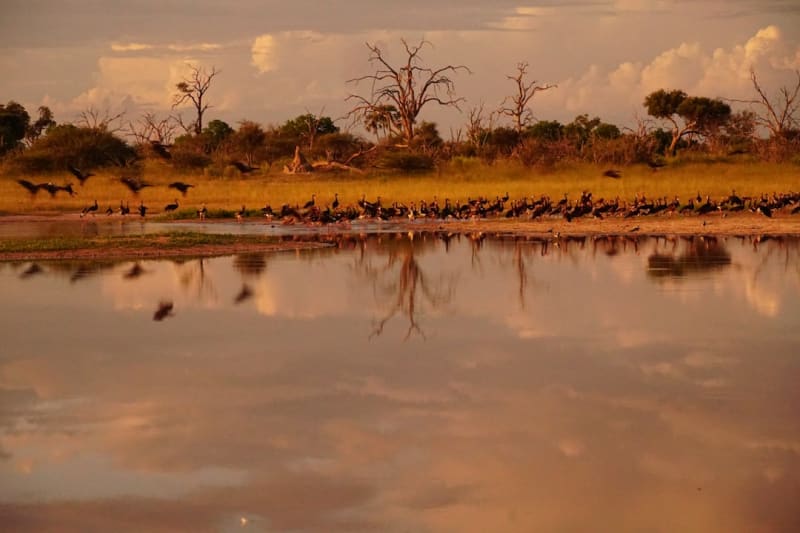 okavango-region
Nxaraga Lagoon
A papyrus-walled lagoon near Chief's Island where hippo grunts and red lechwe splashes carry across still water at dawn.
Explore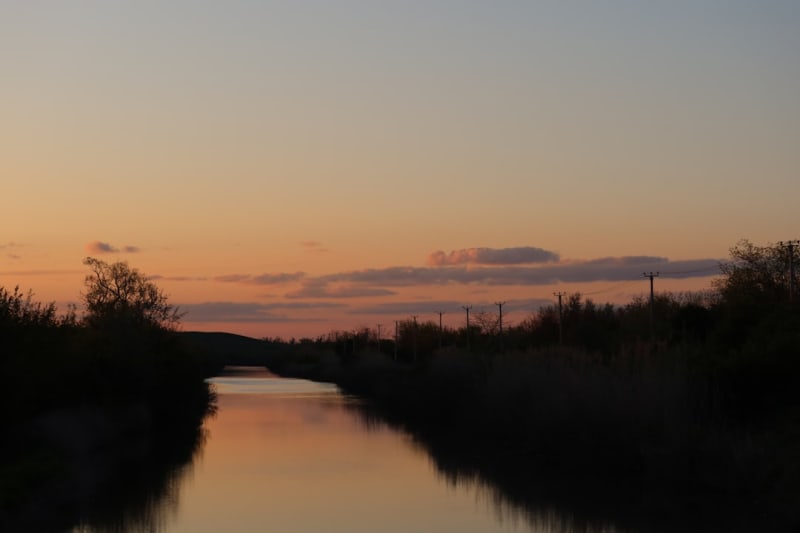 okavango-region
Okavango Panhandle
The narrow northern stretch where the Okavango River first spreads into wetland, quieter and less visited than the delta proper.
Explore