
The city of consuls — grand boulevards, faded Ottoman grandeur, and a café culture so serious it feels like a civic obligation.

There is a boulevard in Bitola called Shirok Sokak — the Wide Street — that runs through the centre of the city in a long, gracious sweep of nineteenth-century architecture and open-air café terraces, and the first time I walked it I had the unmistakable feeling of being in the wrong century. Not in a theme-park way. In the way that a city which was once genuinely important sometimes retains that importance as atmosphere, even after the thing that made it important is long gone. Bitola was once a centre of Ottoman power in the western Balkans, a city of consulates and ambassadors and merchant dynasties, and Kemal Atatürk himself went to school here. That legacy has curdled somewhat into beautiful decay, and I found it absolutely captivating.

The old bazaar sits just off the boulevard, smaller than Skopje’s but more intimate and less touristy. I found a burek shop there that has been frying the same spinach and cheese pastries since before my grandmother was born, and I ate standing up at a counter with four other men who were eating with the focused silence of people attending to something serious. The pastry was shatteringly crisp, the filling hot enough to burn my mouth, the coffee afterwards thick and served in a copper džezva that the owner filled at the pace of someone who does not feel the need to rush. The pace of Bitola is, in fact, the first thing that strikes you — a city that has been walking its boulevard since the nineteenth century has developed a comfortable relationship with its own tempo.
South of the city, a twenty-minute drive through flat agricultural land, are the ruins of Heraclea Lyncestis — a Greek city founded by Philip II of Macedon and later absorbed by Rome, then Byzantium, then abandoned to the grass. The ruins are startlingly good: a Roman basilica with floor mosaics in brilliant tesserae, a small theatre carved into the hillside, colonnaded streets still legible in the afternoon light. I arrived when the site opened and spent two hours without seeing another visitor. The mosaics — hunting scenes, geometric patterns, peacocks with tails splayed — were protected by simple wooden awnings and felt completely unguarded, as if someone had just left them there and forgotten to install the ticket booth.

Back in the city at evening, Shirok Sokak transformed. The café terraces filled, the evening promenade began — families, couples, old men in suits walking slowly and greeting each other — and the façades of the consular buildings went amber in the setting sun. A group of teenagers played guitar badly and happily at one end of the boulevard. A vendor sold roasted sunflower seeds by the bag. I ordered a glass of local Vranec wine at a terrace café and stayed for two hours without moving, which is exactly what Bitola is designed for.
When to go: May and June are ideal, with long evenings and the surrounding plains in their best green. The Carnival of Bitola in late winter is a genuine local event if you can handle the February cold. July and August are hot but the evening boulevard culture flourishes regardless.
Keep exploring
More from North Macedonia
 north-macedonia
Galičica National Park
A mountain ridge between two ancient lakes where shepherds still follow the old paths and the views from the top make you feel briefly omniscient.
Explore north-macedonia
Heraclea Lyncestis
An ancient Macedonian and Roman city near Bitola, where mosaic floors and a stone theatre outlast the empires that built them.
Explore north-macedonia
Kokino
A Bronze Age observatory on a volcanic hilltop where stone thrones and solstice markers still track the sun 3,800 years later.
Explore north-macedonia
Kruševo
The highest town in the Balkans, where a failed 1903 uprising left behind the world's smallest republic and an outsized sense of its own place in history.
Explore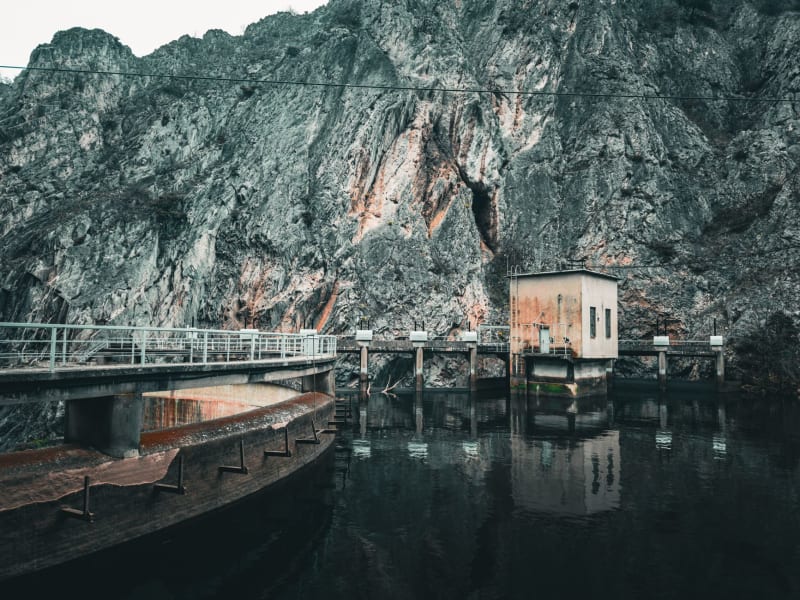 north-macedonia
Matka Canyon
Twenty minutes from the capital, a gorge so steep and quiet it feels like a different country — and possibly a different century.
Explore north-macedonia
Mavrovo National Park
Mountain Macedonia at its most untamed — deep pine forests, a drowned church in a reservoir, and monasteries built into impossible cliffs.
Explore