
Great Alps Waterfall
"The island lost half of itself to the volcano, but the forest never stopped growing around this water."
A 70-foot cascade hidden in the Center Hills rainforest, one of the few hikes that survived Montserrat's volcano and still runs cool and wild.

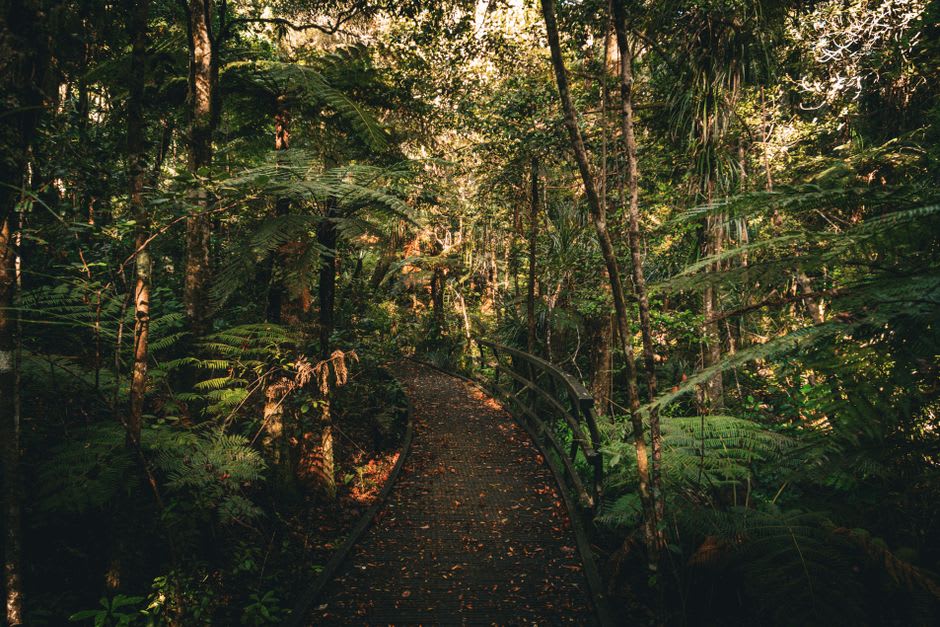
Lia found the trailhead sign near Judy Piece before I did, half-swallowed by ferns, and I remember thinking it looked more like a private garden gate than the start of a national hike. We’d driven up from St. Peter’s that morning, windows down, and the road had that strange quality so much of northern Montserrat has: ordinary, green, alive, and yet you know that just a few miles south the Soufrière Hills eruptions buried entire towns under ash. Standing at that trailhead, it didn’t feel like the edge of a disaster zone. It felt like the start of any good rainforest walk, humid and loud with birds.
The path in was steeper and muddier than either of us expected, even though we’d deliberately come in February to avoid the worst of it. Thirty-five minutes, maybe forty, of climbing over roots and ducking under vines along the Bramble River, Lia complaining good-naturedly about her shoes while I kept stopping to photograph heliconias I couldn’t name. At one point the trail opened onto a shallow bend in the river and I got Lia to wait there a minute so I could get the light coming through the canopy just right.
You hear the falls before you see them, a low steady roar that builds through the last few switchbacks, and then the trees pull back and there it is: seventy feet of water folding over dark volcanic rock into a pool that was, frankly, colder than I was prepared for. I got in anyway. Lia stayed on a rock at the edge, laughing at me, and told me afterward that watching me flinch my way into that pool was worth the whole hike on its own. What stayed with me longer, though, was the thought that this particular piece of forest, this river, this waterfall, had kept running the entire time the south of the island was being erased. It felt less like a tourist stop and more like something the island had chosen to keep.

We ate lunch on a flat rock near the pool, cheese and bread we’d bought that morning in St. Peter’s, and I kept catching myself listening for something under the sound of the water, some echo of the volcano, and never finding it. Just birds, and Lia wringing out her socks, and that particular tiredness that comes from a good muddy hike. On the walk back down I understood why locals speak of Great Alps almost protectively, as the hike that proved the north still had something worth walking to.
When to go: We went in the dry season, between February and April, when the trail holds less mud underfoot but the Bramble River still runs full from the months of rain before it, giving you a proper waterfall rather than a trickle.
Keep exploring
More from Montserrat
 montserrat
Jack Boy Hill
A ridge viewpoint where the Caribbean sparkles on one side and the grey exclusion zone falls away on the other — two worlds from one spot.
Explore montserrat
Little Bay
Montserrat's future being assembled in real time — a horseshoe bay where a new capital is rising, one concrete block at a time, with uncommon determination.
Explore montserrat
Plymouth
The Caribbean's only ghost capital — a functioning city buried under volcanic ash, its church spires still visible above fifteen metres of grey.
Explore montserrat
Rendezvous Bay
Montserrat's only white sand beach — reachable by boat or a forested trail with no road, no signs, and no one there when you arrive.
Explore montserrat
Soufrière Hills
An active Caribbean volcano that has been erupting since 1995 and hasn't finished — the dome still building, the steam still rising, the story still open.
Explore montserrat
Montserrat Volcano Observatory
A working observatory perched at a safe distance from a live volcano, where scientists watch the mountain that swallowed a capital city.
Explore