Progreso
"The pier goes on so long you start to feel you've left Mexico behind. Then you turn around and the coast is waiting."
The drive from Mérida takes 35 minutes on a flat two-lane highway through sisal hacienda country, and then the Gulf of Mexico appears: a long, low horizon, grey-green, with the pier extending into it like a road someone built into the sea. I had read that the pier was 6.5 kilometers long, which is impressive in description, but the actual sight of it from the waterfront — this impossible thin line of concrete going straight out toward the horizon until it disappears — makes the number feel inadequate. It doesn’t look like a pier. It looks like an argument with geography.
The argument is necessary. The Gulf of Mexico off the Yucatán coast is extremely shallow — ships could not dock at the natural shoreline because the water simply wasn’t deep enough — so in the late nineteenth century the Yucatán built a pier extending out until the water was actually navigable. The result is one of the longest commercial piers in the Western Hemisphere: at the far end, a working port handles cruise ships and cargo. Along the rest of it, on Sundays, Meridanos walk, fish, and eat shrimp cocktail from vendors with Styrofoam coolers.
The Pier
I drove from Mérida on a Sunday, which I understand in retrospect was either the correct or incorrect timing depending on what you’re looking for. On Sundays, Progreso belongs to Mérida. The beach clubs along the malecón were full — this is the capital’s ocean relief, 35 kilometers of highway the only thing separating a city of a million people from its beach — and the parking situation required patience I had to discover I possessed.
But the pier. I walked out to roughly the halfway point, which is already further into the Gulf than feels reasonable, and turned back to look at the coast. Progreso is a low, flat line of buildings and palms. To the south, Mérida doesn’t exist — it’s too far, and the earth has swallowed it. There’s nothing here but the Gulf and the concrete under your feet and the fishing boats anchored at odd intervals. A pelican landed on the railing two meters from me and considered me with total indifference.
At the halfway point, a vendor with a cooler was selling cocteles de camarón. I had the large one — shrimp in tomato broth with avocado, serrano, cilantro, and lime — sitting on a concrete bench watching the fishing boats and a distant tanker on the horizon. It was one of those meals that makes complete sense in its specific context and would make no sense anywhere else.

The Beach That Isn’t Caribbean
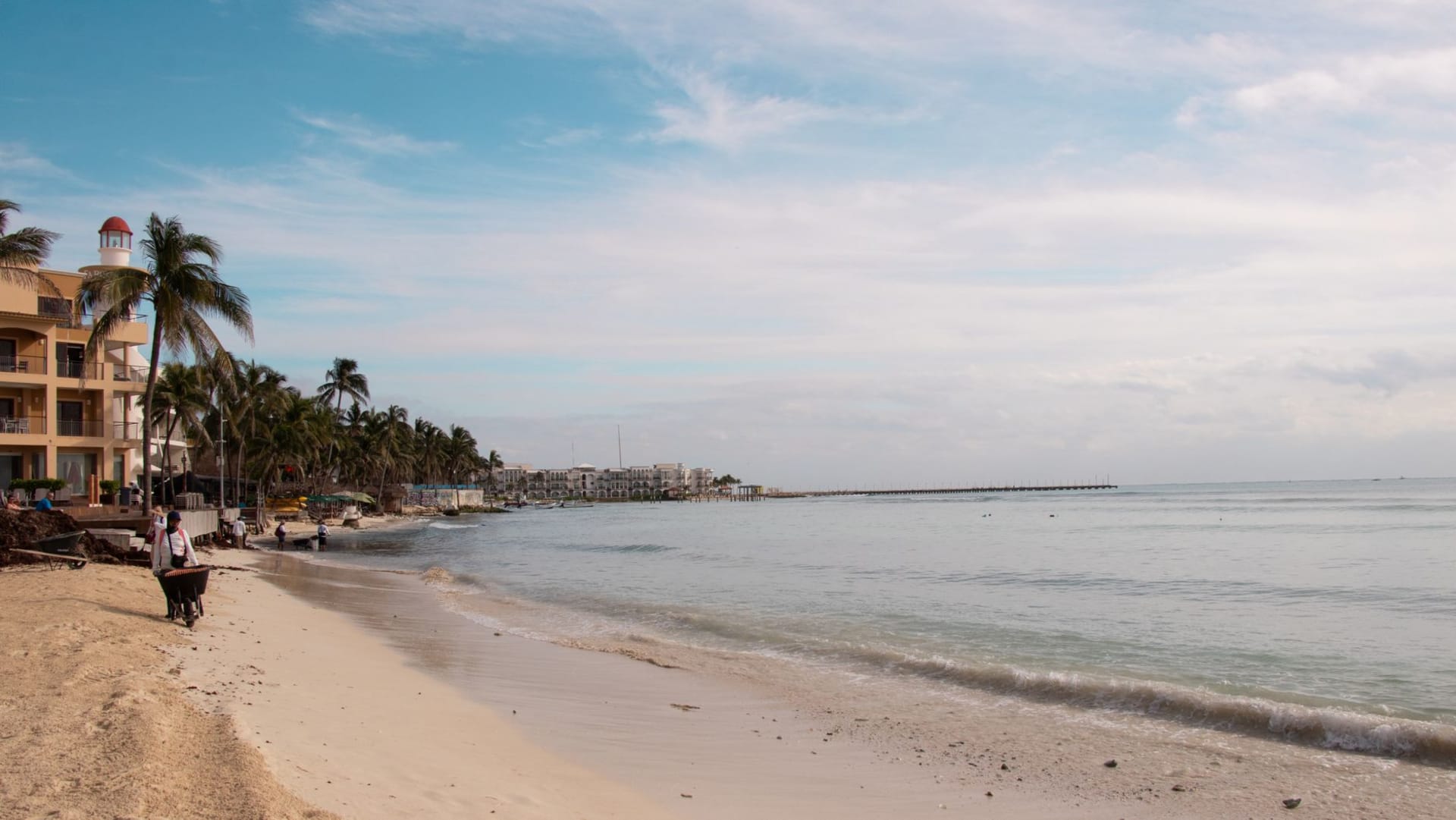
People who arrive at Progreso expecting the Caribbean are consistently disappointed, and I think this expectation is understandable and wrong. The Caribbean side of the Yucatán Peninsula — the Riviera Maya — has that turquoise that photographs well. The Gulf side is different: the water is grey-green to brown depending on the light and the day, the beach sand is fine but not blindingly white, the waves are small. It is a normal beach.
What Progreso is not is a resort beach. There are no all-inclusive complexes here, no security guards, no wristbands. The beach clubs are Mexican beach clubs — plastic chairs, speakers playing norteño and cumbia at volumes that suggest a building opinion on the matter, an ordering system based on trust and proximity to a cooler. Families from Mérida come here every weekend of summer as they have for generations, and the beach has the comfortable, inhabited quality of a place that doesn’t need to explain itself.
I went on a weekday the second time, which is a different experience entirely. Progreso on a Tuesday is quiet and slightly melancholy in the way of beach towns in the off-hours — the vendors are still there, the birds are abundant, the pier is nearly empty. The gulf light in the morning is something I hadn’t anticipated: flat and silver, the water barely distinguishable from the sky at the horizon.
Getting There
The colectivos from Mérida’s Parque San Juan run constantly and cost almost nothing. The drive is 35 minutes. If you’re staying in Mérida — which you should be, at least a few nights — Progreso is an obvious half-day. Go on a Sunday for the full social experience; go on a Tuesday for the quiet.

Eat at the beach clubs or from the pier vendors rather than the sit-down restaurants on the main street. The ceviche and the shrimp cocktail are the point. Order the large size.