Xilitla
"Someone built staircases to nowhere in a waterfall canyon in the cloud forest and the jungle is slowly taking them back. I cannot think of a more fitting end."
Edward James was a wealthy Englishman who befriended Salvador Dalí and René Magritte and used his inheritance — he was the possible illegitimate son of Edward VII, depending on which account you believe — to fund Surrealist art in the 1930s and 40s. In 1949, he came to the Sierra Madre Oriental of San Luis Potosí and didn’t leave. He bought land in the cloud forest above the town of Xilitla and spent thirty-five years building Las Pozas: a garden of concrete sculptures in a canyon cut by waterfalls, intended to be an inhabitable Surrealist artwork, larger than anything his friends had painted.
He died in 1984. The garden continued without him, which is the only logical outcome.
Las Pozas
The entrance is on the edge of the cloud forest, and the transition from the access road to the garden is immediate and slightly disorienting: one step and you’re in a different kind of light, filtered through a triple canopy that drops the temperature five degrees and makes the air visibly wetter. The concrete structures begin within thirty meters of the entrance.
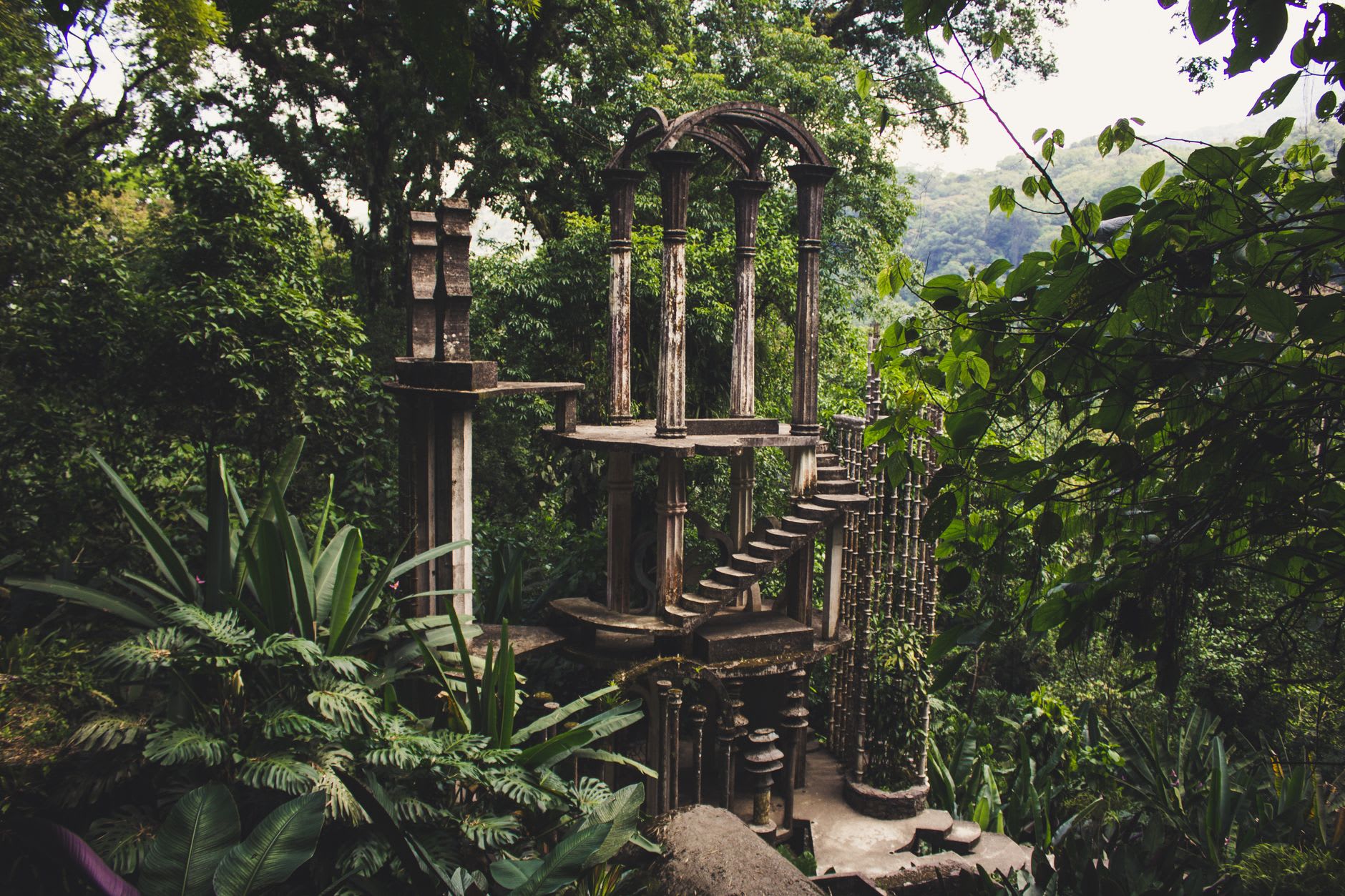
The structures are the right word — not buildings, exactly, though some of them have doorways and staircases and rooms. They were never fully finished, which was part of James’s intention but also simply the result of a project that grew continuously for thirty-five years without any fixed end point. There are towers that rise to platforms that have no function. There are stairways that begin at ground level and end fifteen meters up in open air. There are arched doorways that lead to vertical drops into the ravine. There are columns in shapes that are not columns — spiraling, bifurcating, ending in giant concrete flowers that are also hands that are also something else entirely.
James designed them himself, with local workers named Plutarco Gastelum and his team who built what he sketched and probably added their own interpretations in the spaces where the sketches were incomplete, which was often. The concrete was poured around a steel rebar armature and in some places the rebar is now visible where the concrete has eroded, adding a layer of industrial skeleton to the organic deterioration of everything else.
The organic deterioration is the most striking thing. In 1984, the garden was overgrown but the structures were more or less intact. In 2024, the jungle has reclaimed territory on every surface: mosses on every horizontal plane, ferns rooted in cracks in the towers, orchids in the upper joints where moisture collects, philodendrons climbing the columns with a patience that seems organized. The concrete has gone grey-green in places, dark with algae in others, and the waterfall spray from the natural pools (the pozas of the name) has left mineral staining across the lower structures that looks like the garden’s own painting of itself.
I spent four hours in Las Pozas and came out with the conviction that Edward James built exactly what Surrealism was always describing and could never achieve inside a frame or on a museum wall: a place where the logic of the ordinary world — stairs lead somewhere, doors open into rooms, architecture serves a function — is systematically undermined, without the safety net of the gallery.
The Cloud Forest
The forest itself is the other thing. The Huasteca Potosina — the eastern sierra region of San Luis Potosí — contains a remarkable range of biological zones, and the cloud forest around Xilitla, at around 1000 meters, is in the transition zone between the tropical lowlands and the higher sierra. The result is a forest that behaves differently depending on the hour: at 8am it’s wrapped in cloud and everything drips; by 10am it might be clear and the canopy filters sunlight into columns; by 3pm the cloud is often back and the light goes grey-green and the frogs start.
The frogs are one of the sounds of Las Pozas. The waterfall is the main sound — a constant bass note that you stop consciously hearing after twenty minutes and then notice again when you walk away from it — and the frogs are the texture above it. I didn’t see as many species of birds as I might have with a guide and better binoculars, but I saw a blue-crowned motmot perched on a concrete ledge with a lack of concern for its surroundings that suggested it regarded the garden as its own property. I think it’s right.
The natural pools (pozas) at the base of the waterfalls are swimmable and very cold. I swam in one at noon, which was the sensible moment — the sun had been on the water for a few hours and it was merely cold rather than glacial — and floated on my back looking up at a concrete tower with a spiral staircase rising into the canopy while water from a six-meter fall hit the pool ten meters away and produced a mist that moved across the surface. This is the experience I would describe to someone as “the reason to go to Xilitla.”
The Town Below
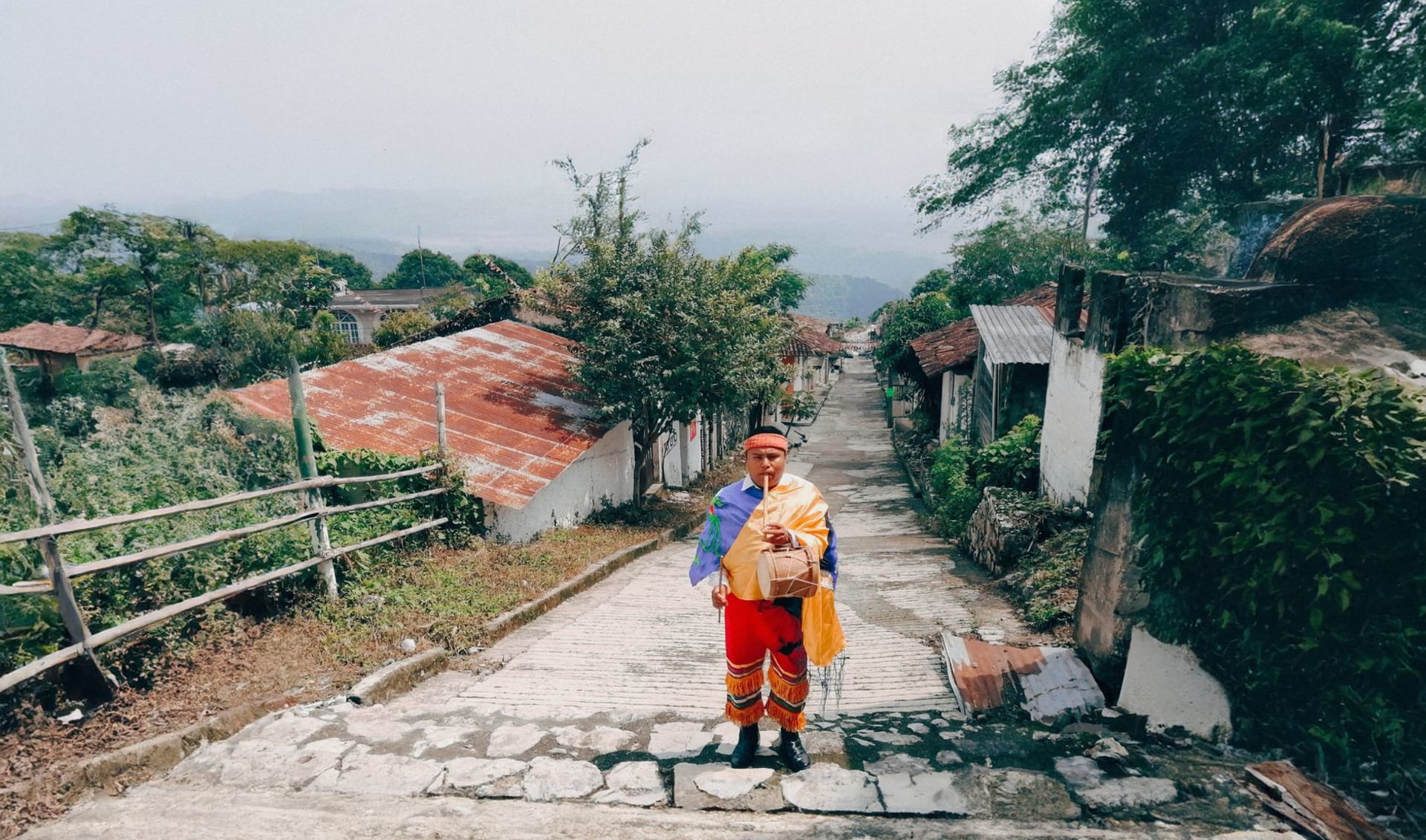
Xilitla itself is a small town — maybe 15,000 people — that sits at a lower elevation than the garden and has the particular quality of small Huastecan towns: warm, slightly humid, with a market that sells both altitude crops (coffee, vanilla) and lowland tropical fruits, and people who are accustomed to visitors arriving for the garden and departing without engaging much with the town.
The coffee from this region is worth paying attention to — the altitude and cloud-forest conditions produce arabica with a slightly fruity, high-acid profile that is sold both as green beans and roasted at a few stalls in the market. I bought two hundred grams of roasted beans and carried them back to San Luis Potosí in my bag and thought about them the whole journey.
There’s a monastery — the Ex-Convento de San Agustín, sixteenth-century — at the center of town that most visitors who come for Las Pozas don’t enter, which is a mistake. The cloister has a peculiar overgrown quality that rhymes visually with the garden up the hill. Whether that’s coincidence or Edward James noticed it when he chose this location, I couldn’t say.
Lia described Las Pozas, afterward, as the Dalí of gardens. I think she’s right, with the addition that the Salvador Dalí Museum in Figueres was designed by someone who knew what he was building and controlled the outcome. Las Pozas was designed by someone who had the same impulse and let the jungle design the rest. The result is stranger, and also sadder, and also more alive.
Practical Notes
Xilitla is roughly 300 kilometers northeast of San Luis Potosí city — about 4 to 5 hours by car on roads that become increasingly winding as you enter the sierra. There are bus services from San Luis Potosí and from Ciudad Valles (the nearest large city, 90 minutes by road); check current schedules as they change seasonally.
Las Pozas is open daily from 9am to 6pm. Admission was around 100 pesos at last visit. The site is maintained by the Xilitla Foundation; guided tours are available and useful for understanding the intent behind specific structures, though wandering unguided also works.
Wear shoes with grip — the paths are stone and concrete and become very slippery when wet. The dry season (November to April) offers more photogenic conditions; the wet season is greener and more atmospheric but also muddier. Bring insect repellent regardless of season.
Accommodation in Xilitla is limited: a handful of small hotels, the best of which are up in the hills above town with views into the cloud forest. Posada El Castillo is a hotel actually within a house that Edward James built on the property — it sleeps a small number of guests and is the most obviously correct place to stay. Book far in advance.