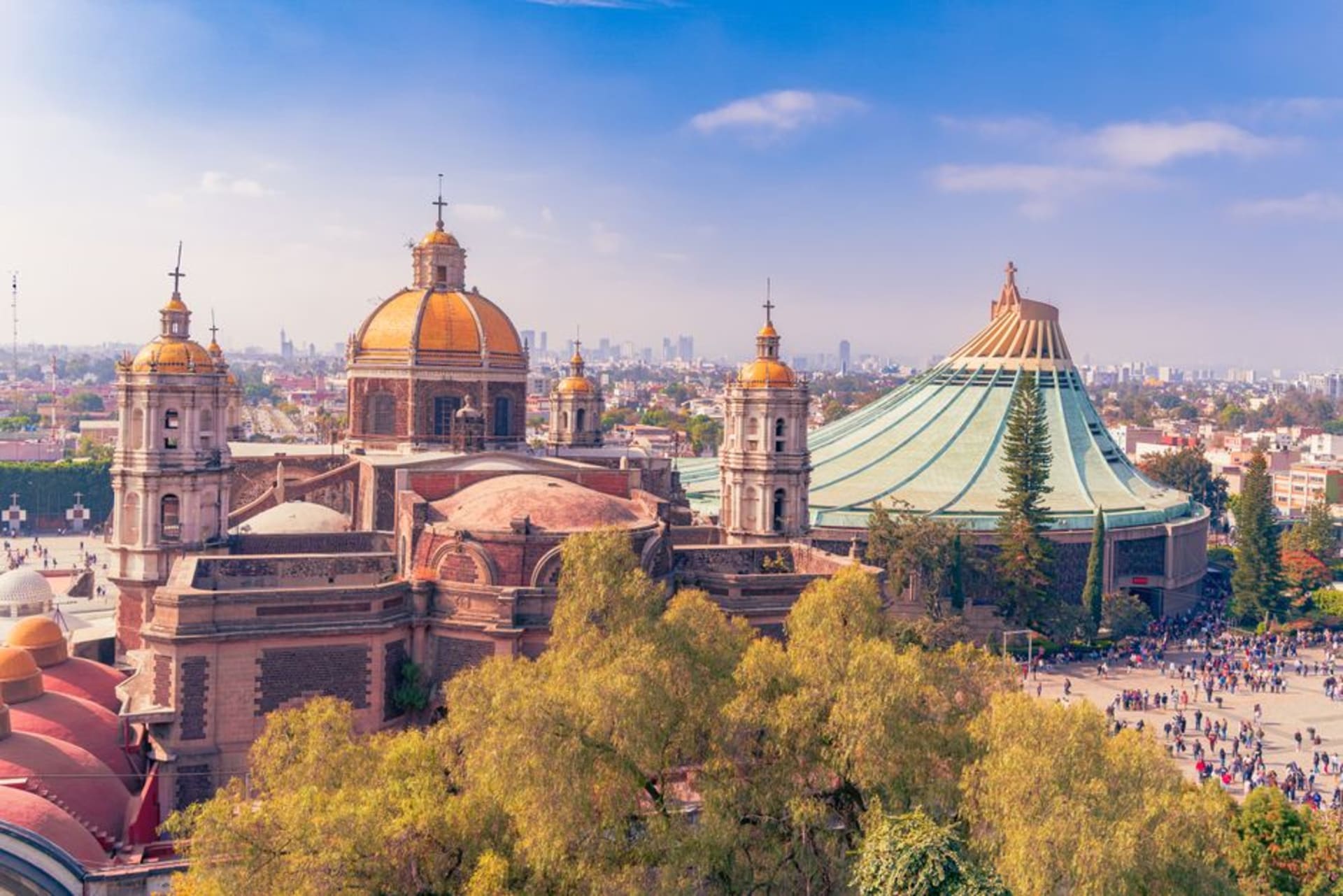
Basílica de Guadalupe
"Twelve million people visit each year. On December 12th, that number feels accurate."
I came to the Basílica de Guadalupe on a Tuesday in November, which I thought would be quiet. I was wrong. I walked out of La Villa metro station into an atrium the size of several city blocks and immediately found a man in his sixties crossing the stone plaza on his knees, arms outstretched, a portrait of the Virgin pressed to his chest. His wife walked alongside him, saying nothing. I stood there for a long time before I went inside. Some places ask for your attention before they ask for your opinion.
Two Buildings, Four Centuries Apart
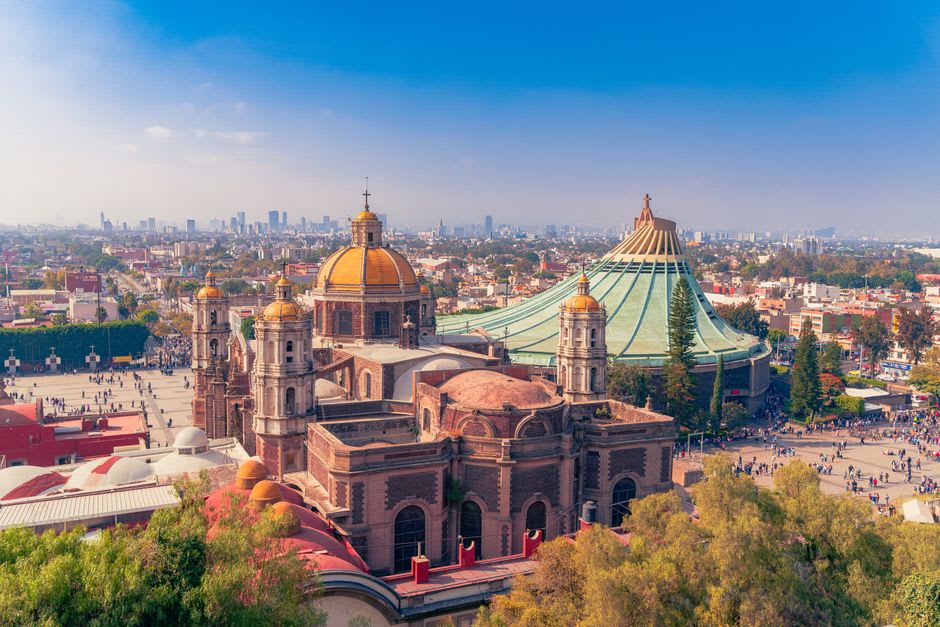
The ensemble is stranger and more compelling than any photograph suggests. The old Colegiata — officially the Antigua Basílica, built between 1695 and 1709 — has been sinking into the unstable volcanic soil of the former lake bed for three centuries, and it shows. The facade tilts visibly, the floor inside rippling like a slow-frozen wave. It was deconsecrated in 1976 when the new basilica opened next door and now functions as a museum. Walking inside, past the cracked gilded altarpieces and the uneven marble floors, I felt the weight of that geological patience — the earth slowly, methodically winning.
The new basilica, designed by Pedro Ramírez Vázquez, is circular and deliberately modern — large enough to hold ten thousand worshippers at once, built so that every seat faces the altar and the image above it. It looks nothing like a colonial church, which is either jarring or precisely correct depending on your sensibility. I spent time in both, and I needed both.
The Tilma Above the Altar
The image that draws twelve million people a year is a small one — roughly 1.7 meters tall, mounted high above the altar of the new basilica. Juan Diego’s tilmanli, the rough-woven ayate cloak on which the Virgin is said to have miraculously appeared in 1531, hangs behind thick glass, illuminated so that it glows slightly against the dimness of the space. To see it up close, you ride one of the moving walkways installed below — conveyor belts that carry visitors slowly past and beneath it, so that no one lingers too long in any one spot.
The first time I rode those walkways, I watched the people around me as much as the image. A woman crossing herself without looking away. A teenager raising his phone and then lowering it again, deciding something. An elderly man standing perfectly still as the belt moved him forward. What you encounter here is not simply an icon. It is an ongoing conversation between this country and something it has believed in for five centuries.
The Hill and the Hours
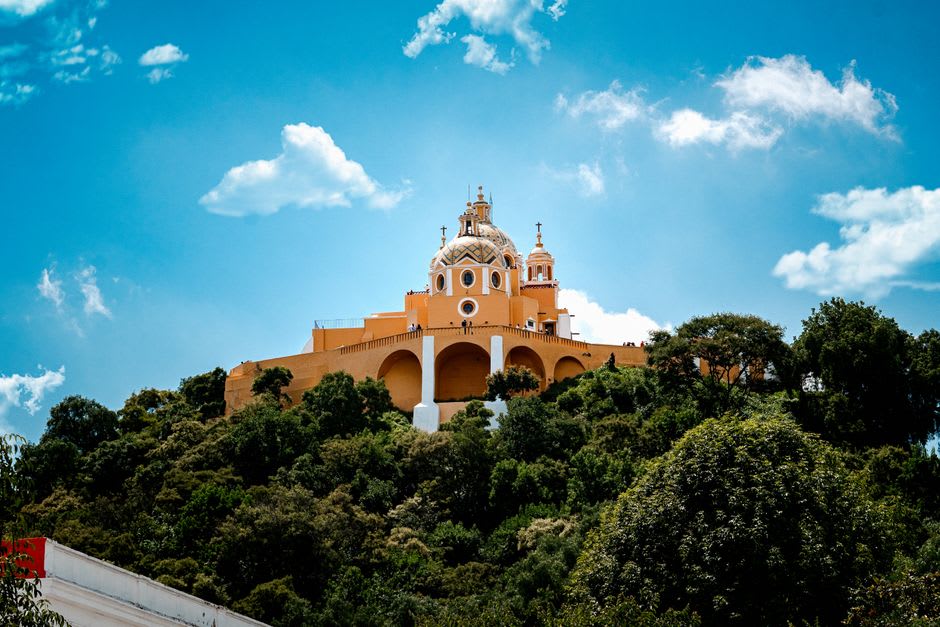
Most visitors miss the Cerro del Tepeyac — the hill rising directly behind the basilicas. A path climbs past a series of small chapels to a hermitage at the top, the Capilla del Cerrito, which marks the spot where Juan Diego’s apparitions are said to have occurred. The climb takes twenty minutes and the view over the northern sprawl of Mexico City is clear on any smog-free morning. Up here the crowd thins to almost nothing.
Come early — before 9 a.m. on a weekday if you can. The atrium fills steadily through the morning, and by midday on a Sunday it is difficult to move. December 12th, the feast day of Our Lady of Guadalupe, transforms the neighborhood into something beyond a pilgrimage: groups arrive from across the country in traditional dress, dancing for hours in the atrium. I have not yet been for December 12th. I am told it is not something you can be fully prepared for.
Getting There
Take Metro Line 6 — the rose-colored line — to La Villa–Basílica station; the atrium gates are a three-minute walk from the exit. The complex is free to enter and open daily from roughly 6 a.m. to 9 p.m., though hours shift around feast days. The street food around the plaza rewards an early arrival — tamales and atole from the vendors along Calzada de Guadalupe in the morning, before the crowds arrive.