
Nono
"I counted eleven hummingbird species at one feeder before I ran out of patience to keep counting."
A small cloud forest village on the northwestern slope of Pichincha, and the first proper stop on Ecuador's celebrated hummingbird route out of Quito.

Nono sits barely an hour from Quito by road, but the drop in elevation down the western slope of Pichincha changes the entire ecosystem so completely that it feels like a different country. The high-altitude scrub and eucalyptus of the capital give way, over a surprisingly short distance, to genuine cloud forest — mist snagging on ridgelines, epiphytes weighing down every branch, and a soundscape dominated by birds I couldn’t begin to identify without help.
The Paseo del Quinde
Nono is the gateway to the Paseo del Quinde, a loosely connected string of private reserves and feeder stations along the old Nono–Mindo road that has become one of South America’s most celebrated birding routes, built specifically around hummingbirds — “quinde” being the Kichwa word for them. I stopped at a family-run reserve with a covered porch and a dozen feeders, and within twenty minutes had lost count of species: Buff-tailed Coronets muscling in ahead of Booted Racket-tails, a Velvet-Purple Coronet that looked implausibly, almost artificially iridescent in direct light, a Sword-billed Hummingbird arriving to work flowers with a bill longer than the rest of its body. None of this required any hiking. I sat with coffee and simply watched a feeder for most of a morning.

Yanacocha Reserve
A short drive above Nono, the Yanacocha Reserve protects high-altitude Polylepis forest — a gnarled, high-elevation tree species with distinctive peeling reddish bark that grows at altitudes few other trees tolerate — and is one of the more reliable spots in Ecuador to see the Black-breasted Puffleg, a critically endangered hummingbird found almost nowhere else. I didn’t see the puffleg, which the guide told me not to feel bad about since even dedicated birders often miss it, but the walk itself, along a mostly level old aqueduct trail with views down the western Andean slope into cloud-filled valleys, was worth the trip on its own terms.
A Quiet Village, Mostly Untouched by the Traffic Passing Through It
Nono itself remains a small, quiet agricultural village that most birders pass straight through on their way to reserves further down the slope toward Mindo. I stopped in the plaza for lunch — a simple almuerzo of soup, rice, and grilled chicken at a family-run comedor — and had the distinct sense that the village’s relationship to its own tourism economy was still mostly indirect, the reserves and feeders around it doing the drawing while the town itself stayed exactly as unhurried as it’s always been.

When to go: The cloud forest here sees rain in most months, so pack accordingly whatever the season; hummingbird activity stays fairly consistent year-round, making it a viable day trip from Quito any time. Early morning is by far the most active feeding window.
Keep exploring
More from Ecuador
 ecuador
 Otavalo
The largest indigenous market in South America, where Kichwa traders have been selling textiles on this same plaza for centuries and show no signs of stopping.
Explore ecuador
 Papallacta
A cluster of volcano-fed thermal pools two hours from Quito, perched at 3,300 meters where the Andes start dropping toward the Amazon.
Explore ecuador
 Podocarpus National Park
A cloud forest reserve straddling the Andes-to-Amazon transition in Ecuador's far south, thick with orchids and hummingbirds and named for one of the last native conifers in South America.
Explore ecuador
 Puerto Lopez
A working fishing village on Ecuador's central coast where humpback whales pass close enough to see from the beach, and the boats that chase them at dawn are the same ones hauling in the day's catch by noon.
Explore ecuador
 Puyo
A humid provincial capital where the paved streets of the Andean foothills simply stop and the Amazon begins, without much of a transition in between.
Explore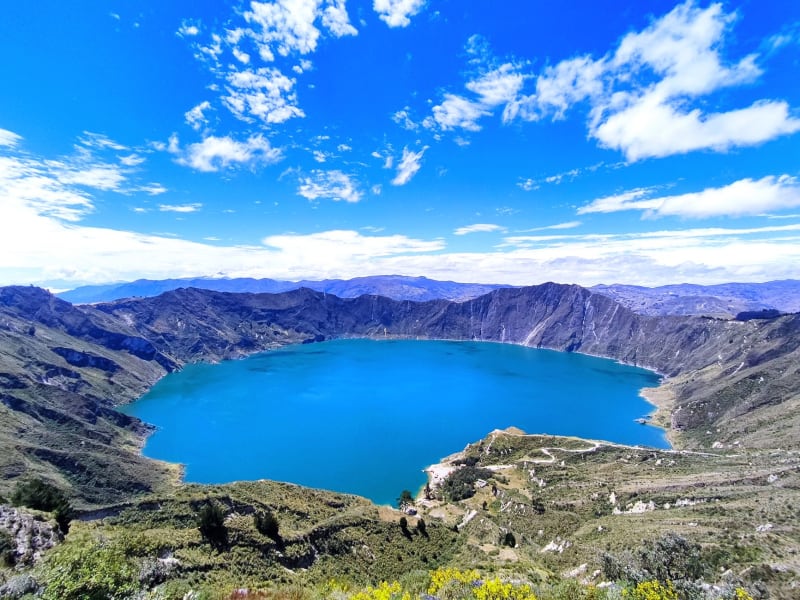 ecuador
 Quilotoa
A collapsed volcano filled with a crater lake of improbable green, sitting at the end of a four-day walk through indigenous villages that most travelers skip entirely.
Explore