
Simon's Town
"Simon's Town has the quiet authority of a place that's been important for a very long time and doesn't need to tell you."
A Victorian naval town on False Bay where the main street has barely changed since the 1890s and the penguins live at the bottom of it.

I arrived in Simon’s Town by train, which is the correct way. The train from Cape Town winds along the False Bay shoreline for the last twenty minutes of the journey, and you arrive at a Victorian-era station with an ornate facade and a main street that has maintained its colonial architecture so consistently that it reads as either a museum or a refusal. The storefronts are low and uniform, painted in heritage colors — mustard, deep red, cream — with iron balconies and wooden signs. It looks like 1895, except for the cafe menus and the occasional table of backpackers.
The town has been a naval base since the British took it in 1814, and the Royal Navy presence defined its architecture, its culture, and its sense of purpose for well over a century. The South African Navy maintains a base here still, and you can see the grey forms of patrol vessels from various points along the waterfront. The Simon’s Town Museum — in the old Residency building dating to 1777 — carries enough layered history that an afternoon disappears in it. I’m not usually a museum person. Simon’s Town made me one.

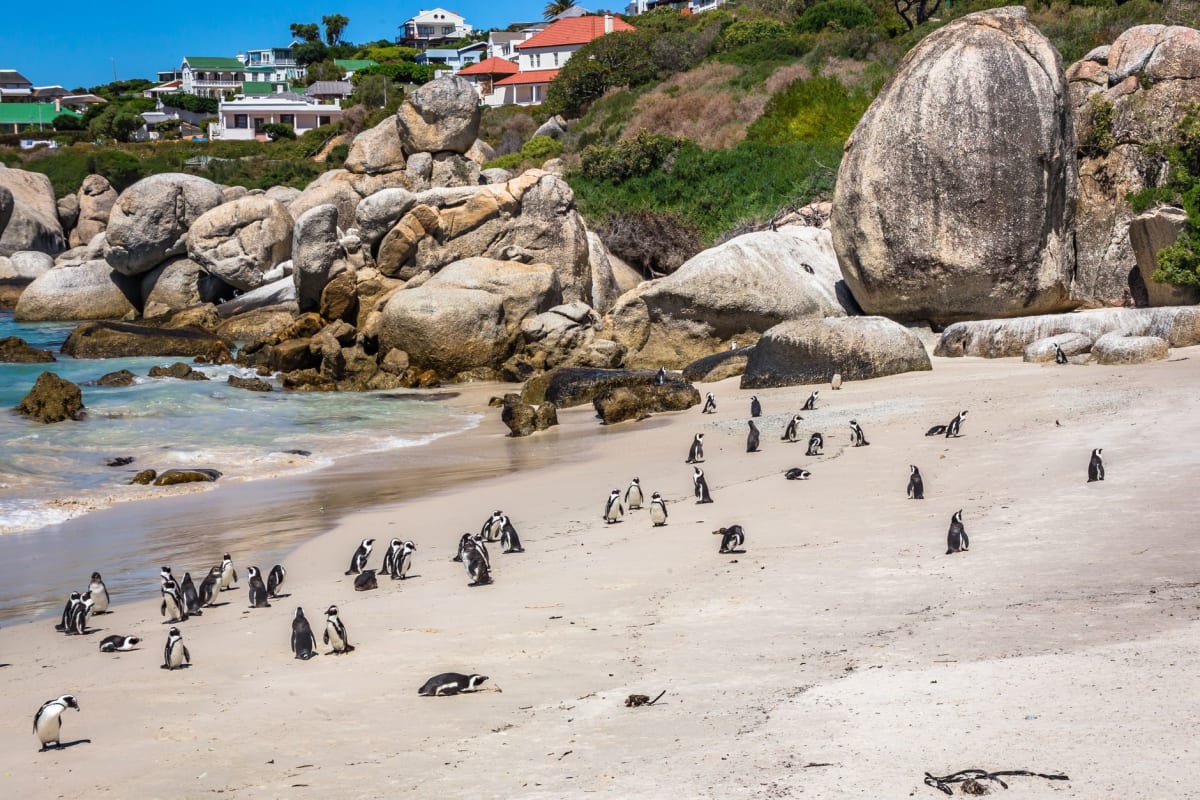
Between the town center and the suburb of Boulders to the south, a series of small bays — Seaforth, Froggy Pond, Windmill Beach — offer sheltered swimming in False Bay’s relatively warm water. In summer these beaches fill with families who know this is some of the most swimmable water on the Cape. At Seaforth, penguins from the Boulders colony sometimes appear directly on the beach, walking among the picnic blankets with the air of unexpected inspectors from an agency no one has heard of.
Jubilee Square at the center of town is the social heart — benches, a small boat-building display, and the bronze statue of Just Nuisance, the Great Dane who was officially enlisted in the Royal Navy in 1939 and spent the war accompanying sailors on the train to Cape Town. The statue has the look of a dog who’s aware of his own legend and finds it mildly embarrassing. People pose with him continuously.
The main street carries good independent bookshops, a few galleries, and the kind of restaurants that don’t need to try very hard because the location does the work. I ate grilled yellowtail looking across the bay to the Hottentots Holland Mountains — snow-dusted in winter on their highest ridges — and thought about how long people have been eating fish on this waterfront in various states of empire, and how the mountains don’t change.
When to go: October to April for swimming and clear bay views. The train from Cape Town runs year-round and costs very little; the same line continues to Kalk Bay, making an easy linear day. July to November is whale-watching season in False Bay — southern right and humpback whales are visible from various points along the waterfront, often close enough that you don’t need binoculars.
Keep exploring
More from Cape Peninsula
 cape-peninsula
Boulders Beach
A sheltered cove where African penguins colonized the neighborhood so completely that the humans had to negotiate shared terms.
Explore cape-peninsula
Camps Bay
A palm-lined beach suburb beneath the Twelve Apostles, where sunset drinks matter more than actually getting in the water.
Explore cape-peninsula
Cape Point
Where the Atlantic finally runs out of continent and the cliffs drop four hundred meters into churning swells below.
Explore cape-peninsula
Chapman's Peak
A cliff road blasted through sheer mountain above Hout Bay that earns the word spectacular without apology or irony.
Explore cape-peninsula
Fish Hoek
A sheltered False Bay beach town where families still swim safely under the watchful eyes of shark spotters on the mountain.
Explore cape-peninsula
Hout Bay
A working harbor town enclosed by mountains and sea, where trawlers land their catch and seals mob the jetty before lunch.
Explore