
Todtnau
"The waterfall is the kind of thing that makes you distrust any waterfall you've ever photographed."
A small mountain town at the foot of the Feldberg that most people drive through on the way to somewhere else, which is their loss entirely.

I passed through Todtnau twice before I actually stopped, which is the common fate of small towns positioned on the road to something famous. The Feldberg draws you upward and Todtnau registers as a collection of houses and a petrol station and then disappears in the mirrors. On my third pass I stopped because it was raining seriously and I wanted coffee, and I found a Bäckerei with steamed-up windows and two farmers arguing about something agricultural at the counter, and the coffee was proper coffee from a machine that had been calibrated by someone who cared, and outside the rain was turning the main street into a minor river and I sat there for an hour and missed nothing by not driving anywhere.

The waterfall is a fifteen-minute walk from the centre of town through a gorge that narrows quickly into something almost theatrical: high rock walls, dense fir, the sound of the Todtnauer Wasser building as you climb until it is no longer background noise but a physical presence. The fall itself drops 97 metres in stages — not a single clean drop but a series of steep cascades over dark granite shelves, the water white and fast and producing a mist cloud at the base that soaks you before you arrive at the lower viewing platform. In spring, after snowmelt, the volume is extraordinary; by late summer it reduces to something more manageable. I came in May, when the rocks were black with wet and the surrounding beeches were still in their fresh pale green, and the spray reached me at twenty metres and I did not mind at all.
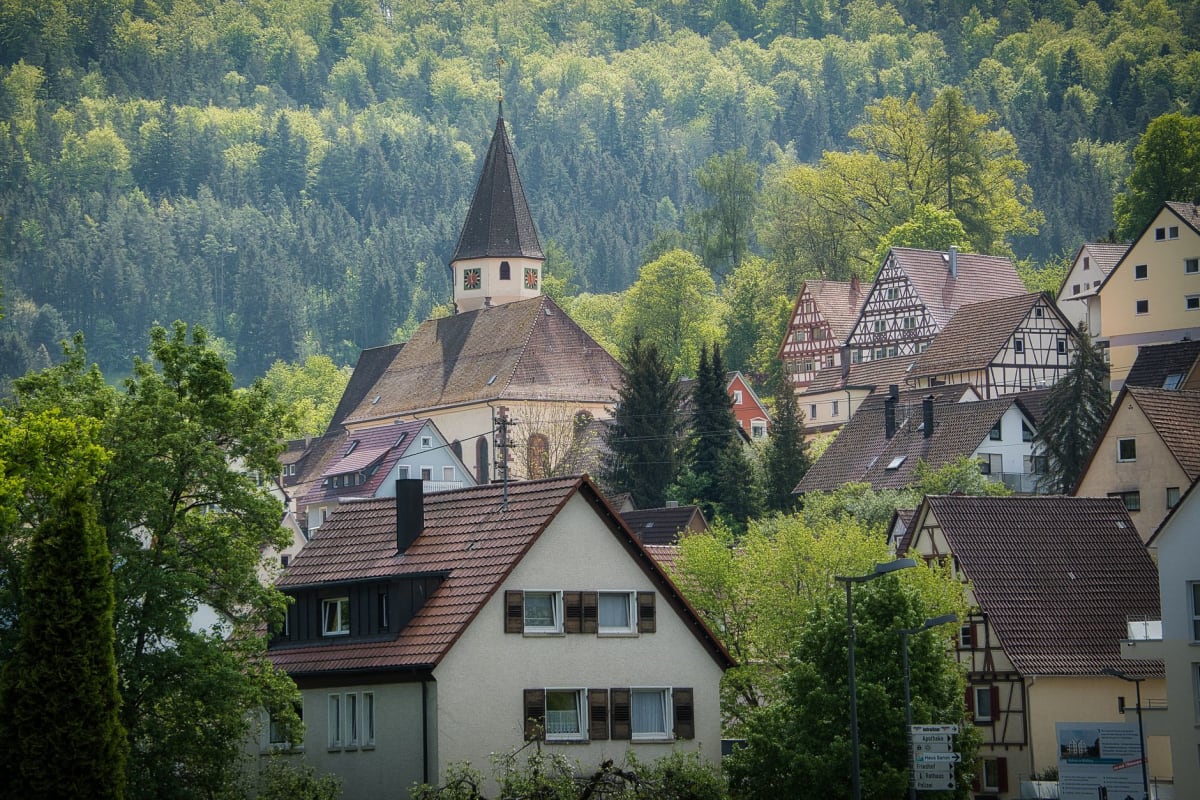
The town itself is unglamorous in a way I find deeply reassuring. It serves the Feldberg ski slopes in winter and the hiking routes in summer, and it contains the kind of infrastructure that working mountain towns contain: a hardware shop, a Gasthof with a hand-lettered menu board, a sports rental place with skis stacked outside in winter like a crop that’s been harvested. The Gasthaus Linde, which has apparently been feeding people in the same location since the eighteenth century, serves Schwarzwälder Vesper — a board of cold cuts, smoked pork, pickles, and rye bread — that is the Platonic form of what you eat in the mountains after walking all day. I had it at a table by the window while the valley below filled with late-afternoon cloud, and I ate everything on the board.
The toboggan run — a summer luge track that descends from the upper slopes — is the town’s other piece of infrastructure, and I did not ride it, but I watched a family of four come down it in separate toboggans at intervals of thirty seconds, each one arriving at the bottom with a different expression: father stoic, mother laughing, older child composed, younger child apparently having recently had a religious experience of some kind. It seemed like the right thing to do on a sunny afternoon in the mountains. I nearly went back for a second look at the queue.
When to go: May and June for the waterfall at peak flow and the valley meadows in flower. December through February for skiing on the Feldberg slopes above town, with Todtnau functioning as a quieter and considerably cheaper alternative to the summit resort infrastructure.
Keep exploring
More from Black Forest
 black-forest
Triberg
Germany's highest waterfalls and the world capital of cuckoo clocks — a place that earns its tourist reputation by actually delivering.
Explore black-forest
Wutachschlucht (Wutach Gorge)
A 30-kilometer wild river gorge where waterfalls, orchids, and a ruined castle sit inside one of Germany's oldest nature reserves.
Explore black-forest
Baden-Baden
A spa town of such practiced elegance that arriving in hiking clothes feels like showing up to the opera in a raincoat.
Explore black-forest
Calw
Hermann Hesse's birthplace on the Nagold river — a medieval town that wears its literary history lightly and is better for it.
Explore black-forest
Feldberg
The Black Forest's highest point at 1493 metres — a bald summit above the treeline where the weather arrives without warning and the views stretch to the Alps.
Explore black-forest
Freiburg im Breisgau
A cathedral city with open-air streams running through its streets and more sunshine than anywhere else in Germany.
Explore