
A thermal valley where the earth cooks your lunch and the sulphur gets into everything, including your idea of what a landscape should be.

The smell hits you before anything else — that dense, mineral sulphur that catches in the back of the throat. I’d smelled something similar near Yellowstone once, but Furnas is more intimate. You’re walking through a valley that is quietly boiling, past bubbling mud pools and vents releasing columns of steam, and the effect is less dramatic than you’d expect and stranger than that. The landscape is perfectly green. Birds sit on rocks two metres from a fumarole. A family with a pushchair is photographing a mud pot. The ordinary and the geological are in total, unremarkable coexistence here.
The cozido is the thing I came for. Cozido das Furnas is a stew — beef, pork, various sausages, cabbage, potato, carrots, blood sausage — sealed in a ceramic pot and placed in a hole in the geothermal ground of Furnas to cook for six to eight hours. Several restaurants in the village pull their pots from the earth at lunchtime, and the whole business, when you watch it, looks less like cooking and more like archaeology. A man with gloves and a hook lever the lid off and this steam cloud erupts, carrying the smell of something ancient and deeply correct.

I ate at Tony’s, the oldest of the cozido restaurants, which has been pulling pots from the same ground since the 1930s. The room was full of Portuguese families from the mainland doing what I was doing — eating something cooked by a volcano. The stew was rich without being heavy, the vegetables soft but not disintegrated, the broth the colour of amber. I ate too much and had no regrets. The bread was dense local sourdough. There was local wine. It was one of those lunches that makes the afternoon impractical.
Furnas Lake sits at the end of the valley, and its margins are lined with more fumaroles — you can walk to the water’s edge and see the vents releasing steam directly into the lake, the water around them faintly warm and slightly sulphurous. Terra Nostra Park is nearby: a botanical garden surrounding a thermal pool the colour of tea, tinted by the iron and tannins in the water. Swimming in it stains your bathing suit orange. The thermal water is genuinely warm, genuinely odd, and genuinely wonderful.

The village of Furnas itself is small and slightly faded — a spa town that had grander ambitions in the nineteenth century, when Europeans came here to take the waters. Some of the old hotel facades survive, crumbling with a certain melancholy charm. On the main square there are kiosks selling thermal water in paper cups, hot from the ground, mineral-tasting and strange. I drank one. It tasted like drinking geography.
When to go: Year-round, though spring and autumn keep the valleys most atmospheric with mist. Book cozido lunch in advance — restaurants fill up by midday every day. Terra Nostra Park is most beautiful in spring when the tree ferns are at their most excessive.
Keep exploring
More from Azores
 azores
Graciosa Island
The pale island — whitewashed windmills, calm seas, and a thermal cave so strange it was used as a wine cellar for a century.
Explore azores
Lagoa do Fogo
São Miguel's highest crater lake, hidden in cloud most of the day, and heartbreakingly clear when it finally shows itself.
Explore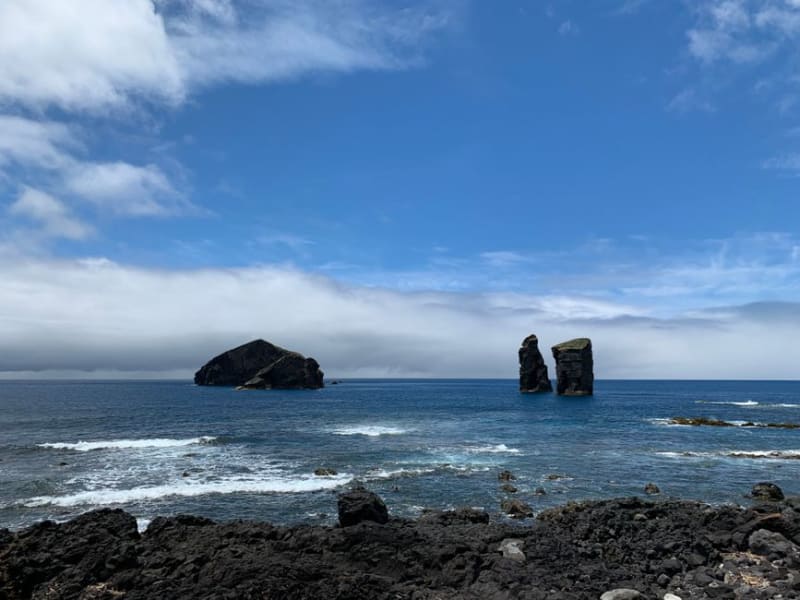 azores
Mosteiros
A black-sand village on Sao Miguel's west coast where volcanic rock pools trap the Atlantic into calm, swimmable seawater lagoons.
Explore azores
Pico Island
A volcano rising from the Atlantic, UNESCO wine country built in black lava walls, and the best place in the archipelago to watch whales.
Explore azores
Ponta Delgada
São Miguel's low-key capital where black basalt architecture meets Atlantic light and the waterfront cafés keep hours that make sense.
Explore azores
Santa Maria Island
The Azores' sunniest, southernmost island, where white-sand beaches and red-roofed villages feel more Mediterranean than mid-Atlantic.
Explore