
Évora
"The Romans built their temple so well that Évora simply grew the city around it and gave up arguing."
A UNESCO-walled city where a Roman temple stands mid-town and five thousand monks pressed their bones into a chapel's walls.

I came to Évora by train from Lisbon on a September afternoon when the air tasted of dust and fermenting grapes. The journey took under two hours, which seemed too brief for how completely the landscape changed — from the Atlantic-washed light of the capital to this browner, drier country where the horizon sat low and wide and the light had a concentrated quality, like it had been left out in the sun too long. The taxi driver from the station barely said a word. He dropped me at the medieval gate with a nod, as if everyone who arrived here already knew what they were doing.
The Roman temple stopped me before I had even found my hotel. It stands on a promontory in the center of town, fourteen granite columns topped with Corinthian capitals, intact enough to feel like a structural presence rather than a ruin. There is no rope, no interpretive panel blocking the view, no entrance queue. It simply exists there, rising above the café terraces and the parked Fiat 500s, a monument to the Roman conviction that if you build something well enough it never really ends. I sat on a bench across from it as the afternoon light went amber and felt an unusual sensation: I was not in a hurry.
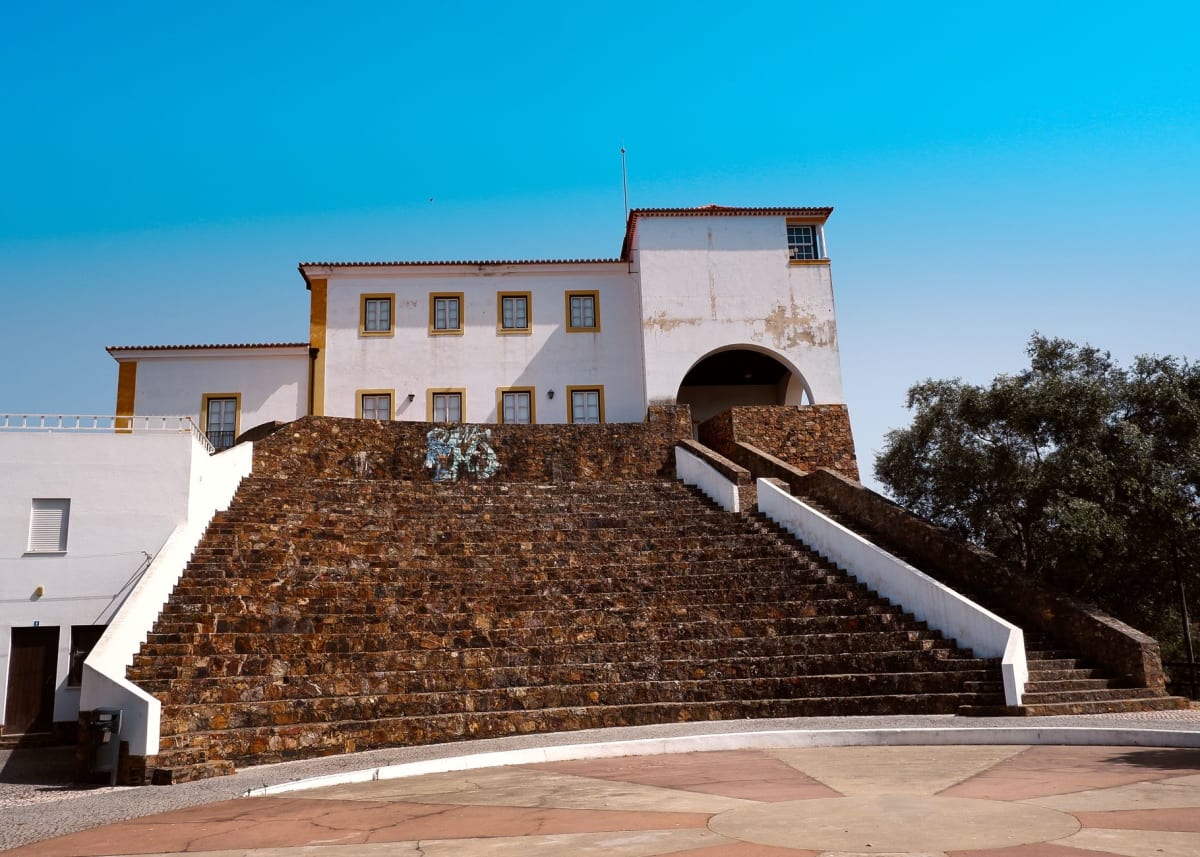
Évora eats seriously. This is not a place for tourist menus — the locals care too much about what is in front of them. I found a table in a restaurant behind the cathedral where the waiter set down a board of queijo de serpa without being asked, the sheep’s cheese so dense and sharp it required the rough bread beside it to make sense. The black pork that followed was braised to the point where the meat dissolved rather than chewed, and the migas — a fried bread-and-garlic mass that sounds humble but is not — were the best I had tasted anywhere in the country. The wine came from Alentejo vineyards just outside the walls, something dense and red and warm from a bottle with a handwritten label.

The Chapel of Bones off the Praça 1 de Maio should be seen after lunch, when you have some ballast. The Franciscan friars built it in the sixteenth century with the bones and skulls of some five thousand monks, arranging the femurs in patterns along the walls and letting the skulls cluster in corners. There is a sign above the entrance that reads, roughly: We bones here are waiting for yours. It sounds macabre on paper. Standing inside the chapel, it feels strangely peaceful — a meditation on impermanence rendered in architectural form, the monks essentially saying: this is what we will all come to, and we may as well be beautiful about it.
When to go: September through October catches Évora in its best moment — the harvest is in, the tourists have thinned, and the temperatures have dropped below the punishing summer highs. March and April are also beautiful, when the Alentejo plains turn briefly, startlingly green.
Keep exploring
More from Alentejo
 alentejo
Marvão
A walled eagle's-nest village clinging to a granite crag in the Serra de São Mamede, where the whole of two countries seems to unroll beneath your feet.
Explore alentejo
Mértola
Portugal's most Islamic town, a white fortress village above the Guadiana where the church was once a mosque and the river runs the color of iron.
Explore alentejo
Monsaraz
A medieval village frozen on its hilltop, watching the vast Alqueva reservoir turn copper at dusk from behind its castle walls.
Explore alentejo
Portalegre
A textile city tucked into the cool northern serra where the air smells of wool and the tapestry factory still weaves the old way.
Explore alentejo
Serpa
A walled town near the Spanish border where the sheep's cheese is so good it earns its own protected designation and the afternoons last forever.
Explore alentejo
Vila Viçosa
A royal town built on marble where the Ducal Palace still smells of dynasty and the orange groves go all the way to the walls.
Explore