Faro
"We stood on a ridge above town glassing a band of Fannin sheep, and I kept thinking how strange it was that the animals had outlasted the mine."
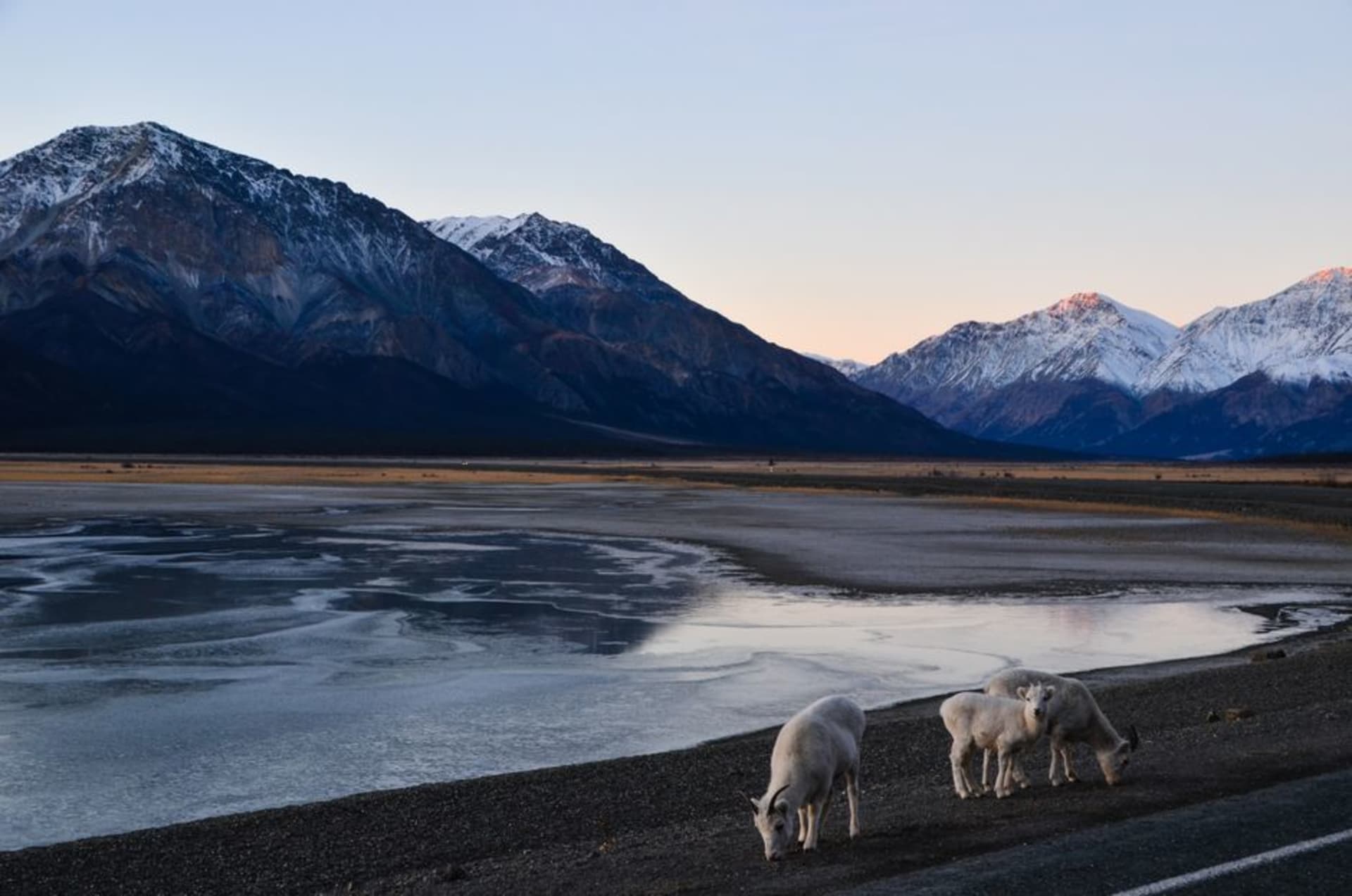
A former lead-zinc mining town built for ten thousand and now home to a few hundred, better known these days for its rare Fannin sheep than its ore.

Faro was built almost overnight in the 1960s for the Anvil Range mine, once one of the largest lead-zinc operations in the world, and the town still carries the ghost of that ambition — wide suburban streets, a rec center, cul-de-sacs laid out for ten thousand people that maybe four hundred now occupy. Driving in from the Campbell Highway, you notice the grid before you notice how quiet it is. Lia said it felt like a movie set built for a much bigger production that got cancelled halfway through.
We’d come specifically for the Fannin sheep, a pale, almost cream-colored subspecies found in real numbers almost nowhere else on earth, grazing the mountains that ring the old mine site. A local guide took us up toward Mount Mye where the sheep come down to graze the mineral licks in early summer, and within an hour we had a band of them in the spotting scope, unbothered, working their way along a scree face like it was nothing.

Back in town we ate at the one diner still open, and the owner talked us through the mine’s closures and restarts over the decades — it shut for good in the late nineties, reopened briefly, shut again — and how the town had shrunk each time and never quite recovered its old size. There’s an interpretive display near the visitor center with photos of the open pit at full production, trucks the size of houses, that made the current silence feel almost staged.

What stuck with me leaving Faro wasn’t the mine story, which is common enough across the north, but the sheep-viewing infrastructure the community built around what was left — trained volunteer guides, a small festival each June, real pride in something that has nothing to do with ore. It’s a town that got handed decline and found something else worth showing people instead of just closing the door.
When to go: Visit in June for the Faro Wildlife and Wilderness Viewing Festival, when the Fannin sheep are most reliably visible on the slopes near town and local guides are on hand.
Keep exploring
More from Yukon
 yukon
Haines Junction
A small town at the edge of the world's largest protected wilderness, where the Alaska Highway meets the mountains and the grizzlies outnumber the residents.
Explore yukon
Herschel Island (Qikiqtaruk)
A remote Arctic island in the Beaufort Sea, the Yukon's only true ocean territory, layered with whaling ghosts and Inuvialuit history.
Explore yukon
Keno City
A near-ghost silver-mining town at the end of the Silver Trail, where a hilltop signpost points toward a hundred cities you'll never see from here.
Explore yukon
Klondike Valley
The creek beds where the gold rush began, still being worked by independent miners a century and a quarter later, accessible by a gravel road that takes you through living history.
Explore yukon
Kluane National Park
The largest non-polar icefield on earth sits behind a wall of mountains so big they create their own weather, and most people only see them from the highway.
Explore yukon
Old Crow
A fly-in Vuntut Gwitchin community north of the Arctic Circle, reachable only by small plane and defined by the Porcupine caribou herd.
Explore