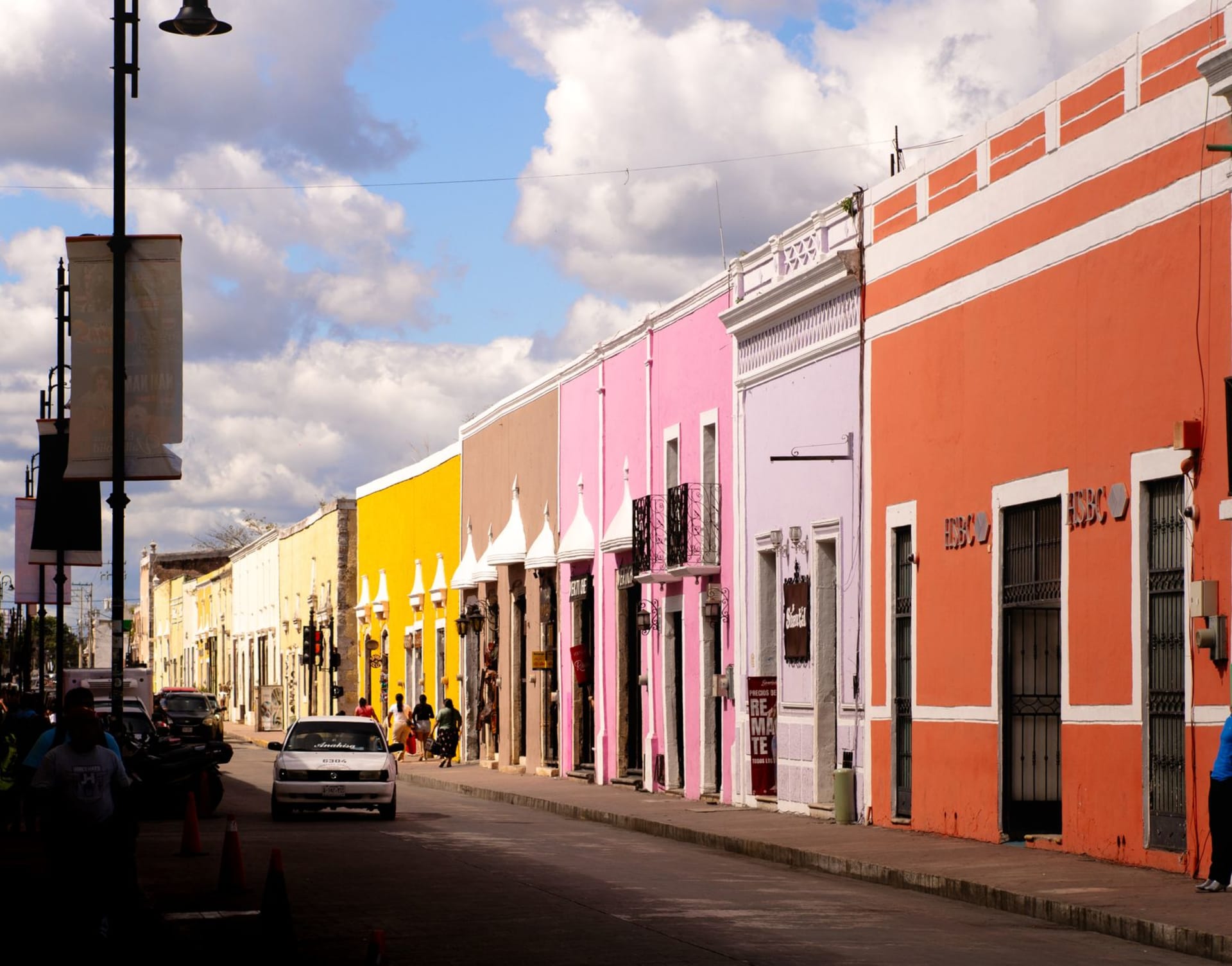
Izamal
"When every building is the same color, you stop looking at the buildings and start looking at the light."
Izamal is about 70 kilometers east of Mérida on the road toward Valladolid, and it requires a conscious decision to stop because the highway doesn’t pass through it — you turn off into a town that the 20th century visited but didn’t particularly renovate. The centro is painted yellow. All of it. Not several shades of yellow, not yellow-adjacent: a specific municipal ochre that was officially standardized for the city’s visit from Pope John Paul II in 1993 and has remained ever since.
The effect, on a clear afternoon when the sun hits the facades at an angle, is something between a dream and a period photograph.
The Convent on the Pyramid
The Franciscans who arrived in the Yucatan in the 16th century did not always choose their building sites at random. At Izamal, they built the Convento de San Antonio de Padua on top of the Maya pyramid of Ppapp-Hol-Chac — using the pyramid’s base as the foundation for what is one of the largest atria in the world, second only to the Vatican’s. The pyramid is still partially visible: the north platform of the original structure forms the floor of the convent’s enormous forecourt.
This layering of civilizations in a single structure is something the Yucatan does repeatedly, but Izamal makes it particularly undeniable. You walk across a space that was a ceremonial center for two entirely different religious systems, and the scale of both ambitions is legible in the same walls.
The convent houses a much-venerated statue of the Virgin of Izamal, to whom miracles have been attributed, and the town receives a steady stream of Mexican pilgrims who arrive in colored buses and walk through the atrium in a different register than tourists do.
The Maya Pyramids
Izamal was a major Maya city — one of the few that was continuously occupied from the pre-Classic period through the Spanish conquest — and several pyramids still stand within the town, incorporated into the urban fabric to varying degrees. Kinich Kakmó is the most accessible: a large stepped pyramid a few blocks from the convent that you can climb on a path of worn stone, arriving at the top where the entire yellow city spreads out below you. The view takes in the convent, the main plaza, the surrounding jungle, and — on a clear day — the flat horizon of the Yucatan peninsula extending in all directions.
I climbed it in the late afternoon when the light was good and sat at the top for half an hour while the town made its evening sounds below.
Horse-Drawn Carriages
Izamal has positioned itself as the calesa (horse-drawn carriage) town of the Yucatan, and carriages are genuinely the recommended transport for getting between the main pyramid, the convent, and the smaller sites. This could easily feel gimmicky but it doesn’t, or not entirely — the streets are narrow and stone-paved, the distances short, and the pace of a carriage ride is approximately right for a town that moves at a ceremonial tempo.
The drivers know the history well enough to serve as tour guides, and the one I had spoke with genuine pride about the town’s layers of civilization. He pointed out which walls were Maya stone and which were Spanish colonial and which were 20th-century concrete repair, and he was right about all of it.
Eating Yellow
The artisanal honey from the Yucatan’s native stingless bees is sold throughout the market and in shops around the plaza. It’s darker than commercial honey and has a complex, almost acid finish — nothing like what I was expecting. I bought a jar and ate most of it before I got back to Mérida.
The market loncheras do a solid Yucatecan lunch: longaniza, panuchos, lime soup. Nothing exotic, everything executed well with ingredients that haven’t traveled far.
When to go: Year-round destination given its inland location, though November through February offers the most comfortable temperatures. Pilgrimage festivals — particularly around the feast of the Virgin of Izamal in late June and religious holidays — bring crowds and ceremony that are worth witnessing if you plan for them.