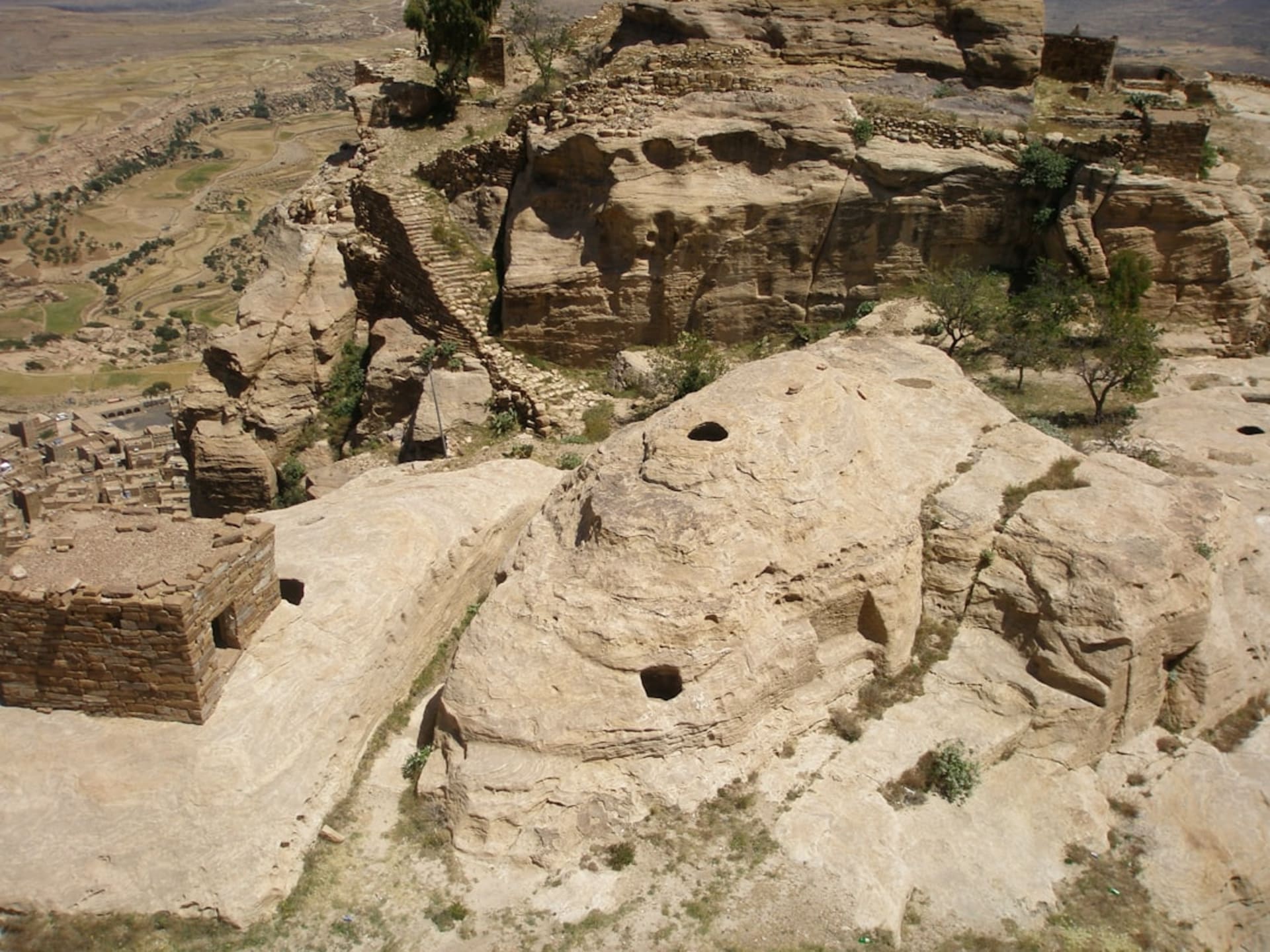
Taiz is the kind of city that presents its credentials without apology. The third-largest city in Yemen sits at 1,400 meters in a bowl surrounded by mountains—Jabal Sabr rising to the east is forested in a way that surprises you given Yemen’s general aridity—and the combination of altitude and agricultural richness has made this a center of trade, scholarship, and coffee production for over a thousand years. The Rasulid sultanate made it a capital in the thirteenth century. The coffee traders of the fifteenth and sixteenth centuries passed through it on the way to the port at Mocha. The Ottomans built mosques here. The British looked at it from Aden and understood its importance. Taiz has never really needed to argue for its own significance—the geography and the history do that work.
I arrived in the afternoon, when the light comes down the mountain at an angle that turns everything in the city slightly theatrical. The old city’s minarets throw long shadows. The market streets are still fully operational at that hour, which in Yemen means the air is a layered thing: incense from the frankincense vendors, coffee from the café windows, frying oil from the street food stalls, the mineral smell of old stone in afternoon heat.
The Old City Markets
Taiz’s suqs are organized by trade in the old manner—the spice sellers in one lane, the silversmiths in another, the cloth merchants in a third—and each section has its own atmosphere. The silverwork is exceptional: Taiz and the surrounding region have a tradition of filigree and granulation that was historically associated with Yemen’s Jewish craftsmen and continues in modified form today. I spent an hour in the silversmith’s lane watching a man solder a chain so fine it was almost invisible, using tools that appeared to predate the Ottoman occupation, producing work that would not embarrass a contemporary jeweler anywhere.
Jabal Sabr
The mountain behind Taiz is reachable by a road that climbs through the city’s edge neighborhoods and then enters a zone of cloud forest—actual cloud forest, with ferns and moss and a temperature drop of eight degrees inside two kilometers. The summit is used for agriculture: qat gardens and small plots of vegetables in the mountain mist. The view back down to Taiz on a clear morning is the view the Rasulid sultans chose, which suggests they knew something about siting a capital.
The Ashrafiyya Mosque
The Ashrafiyya complex dates to the late thirteenth century and is the most formally beautiful building in Taiz. The twin minarets have Rasulid-era muqarnas work at the tops—honeycomb vaulting in carved stone that cascades down from the finials like frozen water. The interior is cool and dim and smells of aged wood and prayer mats, and the tiling around the prayer niches is from a decorative tradition specific to this corner of Yemen, not quite Mamluk, not quite Persian, something that developed here under specific conditions and hasn’t quite been replicated elsewhere.
The Coffee Question
Yemeni coffee is the original—the Coffea arabica domesticated in Ethiopia, first cultivated commercially in Yemen, first traded through Mocha to Europe, the genetic ancestor of every espresso pulled in every coffee shop on earth. The Taiz region is one of the remaining centers of its production. The coffee drunk locally is often prepared as qishr—the husks of the coffee cherry rather than the bean itself, brewed with ginger and cardamom into something pale amber and electric, nothing like what you expect when you order coffee. I drank three cups in a day and understood something about stimulants that I had previously only understood theoretically.
When to go: October through April for the most comfortable temperatures and clearest skies. The monsoon season (June–August) brings heavy rain and the mountain scenery becomes spectacular, but road conditions can complicate movement. Taiz’s altitude keeps it relatively cool year-round compared to the coast or the interior desert.