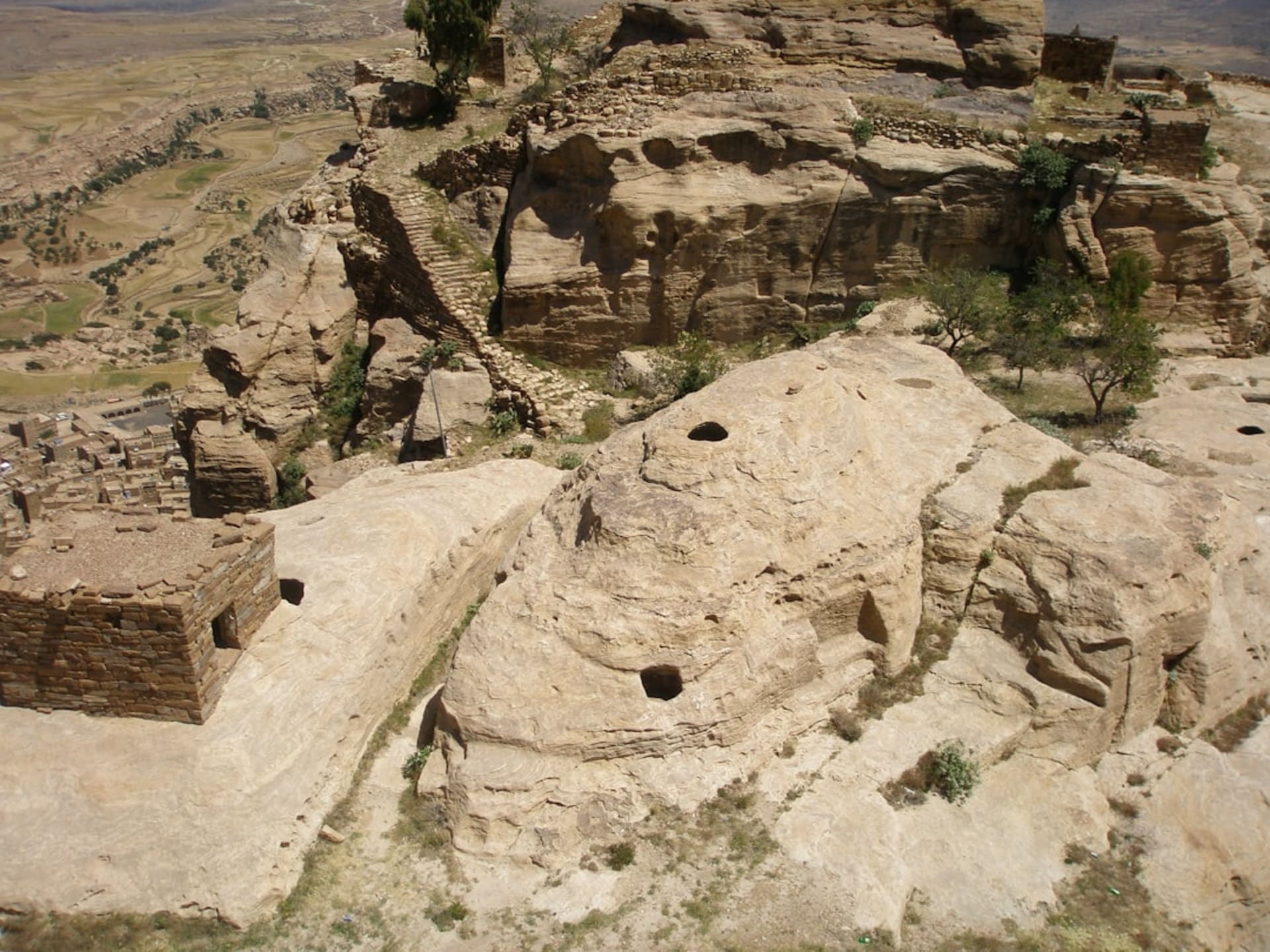
The road to Shahara is the kind of road that gradually eliminates options. Each switchback up the Jabal Shahara removes one more possibility of turning around comfortably, until eventually the road narrows to a single lane carved into the cliff face and the valley below has become abstract—a green smudge visible through breaks in the rock—and the only sensible direction is up. By the time the village comes into view, you have been traveling for long enough that its appearance on the ridgeline feels earned.
Shahara sits at roughly 2,600 meters in the highlands north of Sana’a. It is a Yemeni mountain village in the formal sense: stone houses built directly on stone cliffs, terraced agriculture on every viable slope, a fortified perimeter that made the place essentially impregnable for centuries. The Imams of Yemen used it as a refuge during the Ottoman occupation, and the decision makes immediate tactical sense—Shahara can be defended by very few people against very many, and the views from the ramparts on a clear day extend for distances that make early warning of any approaching force practically automatic.
The Bridge
The bridge is the reason most people come to Shahara, which means it has to be discussed carefully. It is a single arch of cut limestone spanning roughly thirty meters across a gorge that drops perhaps sixty meters to the floor below, connecting Shahara to the village of Al-Ayn on the opposite rim. It was built in the seventeenth century and appears, at first glance, to have been built by someone with a very good grasp of both engineering and drama.
I walked it on a morning when cloud was moving through the gorge below—slowly, in defined columns—and the sensation of the bridge disappearing into mist on either side created a specific kind of vertigo that was not quite fear and not quite exhilaration. The stone underfoot was slightly wet. The arch is narrow enough that two people pass each other with care. I stopped in the middle for long enough that a man with a load of qat crossed behind me and had to detour slightly around my stillness.
The Village Itself
Inside Shahara’s walls, the village operates with the self-sufficiency of a place that spent centuries being inaccessible by design. The houses are stone, the lanes are stone, the steps are stone worn smooth by generations of feet. Every surface that can be terraced is terraced—grapes, sorghum, qat, vegetables in small plots that defy the altitude. The qat here is prized throughout Yemen, grown at elevation and harvested in the early afternoon, its quality attributed to the combination of altitude, climate, and the specific mineral content of the Jabal Shahara soil.
Cloud Weather
The mountains around Shahara make their own weather. In the morning, cloud frequently fills the gorges and valleys below while the village itself sits in thin clear air above. By midday the cloud often burns off, revealing views north toward Saudi Arabia and south toward Sana’a. In the afternoon, new cloud sometimes builds from the southwest. I spent one complete day in the village and watched the landscape change register four times, which is more than most places manage in a week.
The Qat Afternoon
Late afternoon in any Yemeni highland village means qat—the mild stimulant leaf that is chewed after lunch and generates the kind of slow, focused conversation that seems to require no particular topic and no particular destination. I was invited to sit with a group of men on a rooftop, accepted a small bundle of leaves, and spent two hours in a conversation conducted almost entirely without a shared language. The view from that rooftop—gorges, terraces, cloud—made the absence of words feel less like a limitation and more like a natural consequence of having something worth looking at.
When to go: March through May and September through November for the clearest visibility and most comfortable temperatures. The summer monsoon brings dramatic cloud and occasional heavy rain, which makes the bridge crossing memorable in a different way. Avoid December and January nights, which can be genuinely cold at this altitude.