Marib
"A dam that once watered a civilization—now just walls in the sand, and still impressive."
There is a certain category of ruin that does not require a great deal of historical knowledge to understand. You stand in front of it and the scale speaks plainly: someone did something extraordinary here. Marib is that kind of place. The Great Dam, built sometime in the eighth century BCE and expanded and rebuilt for a thousand years after that, once controlled the flood waters of Wadi Dhana and irrigated an agricultural zone that supported an estimated 50,000 people in the middle of the Arabian desert. That is not a small number. That is a civilization.
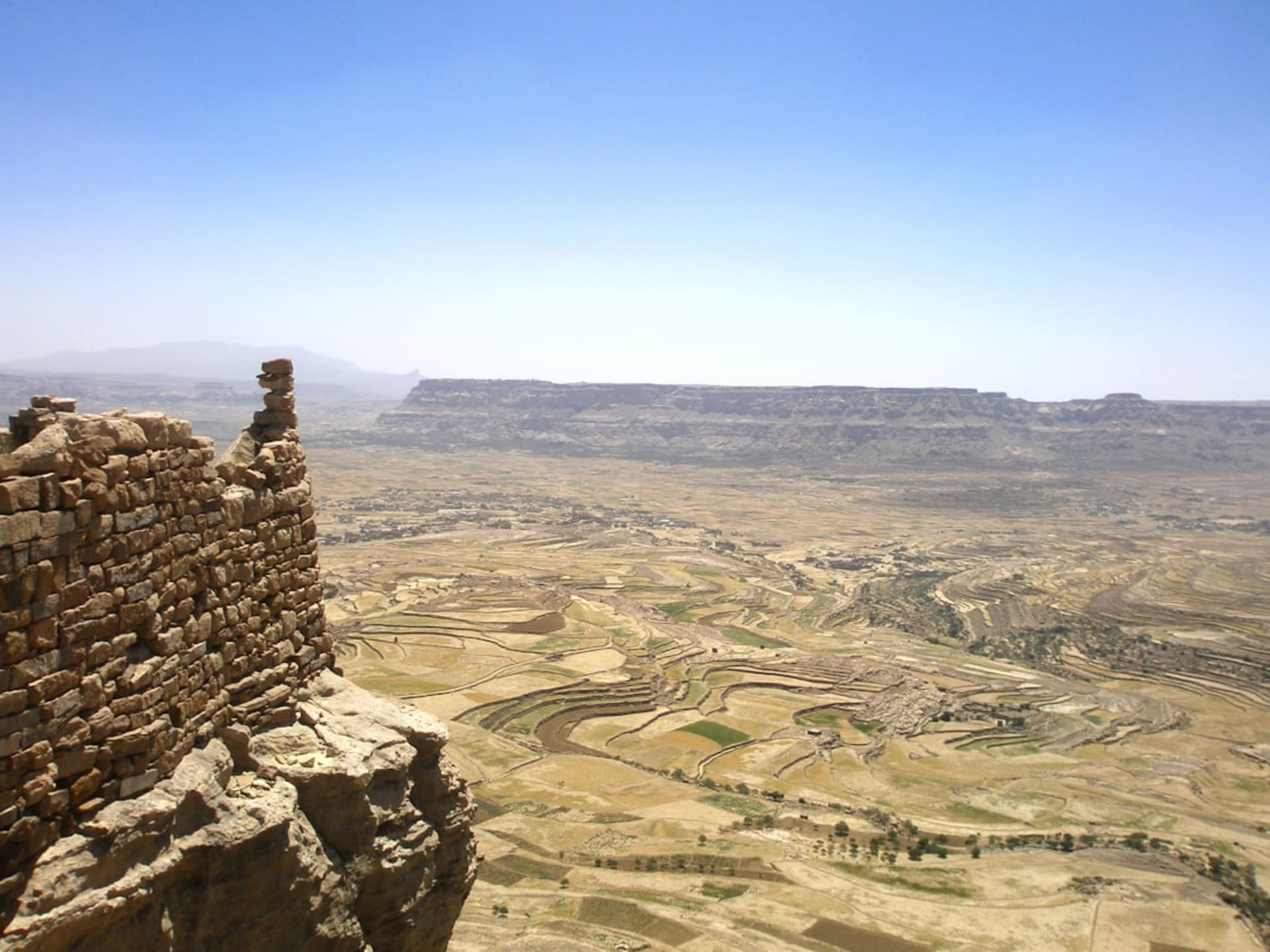
The Sabaean kingdom ran the frankincense trade and understood that controlling water in a waterless landscape meant controlling everything downstream—economically, politically, spiritually. Marib was their capital, and the ruins that remain are scattered across a landscape that has reverted to sand and rock in the fourteen centuries since the dam’s final collapse. Walking between sites in the desert heat, I kept having to remind myself that what looks like wasteland was, within living memory of the Roman Empire, one of Arabia’s most productive agricultural regions.
The Great Dam
The dam’s ruins are both less and more impressive than the photographs suggest. Less, because the scale requires recalibration—you expect something monumental and instead find two stone sluice gates at either end of what is now a dry wadi, connected by earthworks that time and erosion have reduced to broad embankments. More, because once you understand the engineering—the irrigation canals that once extended for 1,600 hectares in each direction, the sluice gates that controlled flow with a precision that was not matched in Europe until centuries later—the restraint of what remains becomes eloquent. This is what a thousand years of maintenance looks like when the maintenance stops.
Bar’an Temple
The Temple of the Moon god, known locally as Arsh Bilqis—the Throne of the Queen of Sheba—sits on a small rise south of old Marib with five of its original columns still standing. The columns are limestone, perhaps eight meters tall, and they were carved and assembled sometime around the seventh century BCE. In the early morning, before the desert heat becomes insistent, they cast long shadows across the sand and the quality of the silence around them is specific: not empty, exactly, but attentive. A crow landed on top of one column while I was there, adjusted its balance once, and did not leave.
Awwam Temple
The elliptical precinct of the Awwam Temple—the national sanctuary of the Sabaean kingdom—is partially excavated, partially still under the sand. The site is large enough that walking its perimeter takes twenty minutes, and enough of the stone inscriptions remain in situ that you can read, if you know the Sabaean script, the names of people who made votive offerings here two and a half thousand years ago. I don’t know the Sabaean script but spent time looking at the inscriptions anyway. There is something in the act of looking at writing you cannot read that is not quite comprehension and not quite incomprehension—something in between.
Old Marib Town
The old town adjacent to the ruins is a study in mud-brick pragmatism: houses built from the same ochre-colored clay as the ruins, lanes that wind without apparent logic, a small market that sells dates and diesel and phone credit. The people here have been living alongside one of Arabia’s most significant archaeological sites for their entire lives and treat it with the casual familiarity of neighbors rather than the reverence of tourists.
When to go: October through March, before the desert heat makes outdoor exploration at the ruins uncomfortable. Early morning arrivals at the temples are strongly recommended—by 10 a.m. in spring the temperature climbs quickly, and the light at dawn on the limestone columns is exceptional. Arrange transport from Sana’a with a reputable guide who knows current road conditions.