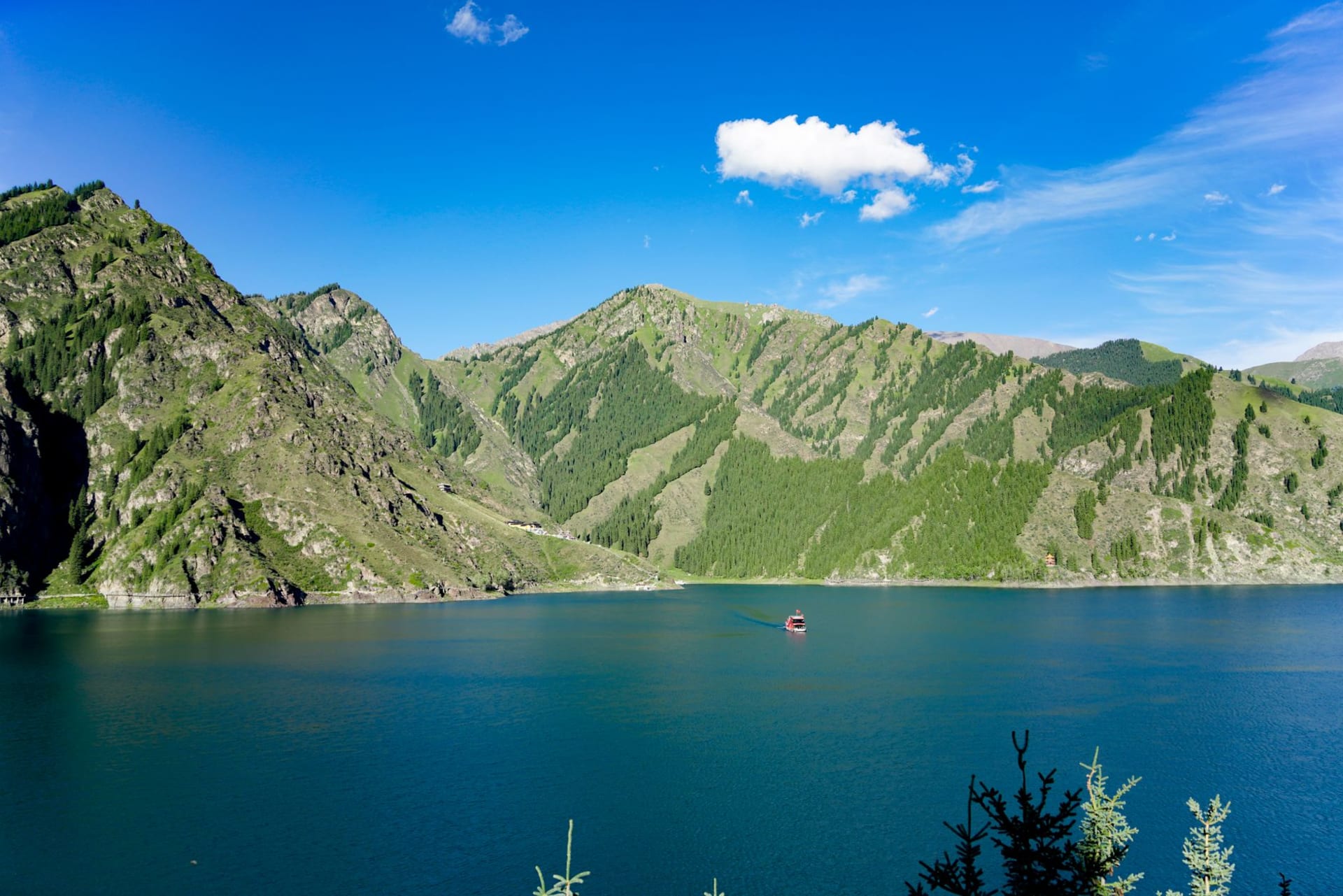
Heavenly Lake of Tianshan
"An hour from a desert city, and suddenly I was standing in the Alps that someone had relocated to Central Asia."
Heavenly Lake — Tianchi — is one of those places whose name sounds like marketing until you see it, at which point you forgive the hyperbole entirely. It sits high in the eastern Tianshan, the great mountain range that walls off the Junggar Basin from the Tarim, about two hours’ drive from Urumqi. I had spent the previous days in the furnace heat of Turpan, the lowest and hottest place in China, and arriving at this cold blue lake ringed with spruce forest and crowned by the glaciers of Bogda Peak felt like stepping through a door into an entirely different country. Central Asia does this — it keeps an Alps tucked behind a desert, and almost no one outside China seems to know.
The Lake and the Mountain
The lake itself is a long, deep splinter of meltwater, its colour shifting from jade to a deep cobalt depending on the light and the cloud. Above it rises Bogda Peak, glaciated and serious at over five thousand metres, the kind of mountain that anchors a whole horizon. There is a boardwalk and a boat that ferries visitors along the shore, and yes, in summer it gets busy with domestic tour groups — this is a famous place in China and I will not pretend otherwise. But walk twenty minutes beyond the main viewpoint, up one of the trails that climb through the spruce toward the higher meadows, and the crowds thin out almost completely. Lia and I followed a path until we reached a small grassy shelf where a Kazakh family had set up a felt yurt and were grazing horses, and we sat there for an hour with the lake far below us and not another tourist in sight.

The Kazakh Pastures
The high country around Tianchi is summer pasture for Kazakh herders, and that, for me, was the real revelation. The Tianshan have been grazed by nomadic people for millennia, and in the warm months the families move their flocks and yurts up to the alpine meadows, just as their grandparents did. We were waved over by an older woman who poured us bowls of salty milk tea and a fermented mare’s milk called kymyz that I can only describe as an acquired taste I did not acquire. Her son spoke some Mandarin and a little English, and through a patchwork of three languages we talked about the horses, the winter down in the valley, and the way the tourists come and go while the mountains stay. It was the kind of unhurried, generous encounter that I keep finding in Xinjiang, a region the outside world mostly knows for the wrong reasons.
Getting the Most From It
The trick with Tianchi is to come early and stay late, ideally overnight in one of the yurts that herders rent to visitors on the upper meadows. The day-trippers pour in around eleven and are gone by four, and in the long golden evening that follows, the lake empties out and goes quiet, the peaks catch the last light, and you remember that this was a sacred mountain lake long before it was a ticketed scenic area. I lay awake that night in a freezing yurt, listening to horses shift in the dark, genuinely happy in the way that only happens a few times on any trip.
When to go: June to September, when the passes are open and the meadows are green. By October the high country is already turning to snow and many yurts close for the season.