Conwy
"The walls still work — you walk them and the town below them makes sense in a way it doesn't from the street."
Inside the Walls
Conwy is a medieval town that hasn’t outgrown its medieval walls, which is unusual and affecting once you understand what you’re looking at. Edward I built the castle and the town walls simultaneously in the 1280s as part of his campaign to control Wales — a project of such systematic violence that the castles he built (Conwy, Harlech, Beaumaris, Caernarfon) are now a UNESCO World Heritage Site, which is one way to deal with history.
The castle is enormous. Eight round towers, two barbicans, walls thick enough to walk on, a great hall open to the sky where ravens now do what ravens do in great halls. The views from the towers take in the estuary, the mountains of Snowdonia, the suspension bridge Telford built in 1826 (its towers designed to match the castle’s, a gesture of continuity that worked better than expected), and the more recent railway bridge that Robert Stephenson built twenty years later. Three centuries of engineering, all in one view.
I paid the entry fee, climbed every accessible tower, and spent longer than planned reading the interpretation panels about the Welsh princes displaced by Edward’s programme. The castle is extraordinary and the history behind it is uncomfortable and both things are true at the same time. Good historical sites don’t let you off the hook.
Walking the Walls
Three-quarters of the medieval town walls survive intact, which means you can walk a kilometre and a half of ramparts above the rooftops of the town and look down into gardens and alleys that the walls have enclosed for seven hundred years. The circuit takes about an hour, involves some steep stair climbs, and rewards you with views that reframe the whole town — the castle’s relationship to the quay, the squeeze of the streets below, the way the estuary opens east toward the English border.
The smallest house in Great Britain is on the quay below the walls. It’s genuinely small — two rooms, nine feet wide, ten feet tall — and genuinely a house, occupied until 1900 by a fisherman who was reportedly six feet three inches tall. The cognitive dissonance keeps me thinking about it.
The Quay and What It Sells
The quay is where Conwy sells mussels. This is not tourism; Conwy has harvested mussels from the estuary for centuries, and the season runs from September to April. The boats come in, the harvest goes to restaurants along the quay, and you eat them with bread and local butter at a table with a view of the castle and the bridge and the water moving. It’s one of those meals that exists entirely in the context of its place — eat the same mussels in a different town and they’d be good mussels; eat them here and they’re something else.
Lia ordered them in a bowl with white wine and fennel from a place right on the waterfront, and the steam coming off the bowl smelled of sea and anise together, and the castle behind us was lit gold in the afternoon light, and I thought: right, I understand why people come back to this.
Around the Estuary
Across the bridge, the village of Deganwy looks back at the castle from the opposite bank — the view from there, with the castle reflected in the estuary at high water, is the postcard. The Conwy Valley runs inland from the town, narrowing into farmland and forest as it rises toward Snowdonia. Bodnant Garden, a few miles south, is one of the National Trust’s great gardens — a formal terraced garden above the river Hiraethlyn that in May is full of laburnum arches and rhododendrons the size of trees.
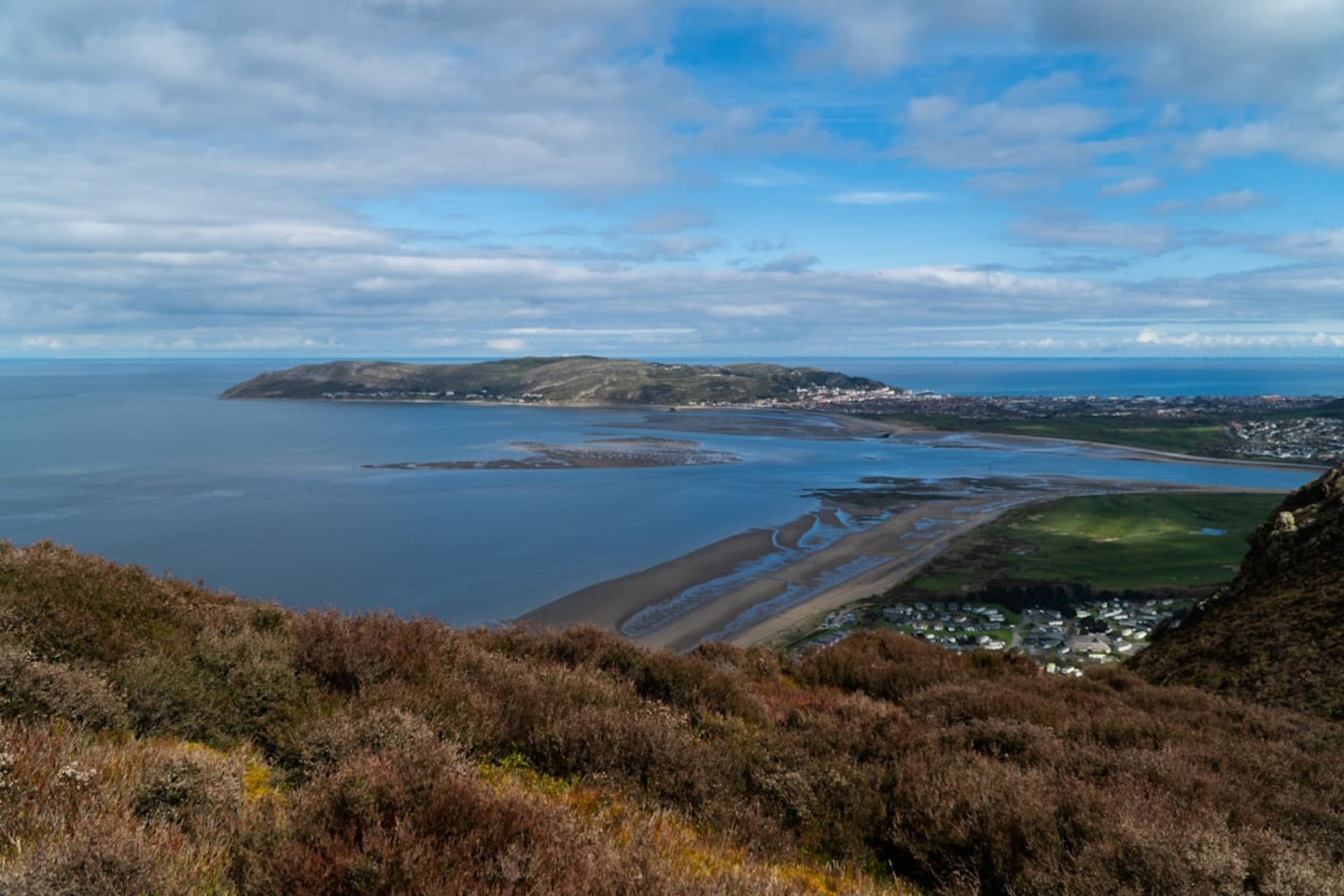
The road west along the coast toward Bangor passes through Penmaenmawr, where there’s a Bronze Age stone circle on the hillside above the town that gets almost no visitors and deserves more. The mountain here drops straight to the sea, and the circle sits on a terrace with views of Anglesey and the Menai Strait.
When to go: May for the gardens and the best light on the castle walls. September and October for mussel season starting and the summer crowds gone. The Christmas market in December fills the town inside the walls and feels appropriately medieval, candles and all.