Brecon Beacons
"The plateau stretches further than maps suggest, and the wind up there has opinions."
The Flat-Topped Mountain
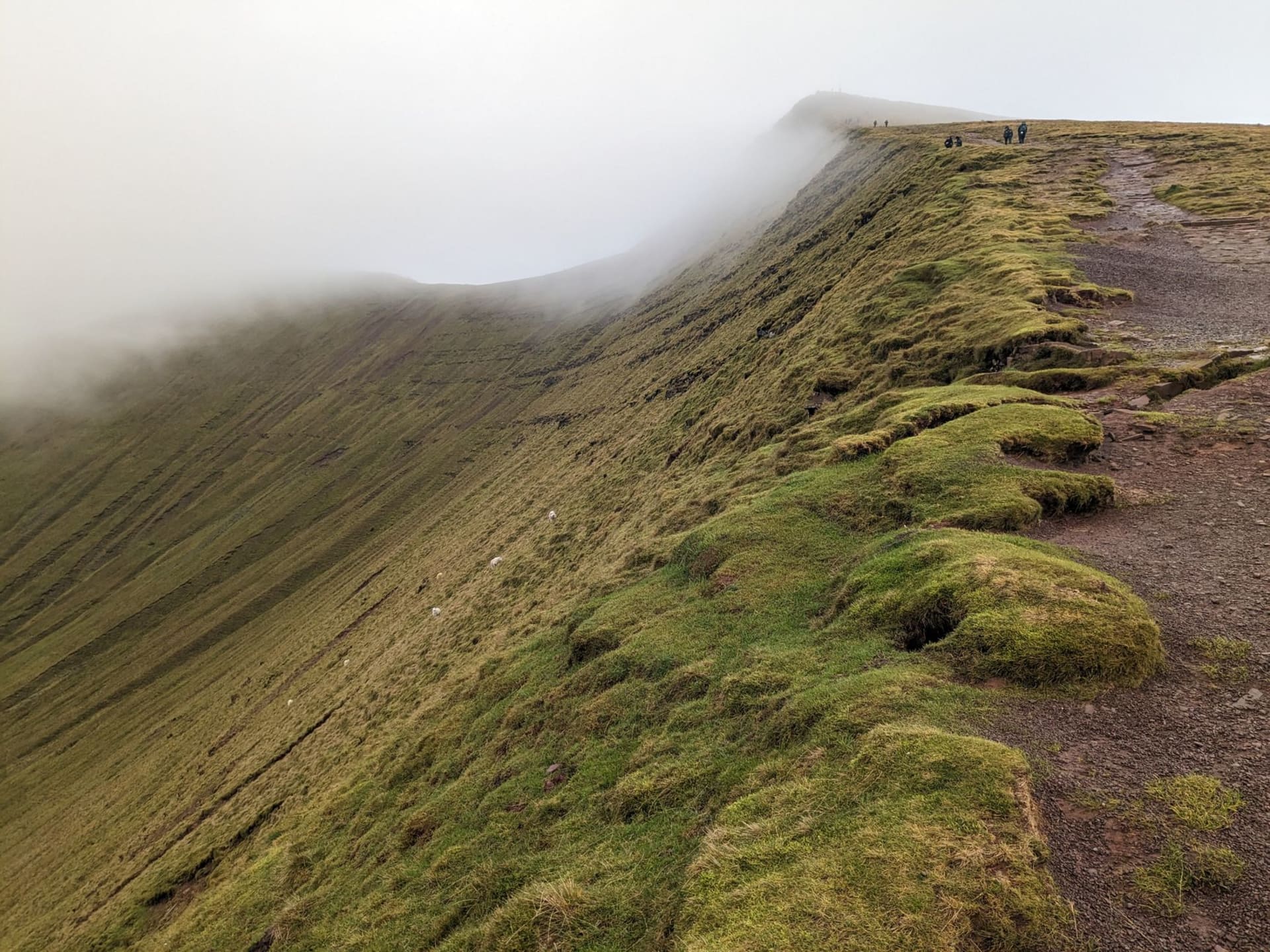
Pen y Fan is the highest point in the Beacons at 886 metres, and its distinctive flat-topped silhouette — the result of the Old Red Sandstone lying in horizontal sheets that erode evenly — is visible from most of the park on a clear day. The standard ascent from the Storey Arms car park takes about ninety minutes and is well-marked, which means it’s well-walked, which means weekends in summer see a line of people moving up the ridge like a slow pilgrimage.
I went on a Wednesday in late May and had the summit mostly to myself. The sandstone is red-brown and warm-looking even when the weather is neutral, which it was — neither sun nor rain, just the particular grey-white sky of the uplands that functions like a diffuser over everything. From the top you can see the Bristol Channel on clear days, and the Black Mountains to the east, and the whole interior of Wales opening north toward nothing in particular.
The descent to Llyn Cwm Llwch, a glacial lake in a hanging valley below the northern escarpment, takes you away from the crowds. The lake is cold and dark and perfectly round, and the cwm walls rise steeply around it. An old legend says a fairy island appears on its surface once a year. It didn’t appear when I was there, but the light off the water at midday was strange enough to make you wonder.
Waterfalls Country
The southern edge of the Beacons, in the Vale of Neath and the Mellte Valley, holds a concentration of waterfalls that shouldn’t be possible. The area is known as Waterfall Country — Sgwd yr Eira, Sgwd Clun-gwyn, Sgwd y Pannwr — and the paths between them run through oak woodland above gorges where the rivers drop in white curtains over carboniferous limestone.
Sgwd yr Eira is the one everyone photographs because you can walk behind it. The path goes behind the curtain of water on a narrow ledge, and the world briefly turns to white noise and spray and the smell of green rock. The falls are highest after rain, which is most of the time. I went in November, the water was in full roar, and the woodland path was slippery enough to require full attention and occasional profanity.
Lia was less impressed by the profanity but agreed the falls were worth it.
The Dark Sky Reserve
The Brecon Beacons is an International Dark Sky Reserve — one of a small number of places in the world with a formal designation for the quality of their night skies. The logic is simple: low population, low light pollution, high altitude. The Milky Way is visible on clear nights from most of the high ground, and the park runs stargazing events from several sites.
I pulled over on a minor road at about eleven o’clock on a clear September night and stood in a field for twenty minutes looking up. The sky was so thick with stars it had texture. Living in Mexico City before this trip, I’d forgotten what sky saturation really means. The Beacons reminded me.
Brecon Town and the Black Mountains
The market town of Brecon sits at the northern edge of the park and has a good-sized Thursday market, a cathedral with a Norman nave, and the Jazz Festival in August that fills every pub and garden with sound for a weekend.
The Black Mountains in the east — separate from the similarly named Black Mountain to the west, Wales being casual about duplication — offer long ridge walks above the Wye Valley with views into England. The Gospel Pass over the Mynydd Epynt is one of the highest road passes in Wales and worth driving for the views alone.
When to go: Late April and May for clear mornings and wildflowers on the plateau. September and October for the dark sky events and turning bracken. Winter is fine if you’re prepared — the ridge can ice up fast and paths disappear under snow, but the park is spectacular in white.