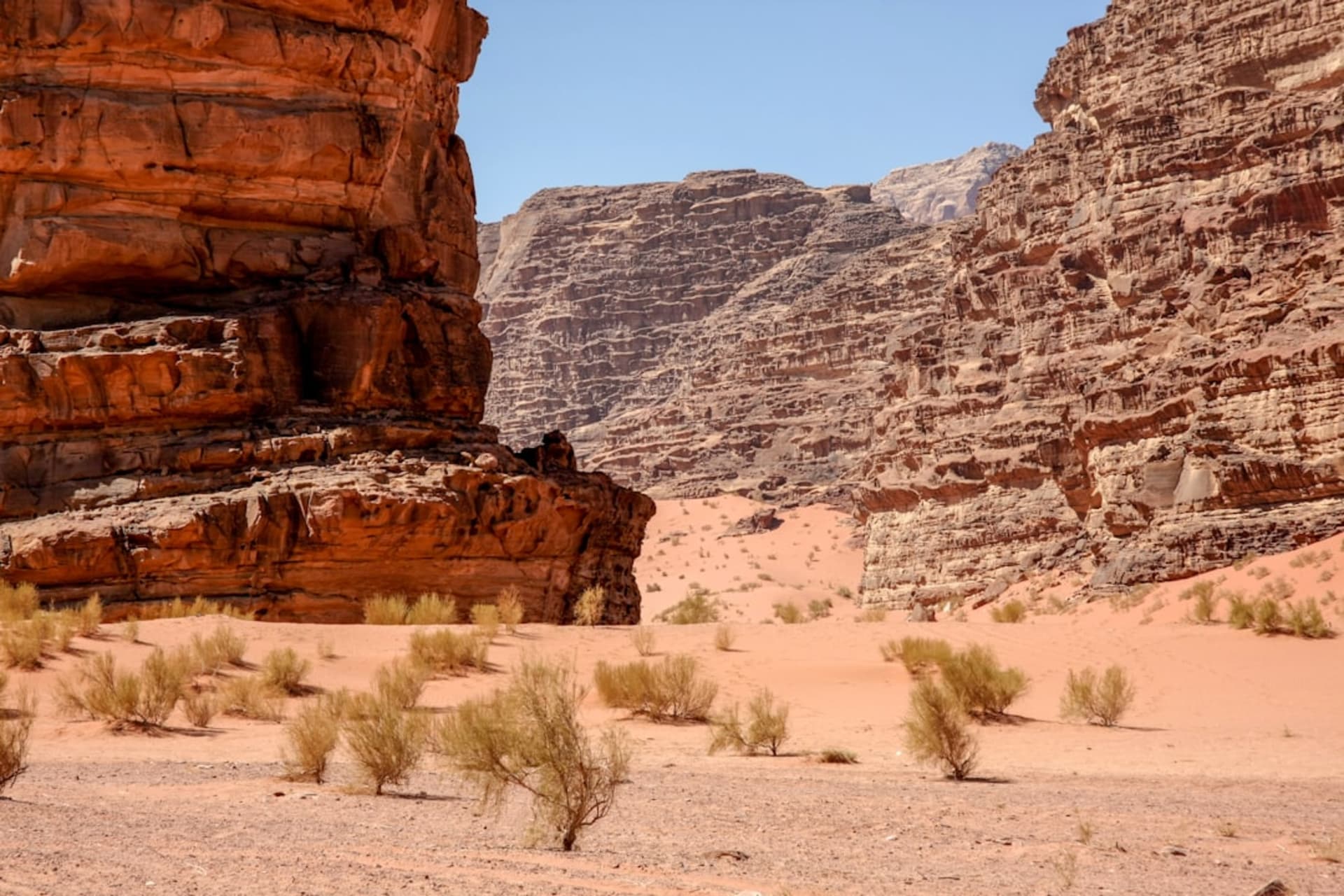
Seven Pillars of Wisdom
"Lawrence named a book after it. Seeing it at sunset, you understand the impulse."
Lawrence didn’t actually name his memoir after this formation — the Seven Pillars of Wisdom is a phrase from Proverbs, and the original dedication refers to something else entirely. But the rock formation outside Rum Village has been carrying the name for decades now, and given the view it provides, the anachronistic association is forgivable. When you see it in the last hour of daylight, fractured into seven distinct buttresses glowing deep orange against a sky that’s going purple at the edges, you’re willing to attribute any amount of literary inspiration to it.
The massif forms the western wall of the valley near the village entrance, and it’s the first significant landscape you see arriving by road. This is fortunate for those who need evidence early that the journey was worth it.
The Seven Buttresses
The formation is a single mass of Rum sandstone that has fractured along natural joint planes over millions of years, creating the illusion of seven separate columns. From certain angles, from the road approaching the village, the count works out to approximately seven — which is presumably how the name landed and stuck. From other angles it’s five, or nine, or a less countable number, which is fine because the mathematics was always secondary to the impression.
Each buttress rises to around 300 meters above the valley floor. The cliff faces are sheer in the lower sections — vertical rock on which I watched a group of sport climbers working routes in the morning, tiny figures against an enormous wall moving with the careful deliberateness of people who have calculated exactly how much friction they’re relying on.
The Morning View
Most descriptions of Seven Pillars focus on sunset, but the morning light is its own argument. Arriving from the east, the low sun hits the formation directly, and the orange-red sandstone becomes almost luminous, the texture of the cliff face visible in high definition: the horizontal bedding lines, the dark streaks of desert varnish, the places where sections have calved away and left raw pale stone behind.
I had a morning in November when the air was cold enough that I could see my breath, and the formation was catching the first sun while the valley floor was still in shadow. The contrast between the lit cliff and the blue-gray desert below was so complete it looked like two different photographs poorly assembled.
What Surrounds It
The area immediately around the formation is where jeep tours converge on their way into the protected area, making it the most trafficked zone in Wadi Rum. This is less disruptive than it sounds — the scale absorbs the vehicles easily, and the viewpoints are spread over a wide enough area that solitude is still available if you walk fifty meters from the road.
There’s a natural viewing area on the valley floor that faces the formation directly, where Bedouin boys sometimes bring camels for the tourist photography market. The camels cooperate with the studied boredom of professionals. The boys negotiate in several languages with impressive efficiency.
Lia spent twenty minutes photographing the cliff face with a long lens, coming away with images she described as “not adequate, which is how I know it’s real.” I thought that was exactly right.
When to go: The formation is impressive year-round, but it’s best at sunrise or sunset when directional light brings out the texture and color of the rock. December and January offer particularly clear air with low humidity, making the cliff detail exceptionally sharp. Accessible directly from Rum Village without a guide.