Middle East
Wadi Rum
"The desert that made me stop reaching for my camera and just breathe."
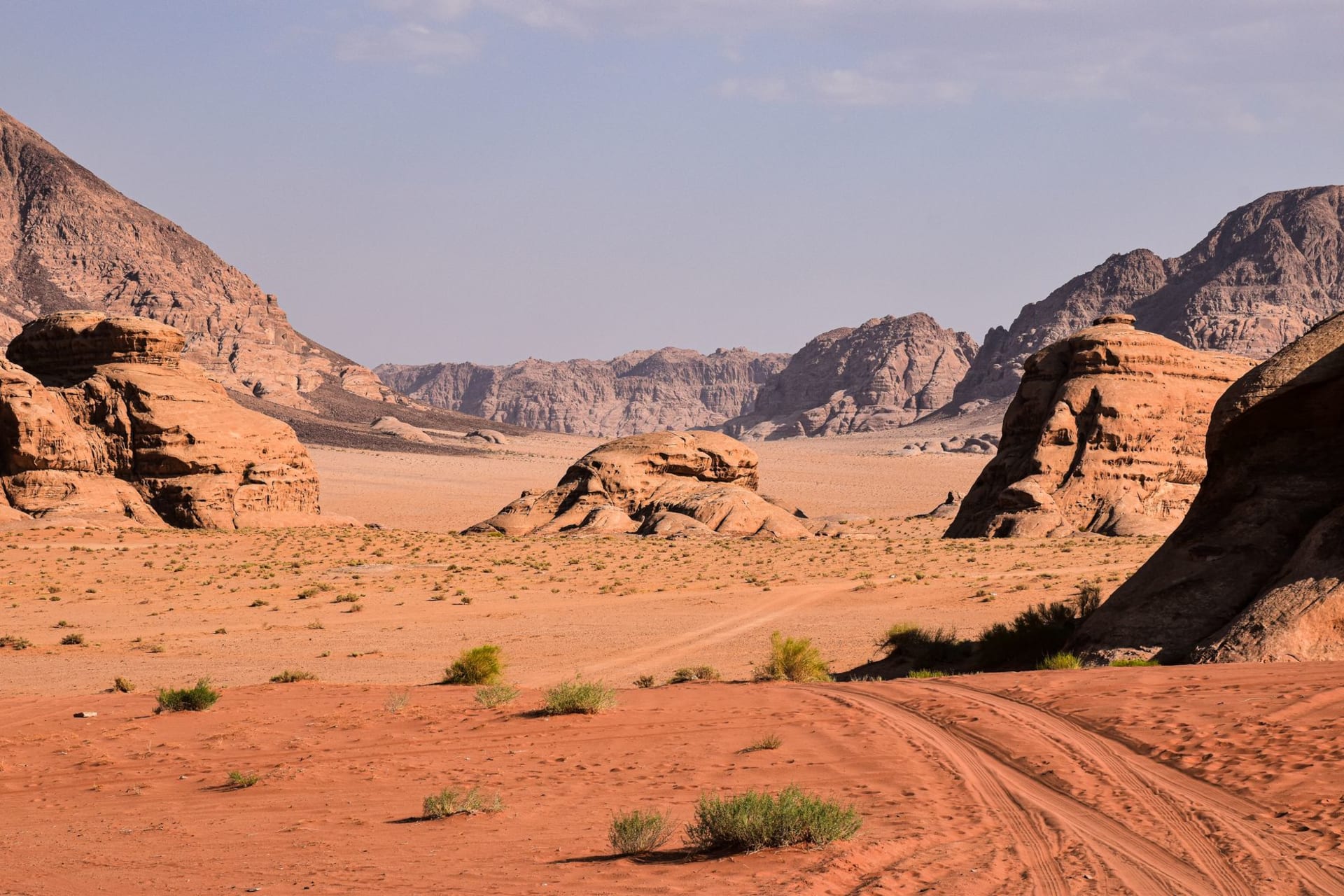
The jeep stopped without warning and the driver — Hamad, a Bedouin in his fifties who hadn’t said more than ten words since Aqaba — stepped out and stood still for a full minute looking at nothing in particular. I got out too. The silence hit like a physical thing. Not the silence of a quiet room, but the silence of a landscape that has simply refused to become anything other than what it is. Red sand. Rose sandstone. Sky. That was my first ten minutes in Wadi Rum, and I understood immediately that every description I’d read had undersold it.
The valley floor is twenty-five kilometers long and ten wide, flanked by massifs that rise 600 meters straight from the sand — Jebel Rum, Jebel Um Ishrin, the Seven Pillars of Wisdom that Lawrence wrote about and which look nothing like pillars and everything like a fever dream in geology. We drove through canyons so narrow the jeep scraped rock on both sides, past ancient Nabataean inscriptions carved at eye level, past a natural rock arch called Burdah that requires a two-hour scramble but rewards you with a view that belongs in a science fiction film. At sunset, the entire valley turns the color of an ember, then deepens to something approaching purple, and the transition happens slowly enough that you can watch it move across the rock faces like a tide.
Night in the camp was the part nobody warned me about. The stars here are the kind that recalibrate your understanding of the word “dark.” The Milky Way is not a faint smear — it is a structural feature of the sky. Hamad brewed tea in a copper pot buried in the coals, poured it three times to mix the cardamom, and handed me a glass without asking if I wanted any. The lamb had been slow-roasting in a zarb pit since midday. We ate on cushions on the sand and no one checked a phone, partly because there was no signal and partly because it would have been embarrassing.
When to go: March to May and September to November are the sweet spots — daytime temperatures between 20 and 30 degrees, cold enough at night that you’ll need a fleece. Summer (June to August) is brutal: the sand radiates heat through the soles of your boots and jeep rides feel like sitting inside a convection oven. Winter nights drop close to freezing, which is actually spectacular for stargazing if you pack accordingly.
What most guides get wrong: They sell Wadi Rum as a day trip from Petra. You can do it that way — a few hours in a jeep, a photo at Burdah arch, back to Aqaba for dinner. But that’s like visiting a cathedral and only looking at the floor. The valley reveals itself through time: the light at 6am that turns the eastern cliffs gold, the afternoon shadow-play that makes the same landscape unrecognizable from morning, the absolute dark that arrives an hour after sunset. You need at least one night. Ideally two. Book a Bedouin-run camp, not one of the inflatable bubble tents marketed to people who want to post a photo of stars framed by a luxury duvet. The real thing is better.