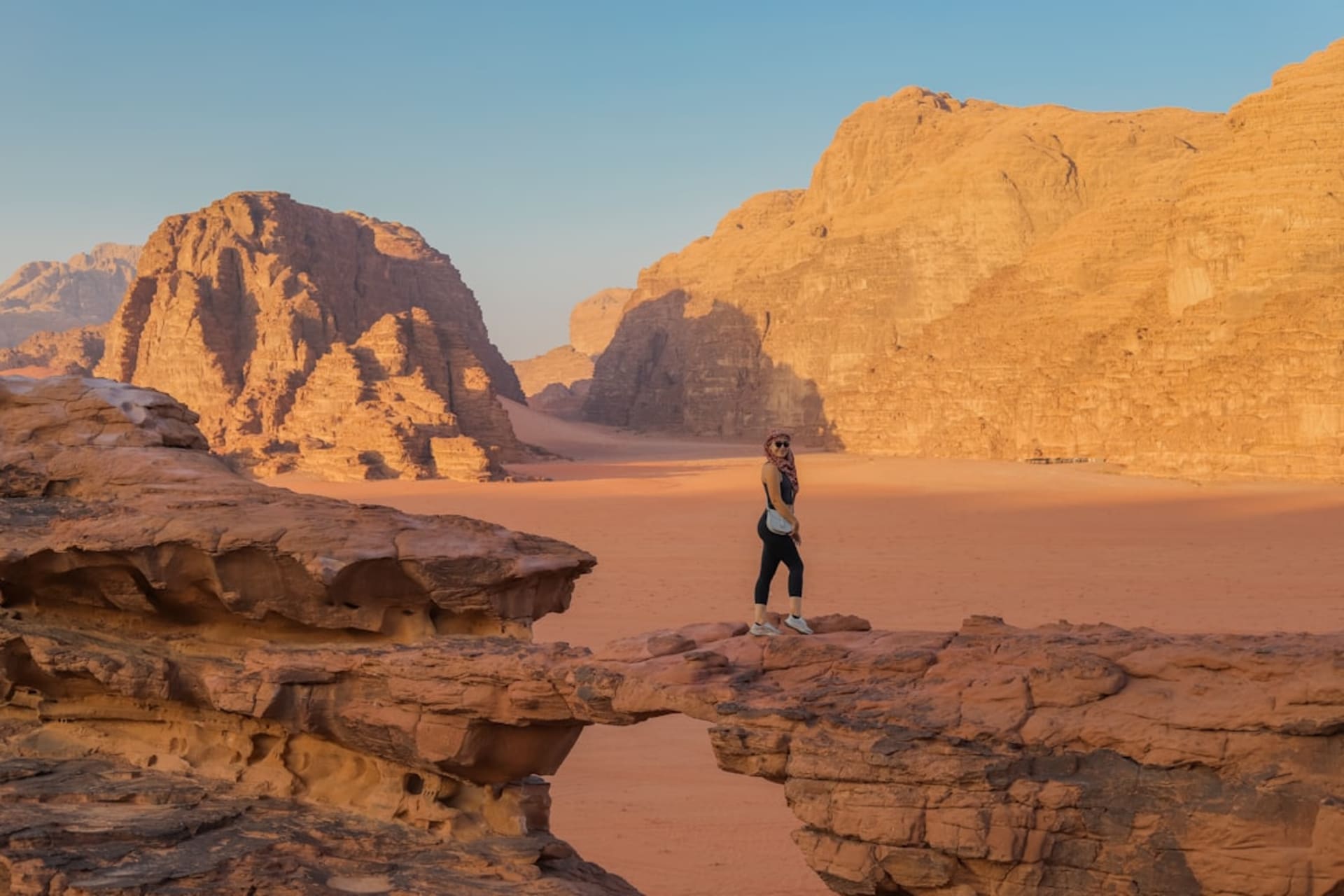
Burdah Rock Bridge
"From below it looks impossible. From the top it looks like the whole desert laid flat."
I almost didn’t go. The jeep driver — a quiet man named Ahmad who had been guiding in Wadi Rum for fifteen years — described the Burdah bridge climb as “not difficult, just long.” This turned out to be the most diplomatic understatement I encountered in Jordan. The approach takes about an hour of scrambling up increasingly steep sandstone ridges, using hands more than feet, with exposure that builds gradually until you realize you’re quite high and there’s no clean way back except the way you came.
The arch itself is not visible until you’re nearly on top of it. You crest a boulder field and suddenly there it is — a span of sandstone crossing a void, maybe seven meters wide at its narrowest, with a forty-meter drop on each side and the whole of Wadi Rum visible to the south.
The Climb
The route up follows a gully on the southeast face of Jebel Burdah, marked by the footprints of previous climbers in the sand and by small cairns that appear and disappear depending on how recently the wind has been active. There are a few sections where the rock is polished smooth from use, which is both reassuring (many people have done this) and slightly alarming (many people have worn down the grip).
I went in November, when the rock was cool and my hands weren’t sweating. In July I suspect the experience would be considerably less pleasant. The final approach to the arch traverses a ledge with a steep drop on one side — not technical climbing, but not casual either. Sandals are not appropriate. Bring a water bottle you can access without removing your pack.
On the Bridge
Standing on the arch felt absurd in the best way. The sandstone underfoot is rough and solid, nothing like the fragile-feeling arch it appears from a distance. I walked out to the middle and looked down through the gap — the desert floor far below looked like a map, the jeep tracks drawn in the sand like pencil lines.
What I hadn’t anticipated was the wind. Up on the arch it comes in from the southwest with nothing to break it, and it carries a smell of hot dust and something faintly mineral, like struck flint. Lia stayed back at the ledge below the arch; heights are her particular form of not-today, which I respect. I took photos she doesn’t need to be in.
What the Views Actually Show
From the top of Burdah, on a clear day, you can see the entirety of the protected area — the main valley floor, the fingers of canyon reaching into the sandstone massifs, and on the eastern horizon, the low blue line of the Hisma plateau. To the west, the Jebel Rum escarpment. It’s the kind of view that makes the climb feel retroactively easier than it was.
The descent took forty minutes. My knees knew about it the next day.
When to go: October through April, when temperatures make the physical effort manageable. The climb takes 2–3 hours round trip; start before 8am in warmer months to finish before midday heat. Hire a local guide — the route is not always obvious and a guide makes the difference between an adventure and a navigation problem.