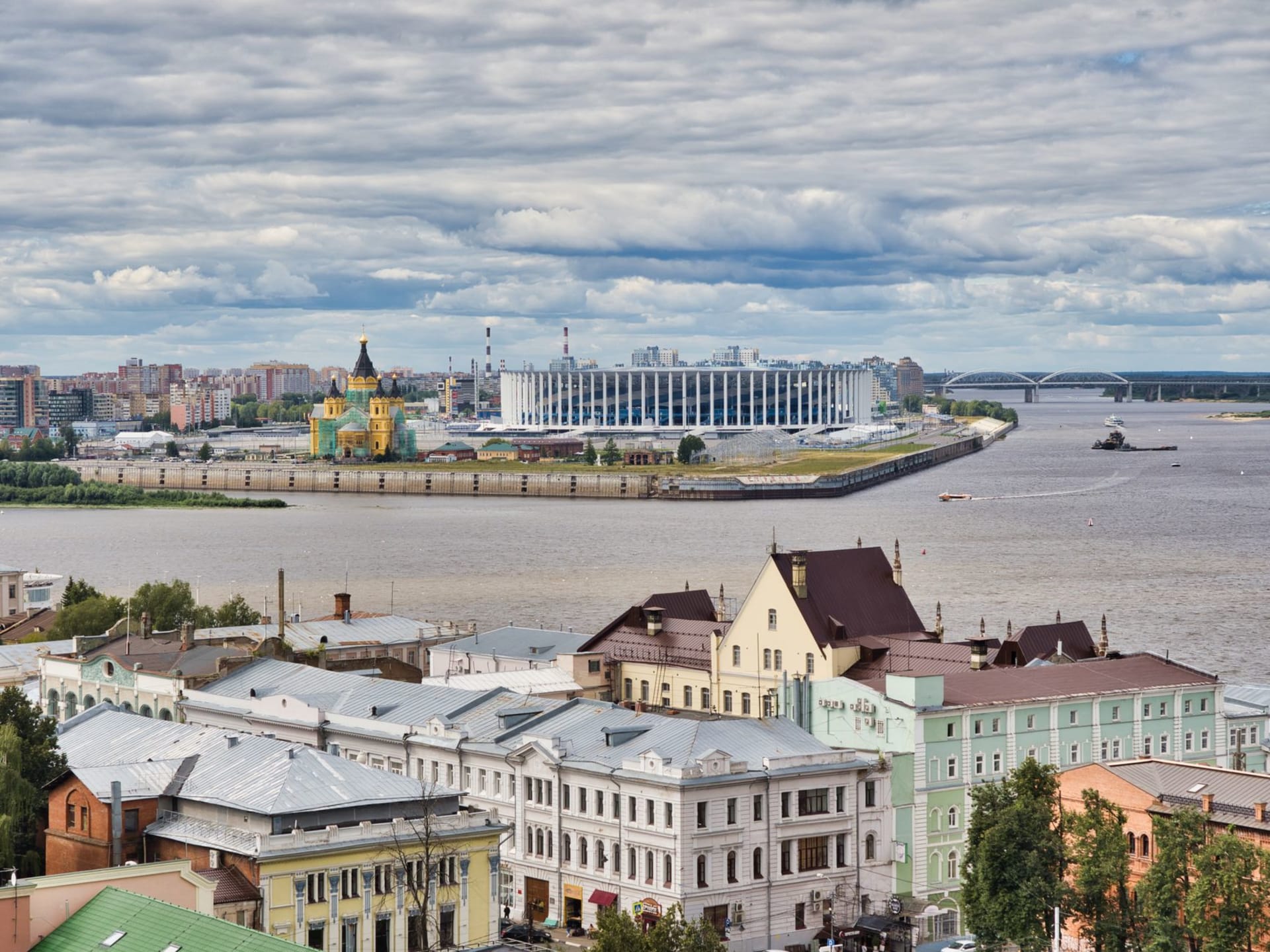
Saratov is where I stopped planning and started noticing. I had arrived between other destinations with a day to fill and ended up staying three, which is the right outcome when a city earns it without trying particularly hard. It’s a place of around a million people on the right bank of the Volga, with a university founded in 1909, a conservatory with a serious pedigree — Alfred Schnittke trained here — and an architectural heritage from the late imperial period that hasn’t been entirely gentrified into usefulness.
The Old Quarter and Its Buildings
The streets between the conservatory and the Radishchev Art Museum hold the best of Saratov’s pre-revolutionary architecture. Merchant mansions in the Russian Moderne style — asymmetrical facades, ceramic tile details, carved sandstone, ironwork gates — sit next to classical government buildings from the 1800s and Soviet-era institutional blocks that don’t ruin things as badly as you’d expect. The Saratov State Art Museum (named after the landscape painter Bogolyubov) is one of the better provincial art museums in Russia, with a collection that ranges from icons to Russian realism to mid-century Soviet graphic work.
I spent an afternoon in there, which I hadn’t planned to do, because the room of Volga landscape paintings had a quality of light in it — northern afternoon sun through high windows falling onto canvases that depicted exactly that quality of light on the river outside — that made leaving feel like a mistake.
The Conservatory and the Sound of the City
The Saratov State Conservatory, the third oldest in Russia, is housed in a building on Kirova Street that looks like it was designed for a different, grander purpose and accepted music as a reasonable substitute. On weekday afternoons, student practice drifts through the windows — a cello phrase, then a piano, then a clarinet running scales — and the street level absorbs it without comment.
The connection to Schnittke is worth noting: his dense, polytonal orchestral work seems absolutely native to a city where nineteenth-century mansion facades face Soviet-era apartment blocks across unpaved side streets. The dissonances fit.
Ribny Bazar and the Volga Fish Trade
The covered market near the central embankment is called the Ribny Bazar — fish market — though it sells much more than fish. The watermelon vendors here are Saratov’s proudest export from late August onward: the lower Volga region grows some of the best watermelons in Russia, and the market stalls stack them in pyramids that seem structurally ambitious. The cheese counter runs the length of one wall and the vendor behind it offered me an unprompted assessment of regional dairy politics that I followed for about sixty percent of its duration.
For fish: smoked sheatfish from the Volga, sold cold and fragrant, wrapped in paper. Eat it standing at the market edge with bread from the bakery stand opposite.
Across the River
The Engels Bridge connects Saratov to the city of Engels on the east bank (formerly Pokrovsk, capital of the Volga German Republic until its dissolution in 1941). The crossing on foot takes twenty minutes. Engels itself is mostly industrial but the view back toward Saratov from the far bank — the old waterfront, the slope of the hills behind it, the conservatory tower — is the city’s best angle.
When to go: Late August through September is ideal: watermelon season, comfortable temperatures, and the city’s academic energy resuming after summer. May and June are also excellent. Summers are very hot (regularly above 35°C) but the market and river embankment compensate. Winters are cold but the art museum and conservatory make them survivable.