Europe
Volga Region
"The river doesn't show you Russia — it shows you what Russia is still becoming."
The first thing that gets you on the Volga is the scale. Not the scale of the river itself — though standing at the embankment in Nizhny Novgorod watching the water go flat and brown and enormous toward the horizon is genuinely humbling — but the scale of what Russia has been doing along its banks for a thousand years. I arrived in Kazan by overnight train from Moscow, stepped out into a city that had no business being this interesting, and spent the next four days revising everything I thought I knew about this country. The Kazan Kremlin alone: a sixteenth-century fortified complex where a white-walled mosque and Orthodox cathedrals share the same hilltop, because Kazan is Tatarstan, and Tatarstan is a place where two civilizations decided to get on with it. I ate chak-chak — a honeyed Tatar pastry that crumbles in your fingers — from a street stall ten meters from a church bell tower. Nobody found this remarkable except me.
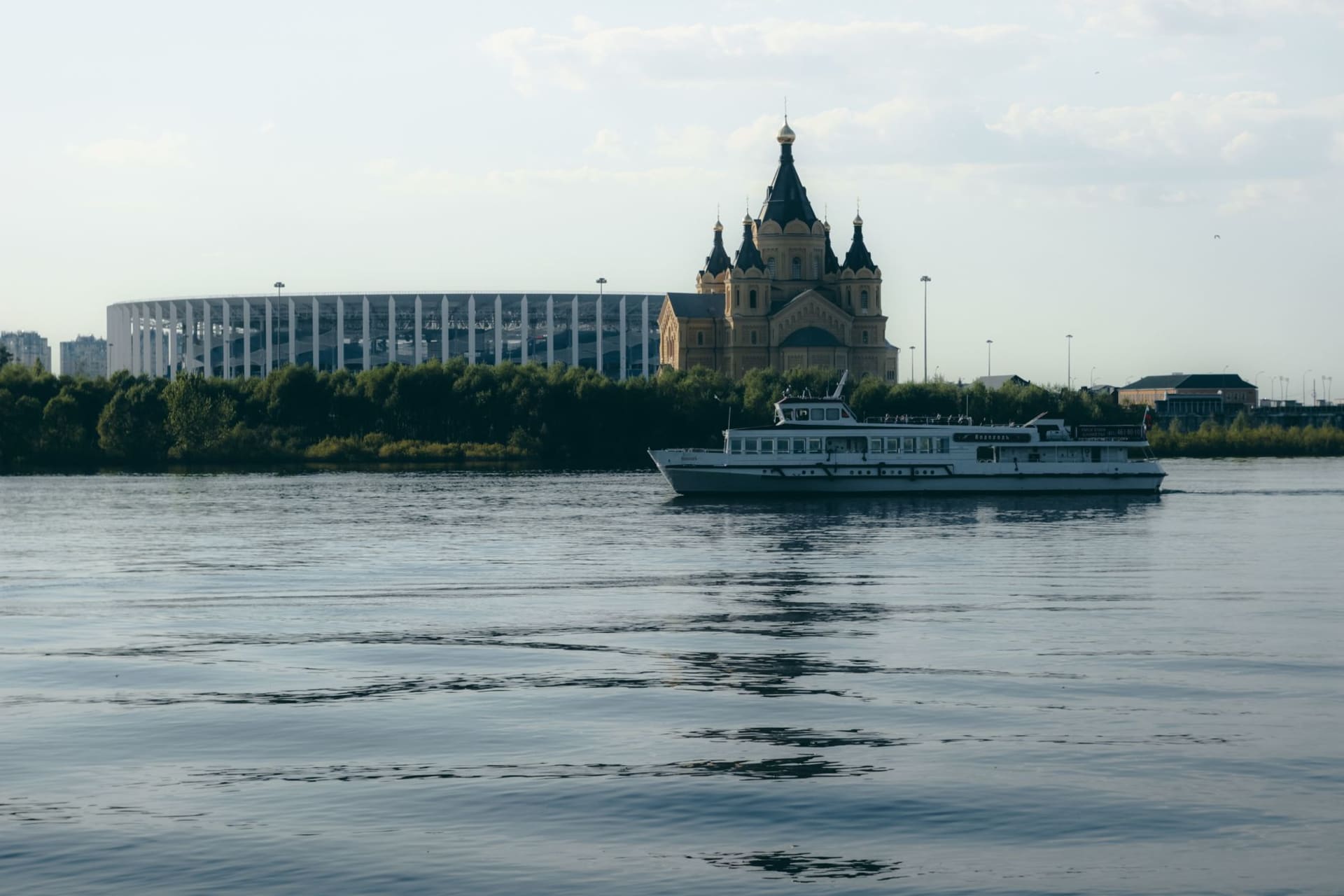
The river is the logic of the whole region. You can take a slow ferry between Kazan and Nizhny Novgorod, and I’d argue it’s the only way to actually understand the Volga. From the water you see the clay bluffs and the birch forests and the occasional village that seems to exist outside of time — green-painted wooden houses, a single Orthodox dome, a dock where nobody is waiting for anything in particular. Nizhny Novgorod has been having a moment since its 2018 World Cup renovation opened up the old city center, and what they uncovered was one of Russia’s most dramatic skylines: the ancient Kremlin fortress on a bluff above the confluence of the Oka and Volga rivers, the streets of the merchant quarter below thick with ornate nineteenth-century facades. Gorky was born here. The place has earned its atmosphere.
Samara sits further down the river and receives a fraction of the visitors of the other two — which is precisely why I’d put it on the itinerary. The embankment promenade is one of the longest in Russia, shaded by linden trees, and on a summer evening every resident of the city seems to be walking it at once. Samara was a closed Soviet city for decades due to its aerospace industry, and that secrecy left behind a remarkably intact historic center, beer halls still serving the local Zhiguli lager from wooden casks, and a Stalin-era bunker under the city that was built for the Soviet leadership in case Moscow fell during World War II. It never got used. You can tour it now. The rooms are still furnished as if someone left in a hurry.
When to go: May and June for the first warmth before humidity sets in, and when the river is high from snowmelt. September for golden light and the start of amber birch color. July and August are hot and the region fills with Russian domestic tourists — manageable, but book accommodation ahead. Avoid deep winter unless you are specifically seeking the aesthetic of frozen river and cathedral silhouettes in grey light — which is a valid reason, actually.
What most guides get wrong: They route travelers through the Volga as a footnote to Moscow and St. Petersburg, which misses the point entirely. This is not provincial Russia — it is the other Russia, the Muslim and Orthodox and Tatar and Slavic and Soviet Russia that the capital doesn’t fully contain. Three days split between Kazan and Nizhny Novgorod will teach you more about the country than a week of Moscow museums. And eat the Tatar food in Kazan. The plov and the echpochmak (triangular meat pastries) are not supplementary tourism — they are the whole argument for the region.