Engels
"A woman at the local museum told me her grandmother still remembered German being spoken on these streets, and something about the way she said it made the whole city feel different to me."
Saratov's quieter twin across the Volga bridge, once capital of a Volga German republic that was dissolved and deported almost overnight in 1941.

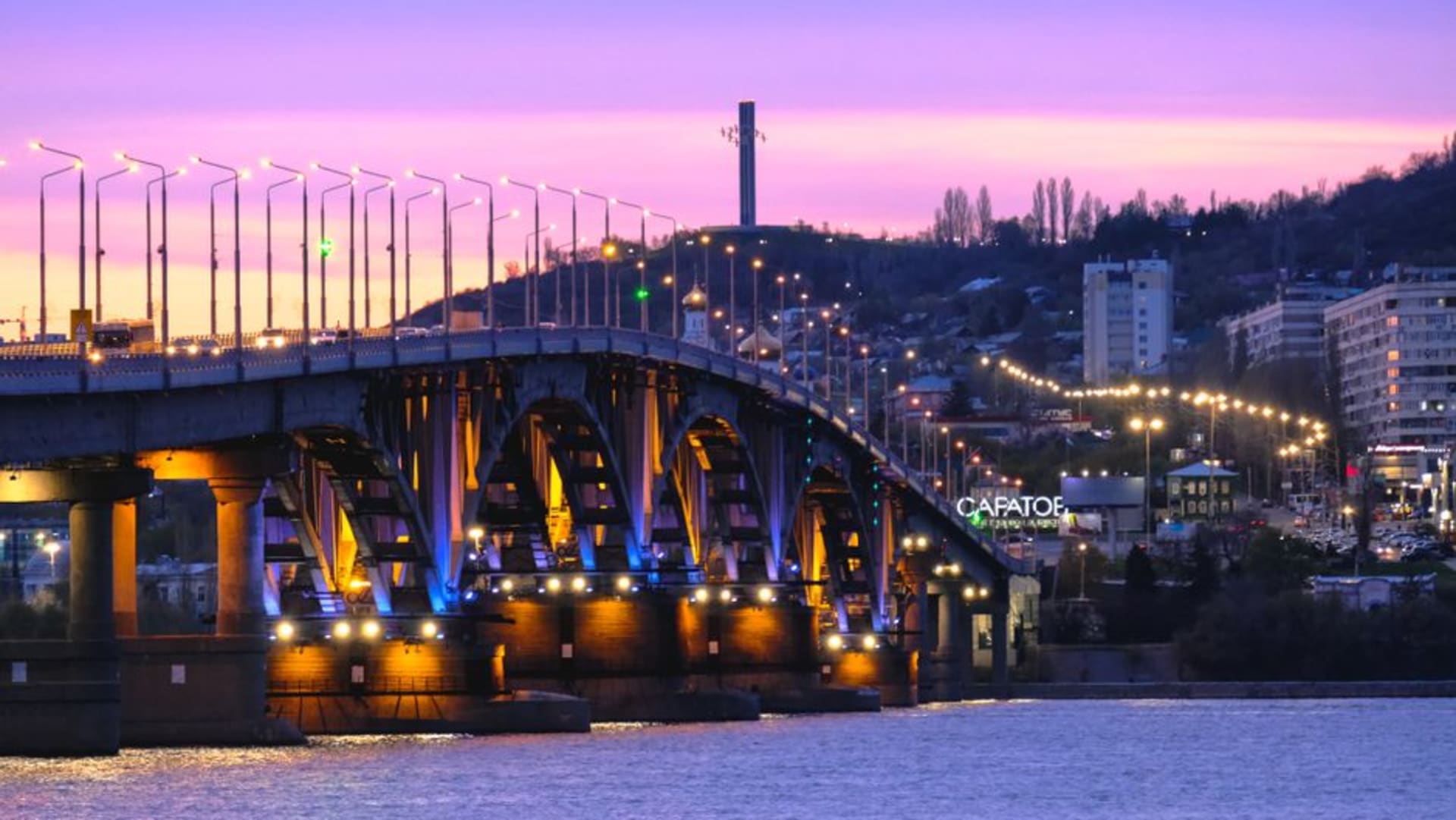
We crossed into Engels almost as an afterthought, walking the long bridge from Saratov on a warm evening because Lia wanted to see the Volga from the middle of it, and only really understood what the city was once we started asking questions on the other side. Engels doesn’t look like much from the bridge — low apartment blocks, an airbase in the distance, the kind of skyline that reads as purely functional. But it used to be Pokrovsk, and before that, briefly, the capital of the Volga German Autonomous Soviet Socialist Republic, a homeland for the ethnic German farmers Catherine the Great had invited to settle the Volga steppe back in the 1760s.
That history came apart almost instantly in 1941. After Germany invaded the USSR, Stalin’s government dissolved the republic within weeks and deported nearly the entire Volga German population — well over 400,000 people — to Siberia and Central Asia, accused collectively of potential collaboration with an enemy most of them had never even met. We visited the local history museum, a modest place with a surprisingly thorough room on this exact episode, old photographs of German-language shopfronts and schoolbooks, deportation orders under glass. A woman working there told me, almost casually, that her own grandmother remembered German still being spoken on these streets before the war. It recalibrated how I looked at every building we passed afterward.

Engels today feels almost defiantly ordinary against that backdrop — a working Russian provincial city with a Soviet-era aircraft plant nearby, wide streets, and a riverside promenade that fills up in the evening with joggers and teenagers on bikes. We wandered down to the water as the light went orange, watched a couple of fishermen cast lines off the embankment, and ate ice cream from a kiosk that had clearly been serving the same recipe since the Brezhnev years. It’s a small, unpretentious pleasure, standing on a random riverside promenade in a city most foreign visitors never think to cross the bridge for.
There’s also a genuinely striking Soviet aviation monument near the old airfield — Engels was long associated with Soviet strategic bombers, and locals still talk about the base with a kind of quiet regional pride, separate from anything to do with the German history. The two threads of the city’s identity, the erased Volga German past and the very present military-industrial one, sit oddly side by side and neither seems to acknowledge the other.

I wouldn’t cross to Engels for its skyline. I’d cross for that museum room, and for the strange, quiet feeling of standing in a city built by people whose names have mostly disappeared from it.
When to go: Summer evenings are best for the riverside promenade and the walk across the bridge; the museum is worth the detour any time of year.
Keep exploring
More from Volga Region
 volga-region
 Kazan
A city where Orthodox domes and mosque minarets share the same kremlin hill, and the tea tastes faintly of cardamom even when you didn't ask.
Explore volga-region
 Khvalynsk
A small riverside resort town tucked into rare chalk hills, with ski slopes in winter and a national park of pine and steppe the rest of the year.
Explore volga-region
 Nizhny Novgorod
Where the Volga and the Oka converge beneath a red-brick kremlin, and the wooden merchant houses in Maryina Roshcha are slowly being rescued from their own elegance.
Explore volga-region
 Samara
A city that built Stalin a nuclear bunker, launched the rockets that carried Gagarin into space, and managed to preserve one of Russia's longest wooden-house embankments — all without making much of a fuss about any of it.
Explore volga-region
 Saratov
A university city on the right bank of the Volga with fin-de-siècle mansions, a conservatory that produced Schnittke, and a covered market where the cheese vendor will tell you exactly what is wrong with the world.
Explore volga-region
 Sviyazhsk
A fortress island once ordered into existence by Ivan the Terrible, now a car-free cluster of white churches and quiet grassy lanes above the Volga.
Explore