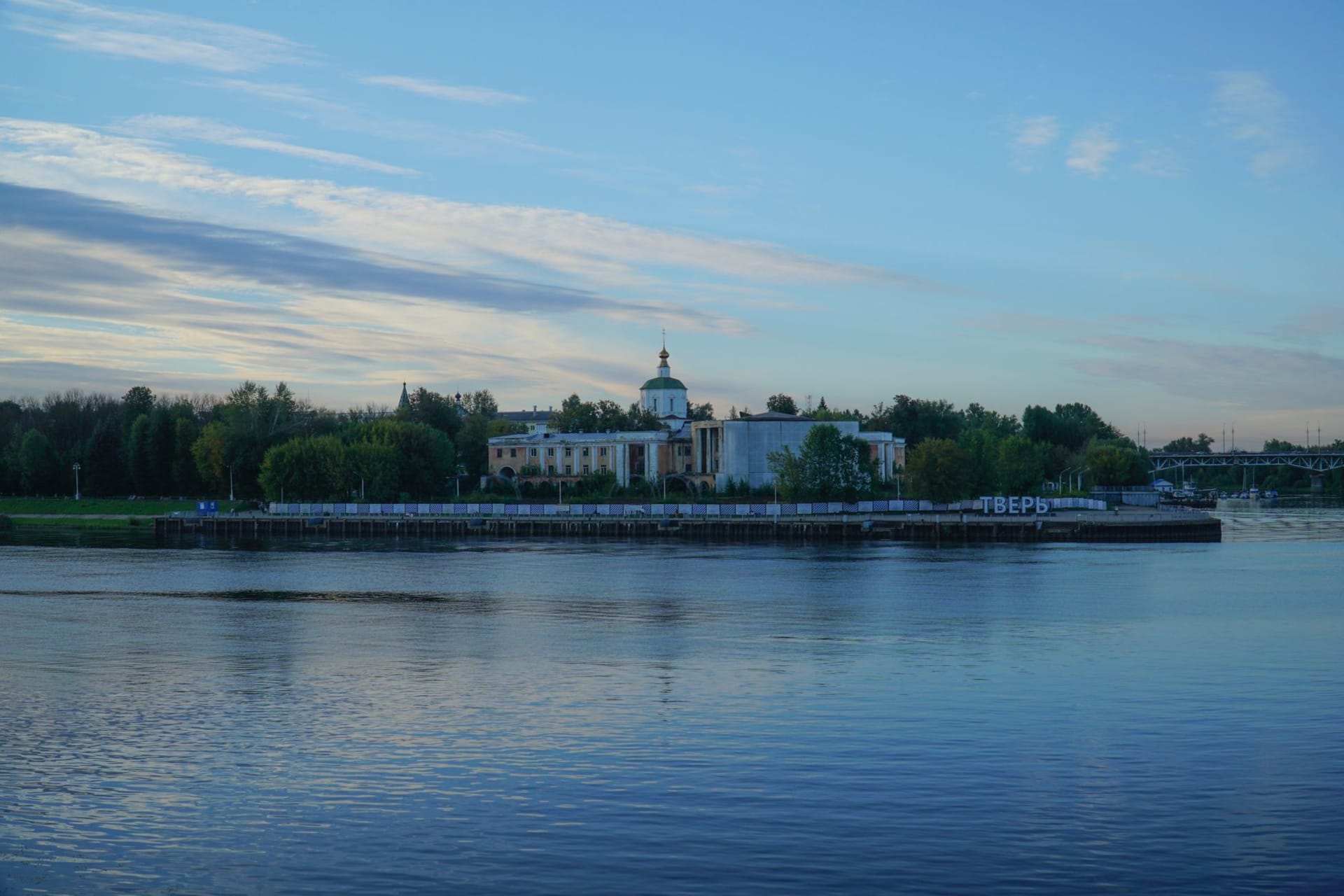
I came to Elabuga for the Tsvetaeva museum and left having understood something about the value of provincial cities that are too small to be ruined. The population is about 70,000 — large enough to have a proper market, small enough that the nineteenth century is still visible without reconstruction. The wooden merchant mansions are occupied, not restored; the old stone church stands because removing it would have required paperwork; the streets are paved but not relaid. Elabuga survived by not being important enough to change.
The Devil’s Tower
At the edge of the town, on a high promontory where the Kama River makes a bend below the Toima tributary, stands a single round tower from the eleventh or twelfth century — the remnant of a Bulgar fortress, everything else of which has long since fallen or been absorbed into the ground. The tower is called Chertovo Gorodishche, the Devil’s Settlement, for reasons that historians describe as locally derived and leave at that.
The view from the promontory is the one that earns the walk: the Kama stretching east toward the Urals, wide enough to lose your sense of scale, the far bank forested and unbroken. In autumn the birches go yellow and the water goes dark and the combination is the kind of thing that people in the nineteenth century painted with great earnestness. They were right to.
The Merchant Quarter
The streets near the old center — Kazanskaya, Spassskaya, the lanes between — hold a concentration of wooden and stone merchant houses that is exceptional for a town this size. The merchant families who built here in the 1800s had wealth from river trade and Ural industry, and they spent it carefully on carved cornices, double-height parlors, and iron-hinged gates. Many of these houses are still used: apartments, a dental clinic, a school administrative office. The decay is managed rather than arrested and the overall effect is of a city that is still living in its own history rather than curating it.
The Tsvetaeva Memorial
Marina Tsvetaeva — one of the great Russian poets of the twentieth century, contemporary of Pasternak and Akhmatova, subject of intense scholarly attention and almost no political protection — came to Elabuga in August 1941 as a wartime evacuee from Moscow. She arrived without money, without a place to live, without a way to work. On August 31st she died in the house of the Brodelshchikova family, where she had been lodging. She was 48.
The house has been preserved as a memorial museum: two small rooms, a window facing the yard, her few remaining belongings. It is very quiet. The museum staff speak about her with care and knowledge. Nearby, her grave in the Piotrovsky cemetery is maintained, the path to it worn clear.
I don’t know how to write about this without either overstating or understating. It is a place that requires sitting with rather than explaining. Bring something of hers to read on the promontory afterward.
The Shishkin Museum
Ivan Shishkin, the nineteenth-century landscape painter of Russian forests — his pines are on the Russian 100-ruble note — was born in Elabuga, and the Shishkin House Museum shows both his biography and a selection of his work in the context of where he developed his eye. Looking at his paintings of Kama River forests and then stepping outside to see those forests is one of those experiences where art and geography collapse into each other and the sequence stops mattering.
When to go: Late May through early October. September is particularly good — the Kama and its surrounding forests are at their most atmospheric, the Tsvetaeva memorial holds its commemorative events around the anniversary of her death (August 31st), and the town is unhurried. Summer weekends attract Kazan day-trippers. The town is accessible from Kazan by road in about two hours.