Siargao
"Cloud 9 broke with a sound like a door slamming — I was on the boardwalk watching, and even from there the power of it made me step back."
The Road to General Luna
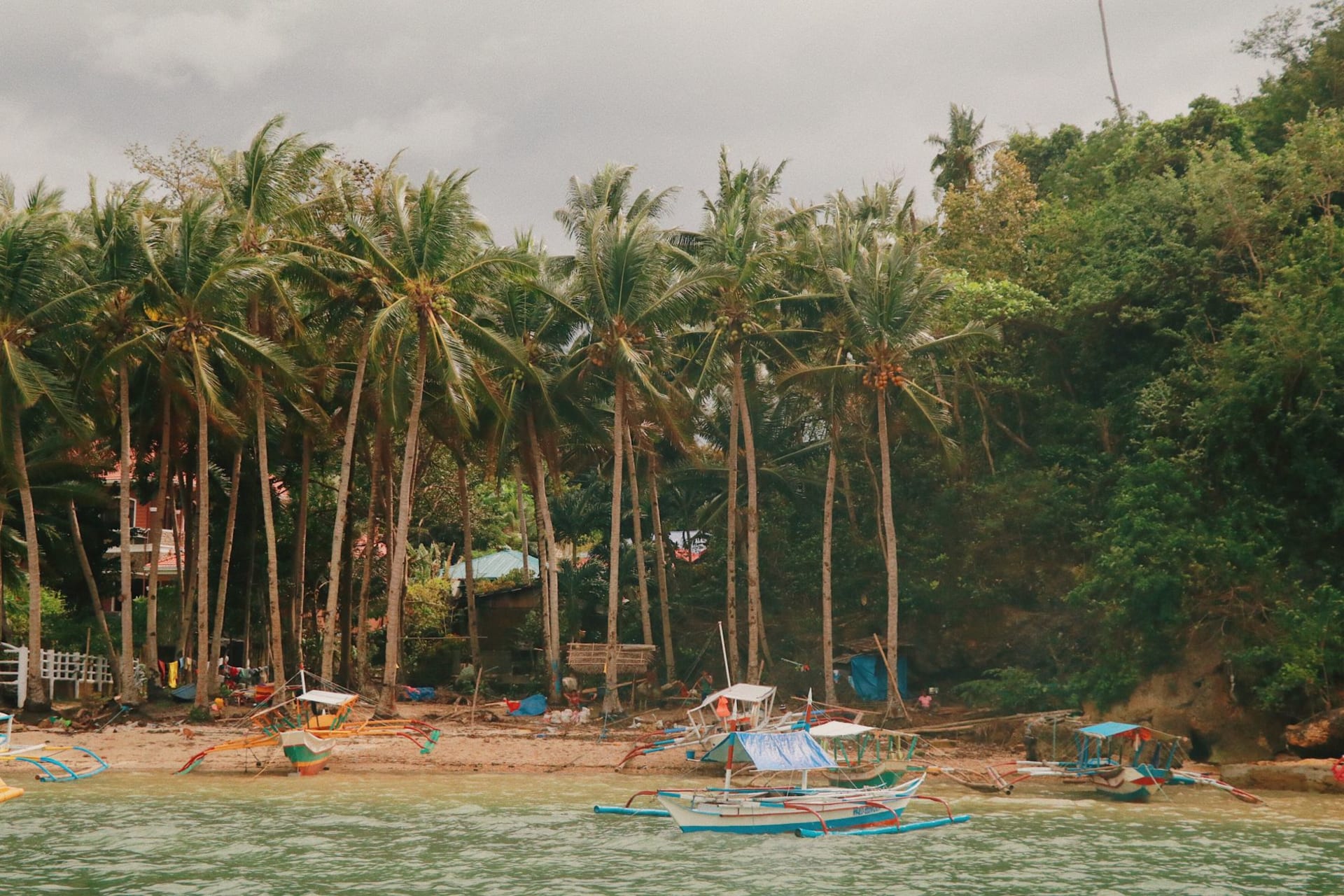
The motorbike road from Sayak Airport to General Luna passes through eleven kilometers of coconut palms so dense and uniform they feel architectural — columns of grey trunk on both sides, the canopy so thick it filters the light into something green and cool that contradicts the heat. I rented a scooter within thirty minutes of landing and took that road slowly, stopping twice to buy buko — young coconut, hacked open with a bolo knife — from roadside vendors who seemed unsurprised by the frequency of this transaction.
General Luna is Siargao’s main town and its personality is unhurried in a way that takes a day to calibrate to if you’ve been anywhere with urgency recently. The streets around the market smell of dried squid and charcoal smoke. The surf shops open late. The coffee is good and nobody seems to be in a hurry to give you more of it.
Cloud 9
The wave at Cloud 9 has a reputation that precedes it so thoroughly that seeing it for the first time still manages to be a surprise. It’s a right-hand reef break — a shallow coral reef just north of General Luna — that produces barreling tubes in the 1.5-to-3-meter range, hollow enough to be the kind of wave that surfers travel significant distances to ride. The iconic boardwalk extends over the reef and gives non-surfers an excellent viewing platform from which to watch people make the drop and disappear briefly inside the barrel before either emerging or not.
I don’t surf. I watched for two hours one morning and drank a thermos of coffee and tried to understand the logic of reading sets coming in from the horizon. The light on the water at 7 a.m. has a particular quality — low-angle, turning the foam gold, the unbroken faces of the incoming waves the deep blue-green of uncut emerald. A Finnish woman next to me on the boardwalk was timing her boyfriend’s rides on a phone stopwatch. He made three good ones and one bad one, and she documented all four.
Island Hopping to the Outer Rings
The island hopping from General Luna — Naked Island, Daku Island, Guyam Island — is the kind of tropical experience that risks sounding promotional but lands, in person, as genuinely extraordinary. Naked Island is just a sandbar, no vegetation, the surrounding water so clear you can see the starfish on the bottom six meters down. Daku is large enough to have a small community, coconut trees, and a woman who makes excellent grilled fish over charcoal and charges a reasonable price for it. Guyam is twenty palm trees on a coral ring, sized for fifteen people maximum.
The sea between them, in the right light, runs from transparent white in the shallows to the specific turquoise that only exists in places the Pacific hasn’t entirely finished with yet.
Magpupungko Tidal Pools
The rock pools at Magpupungko, a forty-minute scooter ride north of GL, reveal themselves only at low tide, when the receding ocean leaves perfectly circular pools in eroded basalt formations. The water in them is bath-warm, clear, and shaded by overhanging rock. Children from the nearby village were jumping off the highest ledge — maybe four meters — into a pool deep enough to accept them safely, which they’d clearly established through thorough empirical testing. I swam in the pools until the tide told me it was time to leave, which happens faster than you expect.
Lia found a sea urchin in her pool and spent twenty minutes drawing it in her notebook while I slept on a flat rock in the sun like a lizard.
When to go: March through October brings the northeast trade winds and best surf, peaking in September and October during the annual Siargao Surfing Cup. December through February can bring the habagat with rougher, less predictable conditions. The island is smaller and more manageable in shoulder months (April, May) before the peak-season crowd peaks.