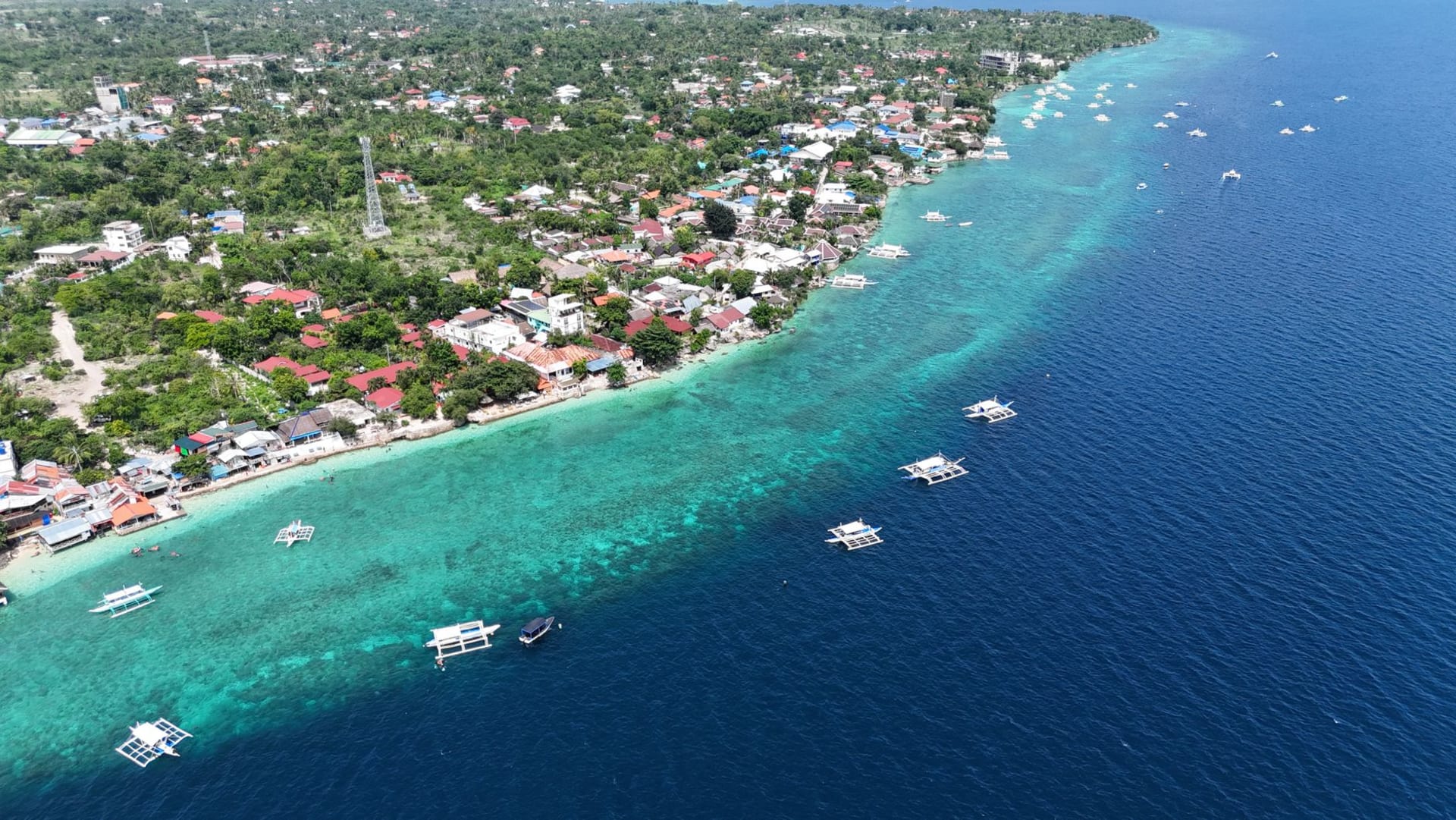
Malapascua
"The shark came up from the dark below us, hung in the water for thirty seconds like it was deciding something, then turned and descended back into blue nothing."
Getting There
Malapascua is not convenient, which is a large part of why it still functions as a fishing village with a dive tourism economy layered on top rather than the other way around. From Cebu City, you take a two-hour bus or van north to Maya port — a small concrete jetty at Cebu’s tip — and from there a twenty-minute bangka boat across a choppy strait to the island. The whole journey takes three to four hours depending on what time you leave and how the northern road is behaving.
I arrived at dusk, the island rising from the water as a low green shape with a single visible pier and a scattering of generator-powered lights. A man on the pier offered to carry my bag to my guesthouse for a hundred pesos, which seemed entirely fair. Bounty Beach, the main beach, is a gentle crescent of white sand backed by dive shops, family-run restaurants, and guesthouses that range from very basic to functionally comfortable. The ambience is quiet, dark enough at night to see stars, and smells like rope, salt, and frangipani.
Monad Shoal at Dawn
The dive to Monad Shoal begins at 5 a.m. The alarm goes at 4:30, which feels uncivilized until you’re in the water. Monad Shoal is an underwater plateau — a seamount that rises to about 25 meters below the surface — where thresher sharks come each morning to be cleaned by wrasse fish. They rise from the deep water around the shoal, sometimes in groups of three or four, circling the cleaning station with the slow, deliberate movement of large animals accustomed to being the most significant thing in their environment.
The thresher shark’s tail is half the length of its body — an evolved hunting tool for stunning schools of fish — and seeing one curve upward out of the blue-dark below you is one of those experiences that stays precise in memory. It doesn’t look like a predator performing. It looks like something that exists on different terms than the surface world.
I dove Monad three mornings in a row. The sharks appeared every time. Some mornings there were four. Some mornings there were two. On the last morning, one came close enough that I could see the gold iris of its eye.
Gato Island and the Mackerel Schools
Gato Island, a forty-minute boat ride from Malapascua, is a limestone outcrop with a marine sanctuary that functions as a nursery for whitetip reef sharks. The dive here is different from Monad — dense, busy, the underwater architecture of the tunnel through the island’s base providing a theatrical setting for the sharks resting in its shadows and the clouds of macro life colonizing every centimeter of its walls.
The open water outside Gato, in the right season, hosts massive schools of jack mackerel that form into living spheres — bait balls — when threatened, thousands of fish moving in tight synchrony that makes the whole thing look like a single organism breathing. I dove through the edge of one and came out disoriented and grinning.
The Village Between Dives
Between morning and afternoon dives, Malapascua asserts its identity as a working fishing community. The boats that aren’t dive vessels are fishing outriggers, and the market near the port sells whatever came in the previous evening — sea bass, squid, various reef fish laid out on banana leaves in the grey morning light. I ate grilled tuna for breakfast three times because the fishermen’s families were selling it at 7 a.m. for fifty pesos and it was fresher than anything I’d had the week before.
When to go: March through June offers the best visibility and calmest seas at Monad Shoal. November through February brings the northeast monsoon, which can make the crossing from Maya rough. Thresher sharks appear year-round, but April and May are the most reliable months.