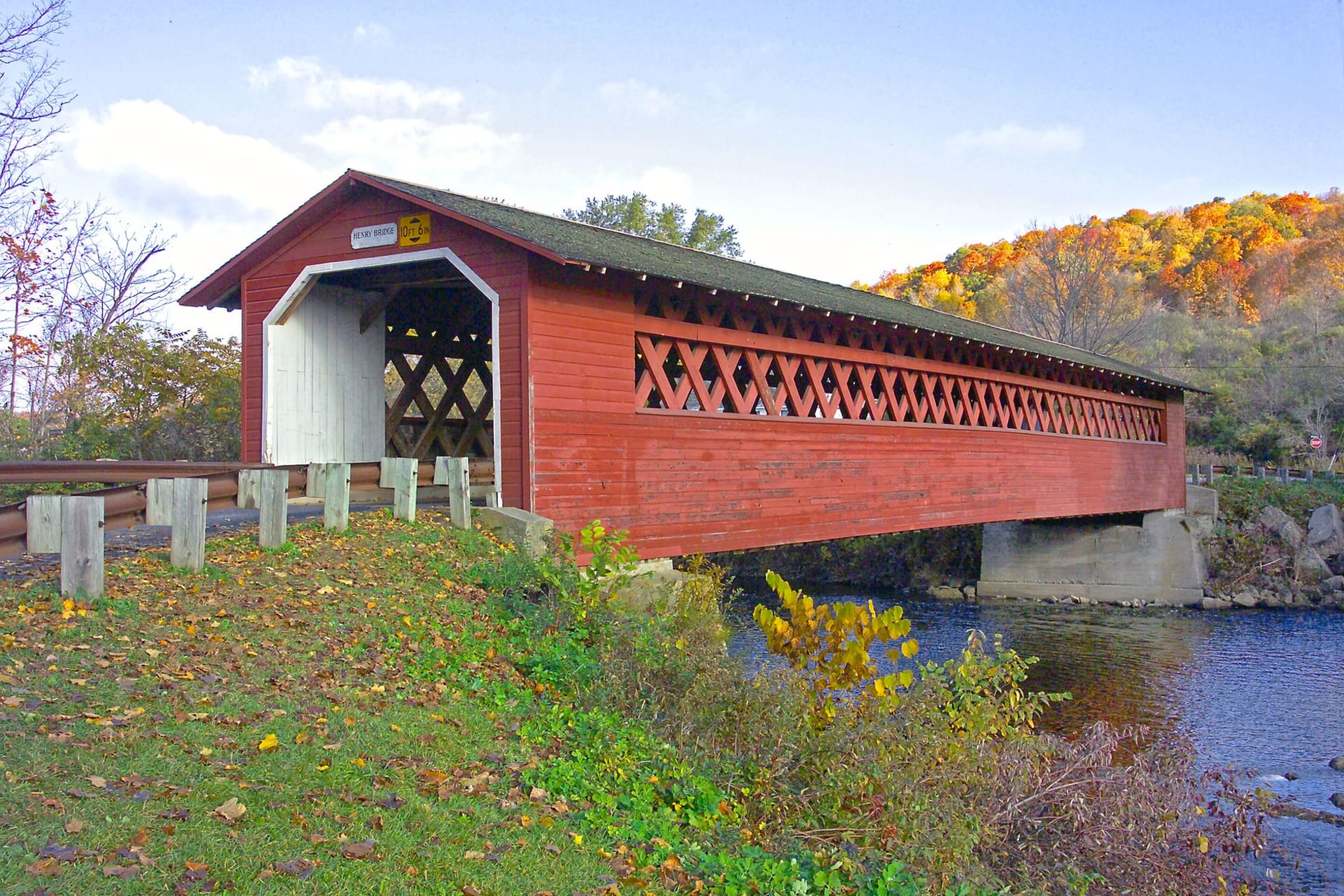
Bennington doesn’t lead with its charms. It’s a working southwestern Vermont town with a downtown that has seen better economic decades, a factory history that left marks, and two distinct areas — downtown and the Village — that feel like different places connected by a single road. The Battle Monument is visible from most of the county, a grey granite obelisk that commemorates a Revolutionary War engagement with the kind of solemn overstatement that nineteenth-century Americans did better than anyone. The whole town rewards paying attention in a way that more obviously attractive Vermont destinations sometimes don’t require you to.
The Monument and What It Explains
The Bennington Battle Monument stands 306 feet tall on a hill above Old Bennington village, completed in 1891 to commemorate the 1777 Battle of Bennington — a turning point in the Saratoga campaign that most Americans have forgotten and most Vermonters feel strongly about. The elevator to the observation deck costs almost nothing and the view from the top takes in three states: Vermont, New York, and Massachusetts. What you’re looking at from that height is the Walloomsac River valley, a stretch of farmland and forest that hasn’t changed in outline since the battle was fought, which is either comforting or melancholy.
The walk around Old Bennington at the base of the monument is one of the better short walks in Vermont for people interested in the built environment. The houses here are eighteenth and nineteenth century in ways that feel uncontrived — not preserved for visitors but simply old and continuing to be inhabited. The Old First Church dates to 1805 and has a churchyard where Robert Frost is buried. The headstone is plain Vermont granite and reads, in Frost’s own words: “I had a lover’s quarrel with the world.”
The Pottery Legacy
Bennington pottery has a history out of proportion to the town’s size. The Bennington Museum, in a low-slung building near the Village, contains the largest collection of American art pottery in the country — Rockingham ware, Parian porcelain, the famous tortoiseshell-glazed pieces that came out of the United States Pottery Company in the mid-nineteenth century. I went in without strong pottery opinions and came out with some, which says something about the quality of the collection and its curation.
The museum also holds Grandma Moses paintings — a significant collection of the folk artist who grew up in the region and painted New England farmscapes with the kind of bright specificity that looks naive until you realize how much information she packed into each canvas.
Park-McCullough House
On the west side of North Bennington, the Park-McCullough House is a Victorian mansion built in 1865 that has been preserved more or less intact — wallpapers, furnishings, carriage barn, children’s playhouse behind the main house. The house is open for tours that feel pleasingly low-key; the staff knows the history and doesn’t oversell it. The garden is in good order. The carriage barn alone, with its collection of Victorian equipage, would justify a visit if you are the kind of person who thinks about the logistics of nineteenth-century transportation.
The Long Trail Connection
Route 9, which runs east from Bennington toward Brattleboro, crosses the Long Trail at Glastenbury Mountain — one of Vermont’s most significant back roads and a good entry point to the Green Mountains if you’re equipped for it. The hike up Glastenbury offers a fire tower at the summit with views that make the elevation gain worthwhile. The mountain has a reputation for being remote and slightly eerie, which I find persuasive rather than dissuasive.
When to go: October for foliage, which is dense and rich in this southwest corner of the state. The Bennington Battle Days in August draws a history-minded crowd and the monument does special events. The museum is open year-round with reduced hours in winter. Avoid expecting a nightlife scene at any season — Bennington is a daytime destination that goes to bed early.